
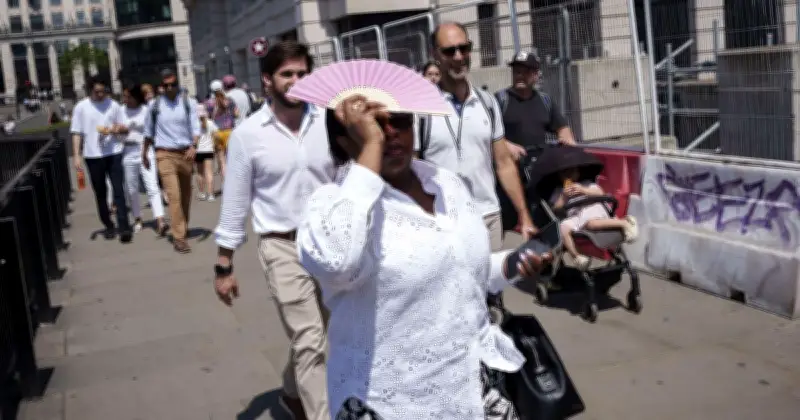
Britons sweltered during the hottest day of the year so far when temperatures hit 38.1C on Thursday. The temperature was recorded at Kew Gardens in London, passing the previous high of 38C set on June 28 at Lingwood in Norfolk.
Fifth hottest day on record
Forecasters at the Met Office said Thursday was the fifth hottest day on record for the UK. It is the second time that the country has hit 38C twice in one year – it last happened in 2022.
Amber warnings for “extreme heat” were in place for swathes of England as the country dealt with its fifth heatwave this year. The UK is facing increasingly extreme conditions, such as drought and wildfires, fuelled by climate change.
Farmers under pressure
Paul Tompkins, deputy president of the National Farmers Union, said: “With each passing day without rainfall, the situation facing farmers and growers is becoming more troubling.”
Mr Tompkins said: “We only need to look out of our windows to see the impact of the dry weather, with brown fields stretching across the countryside. Harvest has once again come early this year, resulting in poor yields for key crops.
“Growers are working hard to keep fruit and vegetable crops watered, at significant financial expense. Meanwhile, livestock and dairy farmers have been forced to start using their winter feed stocks because the grass is no longer growing, which will inevitably increase production costs as they look to replenish stocks later in the year.”
He added: “Meaningful action must be taken now to acknowledge the severity of this situation and build resilience into our food system for the future.”
Drought and wildfires
Climate advisers have urged the Government to take steps to prepare the UK for worsening extremes, from making it easier for farmers to build reservoirs to putting air conditioning in hospitals.
Three quarters of England and the whole of Wales are in drought, heaping pressure on water resources for households, agriculture and the environment.
Some 1,017 wildfires have been recorded in England and Wales this year, according to data shared by the National Fire Chiefs Council (NFCC), the same as last year’s record-breaking total.
Vicki Lee, citizen science assistant at the Woodland Trust, said: “Heatwaves and droughts can put trees under stress and as a result deciduous trees may tint and shed their leaves early and enter dormancy early; this is known as false autumn. We are starting to see reports of early leaf tinting coming into our citizen science project Nature Calendar this year.
“Also, the ultimate effects of drought on woodland can take a long time to be seen: there is external research we have seen that implies some woodland is still recovering from the last major drought in 1976.”
Meanwhile Dr Katie-Facer Childs, hydrologist at the UK Centre for Ecology and Hydrology warned river flows are approaching, or are lower, than the famous drought of 1976 in many catchments in England and Wales.
She said “This is a concerning situation, as this ‘flash drought’ is developing more rapidly than the 1976 event.”
The expert added: “This years’ drought bears more similarity to the droughts we have seen more recently in 2025 and 2022, though the prolonged high temperatures and the truly exceptional lack of rainfall over the past six weeks means river levels are lower now than they were in 2025 and 2022 across most of the country.
“We’d need to see a prolonged period of wetter weather to see soil moisture and river flow conditions improve across most of southern England and Wales.”




