
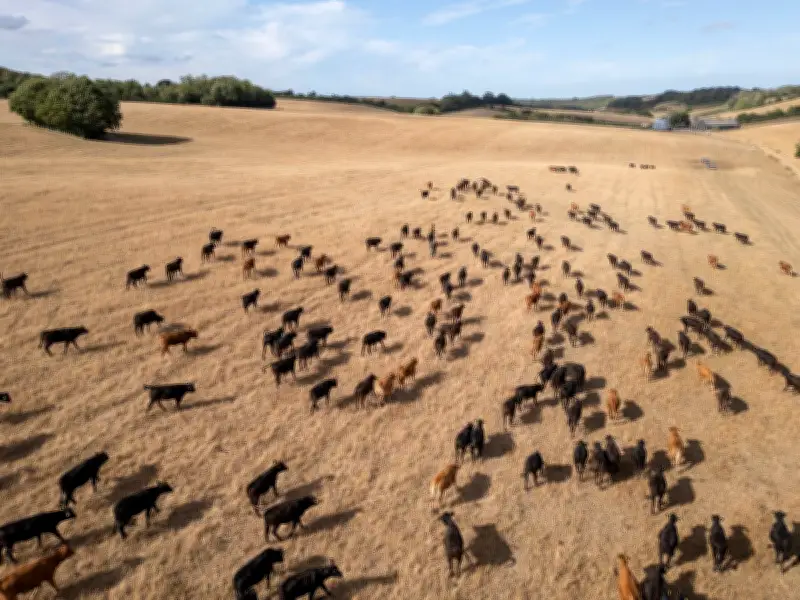
Half of England is now facing official drought conditions due to record-low rainfall and relentless temperatures, prompting millions to restrict water use. Emergency planning documents indicate that water rationing could be introduced in a worst-case scenario.
Water Use Outpacing Nature
Helen Wakeham, Director of Water at the Environment Agency and Chair of the National Drought Group, warned that Brits are "currently using water faster than nature can replenish it." The UK's National Risk Register warns that a worst-case scenario, based on three consecutive years of very dry conditions, would result in mandatory public water supply restrictions.
The emergency document reads: "Severe environmental damage due to drought conditions will occur, along with an increased fire risk due to the prolonged dry conditions. This would be combined with a reduced ability to fight fires due to water scarcity."
Record Heat and Wildfires
July 2026 was provisionally the driest month ever recorded in southern England, following two record-breaking heatwaves in May and June that led to more than 2,800 excess deaths. Two further heatwaves in July have fueled wildfires across the country, prompting major supermarkets to remove disposable barbecues from sale. Firefighters have tackled major blazes from Dunwich, Suffolk, to the Cairngorms.
The dry spell has even revealed a long-forgotten 18th-century garden at Blenheim Palace.
Climate Change and 'Weather Whiplash'
The UK is battling increasingly extreme weather fueled by climate change, caused primarily by burning fossil fuels, industrial processing, agriculture, and deforestation. The hot, dry summer came after a dry spring, marking the second consecutive year of extreme heat and drought, interspersed with extremely wet winters in what has been described as "weather whiplash."
Historical Precedent: The 1976 Drought
In the summer of 1976, Britons endured one of the longest heatwaves in living memory, with 15 consecutive days hitting 32C or higher. No rainfall was recorded for 36 days across England and Wales between June and August. The dwindling supplies led to the Drought Act, granting authorities wide-ranging powers to restrict and ration water.
Public campaigns urged households to conserve every drop, encouraging people to put bricks in their toilet cisterns and rallying behind the slogan "Save water, bath with a friend." Janice 'Jan' Clarke, 67, from Manchester, was a 16-year-old school leaver that summer. She remembers pavements being so hot "you could cook an egg on them" and watching her mother queue for water to wash her dad's taxi.
Memories of Rationing
Households were urged to limit bath depth to five inches and recycle 'greywater' to water plants or flush toilets. David Murray, 83, from Manchester, recalls carrying enamel buckets from standpipes. He told the Mirror: "You'd go out in the street to a standpipe and fill them, and bring them home. And if you had a bath, fill the bath."
In south-east Wales, supplies were cut off for 17 hours a day for up to 11 weeks, and 70 companies were ordered to halve water consumption. The drought destroyed £500 million worth of crops, leading to soaring food prices, and insurance claims for subsidence rose to £60 million.
Preparedness Questioned
The autumn of 1976 went on to be the wettest on record, reshaping government responses to climate emergencies. Long-term water management plans were introduced, and following the 2010 Flood and Water Management Act, the Environment Agency was designated a category one civil contingency responder.
Yet experts warn that half a century later, the UK remains unprepared for the reality of climate change. Public trust in water companies has hit an all-time low of 6.07 out of 10, according to the Consumer Council for Water, largely due to ongoing leaks and sewage pollution.
Met Office meteorologist Simon Partridge said climate change meant extreme weather was becoming "more frequent." "That's unfortunately just the way things are going at the moment and it doesn't seem to be slowing down," he said.




