
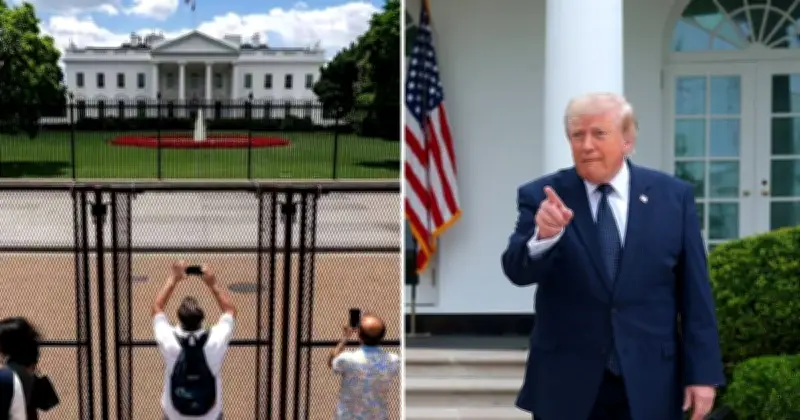
The Trump administration is advancing plans to install a permanent fence around Lafayette Square and additional barriers outside the White House, citing heightened security threats including a reported Iranian assassination plot. The Secret Service, the White House, and the Interior Department jointly unveiled a proposal on Friday that includes an eight-to-nine-foot-tall fence to replace existing temporary barriers, with phased implementation potentially beginning as early as next year.
Proposal Details and Timeline
The plan, published on the Commission of Fine Arts' website, states that the “objective is to enhance long-term safety, preserve the park's identity as a significant [National Park Service] landscape, and maintain public access to this nationally symbolic space.” The commission is scheduled to review the proposal on Thursday. The fencing would also extend to the junction of Pennsylvania Avenue NW and 15th and 17th streets NW, outside the White House, though further details on that element were not immediately disclosed.
Sources told The Washington Post that the White House and Secret Service would have authority to seal the new barriers and restrict pedestrian access in front of the White House if they identify security threats. Lafayette Square, directly opposite the White House, attracts thousands of tourists and protesters annually.
Backlash from Politicians and Activists
The proposal faced fierce opposition from politicians, historic preservation groups, and activists. Eleanor Holmes Norton, Washington, D.C.'s non-voting congressional representative, announced on Friday she would introduce legislation to block fencing at Lafayette Square, Pennsylvania Avenue, and other areas around the White House grounds. “More fencing around the president's Park would send the wrong message to the nation and the world by continuing to transform our democracy from one that is accessible and of the people to one that is exclusive and fearful of its own citizens,” Norton said.
Melissa Byrne, a progressive activist who has helped organize demonstrations outside the White House, warned of consequences for free speech. “Lafayette Park and Pennsylvania Avenue are critical for First Amendment activity. These changes remove all real sight and sound access. It also hinders the tourist experience,” Byrne told the news outlet.
Security Context: Iran Threat and Previous Incidents
The push for enhanced security follows an incident in April when Trump narrowly escaped harm during the White House Correspondents' Dinner—the third assassination attempt in under two years. Trump also cited fresh intelligence from Israel indicating he could be targeted by an Iranian operative, which he referenced during the NATO summit in Ankara, Turkey, the day before the proposal's publication.
This is not the first time the Trump administration has discussed fencing around Lafayette Square. The idea was initially raised during the first Trump administration, including during protests following George Floyd's death in May 2020, when demonstrators breached temporary fencing and Trump was briefly escorted to an underground bunker.
Park Renovations and Projectile Concerns
The proposal also outlines plans to resurface Lafayette Square, as officials expressed concern that existing pavers can be easily dislodged and potentially weaponized as “projectiles” during civil unrest. The plan aims to balance security with preserving the park's identity and public access.




