
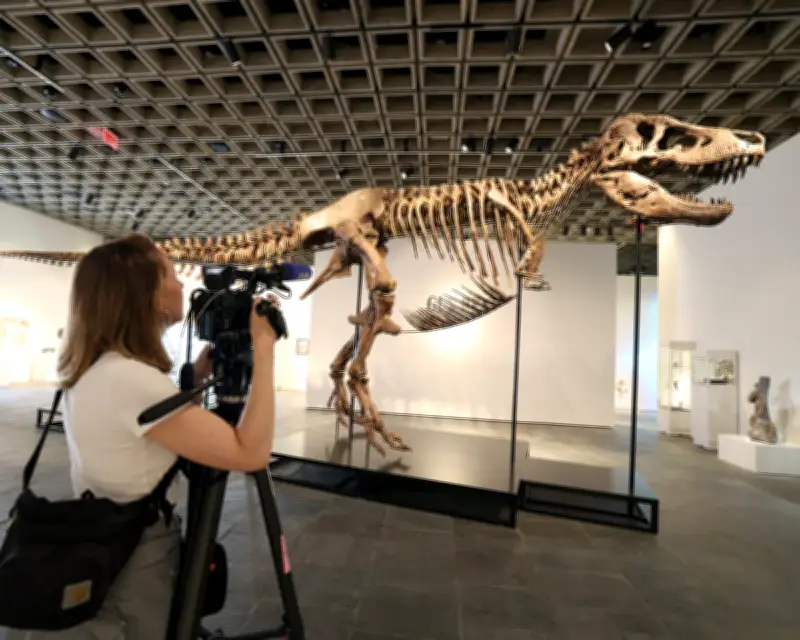
The auction of a multimillion-dollar Tyrannosaurus rex skeleton has sparked outcry from palaeontologists, who warn that the growing trend of selling fossils to super-rich collectors is damaging scientific research. The specimen, nicknamed 'Gus', is set to be sold by Sotheby's in New York on Tuesday with an estimated price of $20m to $30m (£15m-£22.4m).
Gus: A Monumental Discovery
Gus is one of the largest and most complete T rex skeletons ever discovered. Standing at about 3.8 metres (12.5ft) tall in a predatory pose, the fossil is believed to be around 67 million years old. It was unearthed over three years starting in 2021 on a ranch in Harding County, South Dakota, by the commercial outfit Theropoda Expeditions, with permission from landowner Gary 'Gus' Licking, who died before the excavation finished. Cole Jacobs, a field prospector, recalled in a Sotheby's promotional video: 'I straddled the road, walked up, and it was the very first thing I laid eyes on on the first day. I saw the metatarsal poking out of the ground.'
Scientists Sound Alarm
Prof Richard Butler, a vertebrate palaeontologist at the University of Birmingham, said: 'The current trend towards dinosaur fossils being marketed and sold like rare artworks at vast prices by auction houses is very concerning, as is the idea of buying dinosaur fossils as a status symbol or a commodity. A fossil not in a recognised museum collection cannot be studied and is therefore lost to research.' Prof Stephen Brusatte of the University of Edinburgh echoed these concerns, noting that while the auction appears legal under US law, 'as a scientist it still concerns me. If a dinosaur like this fetches tens of millions of dollars at auction, then there’s little that scientists or museums or universities can do. Those prices can only be paid by the super-rich.'
Rising Prices and Private Ownership
The first T rex sold at auction, Sue, fetched $8m in 1997 and was bought by the Field Museum in Chicago. Since then, fossil collecting has become a hobby for wealthy celebrities, including actor Leonardo DiCaprio. The record for a dinosaur fossil is held by Apex, a stegosaurus sold at Sotheby's in 2024 for $44.6m. Prof Michael Benton of the University of Bristol noted that occasionally private owners loan or donate fossils to museums, as with Apex, bought by billionaire Ken Griffin and loaned to the American Natural History Museum. However, Dr Thomas Carr of Carthage College argued that private ownership is insufficient: 'A private collection has no guarantee that a fossil will stay in a collection for all time, whereas a public trust’s mission is to maintain, conserve and curate its collection indefinitely. Fossils need to be available to test previous observations and to make new insights; the fossils are the data so they must always be available for study.'
Call for Legal Protections
Carr and Brusatte advocated for legal protections similar to those in countries like Mongolia, where all fossils belong to the state. Brusatte said that if he were a billionaire, he would donate a fossil to a museum. 'I hope that is what happens here,' he said. Carr hoped Gus would eventually be donated to a public trust. 'A fossil in a public trust is a win for science and society all around,' he said, 'rather than being hoarded in some McBillionaire’s living room.' Experts at Sotheby's defended the excavation, arguing that without private companies, some dinosaurs might never be recovered, and the price reflects the fossil's importance and recovery effort.




