
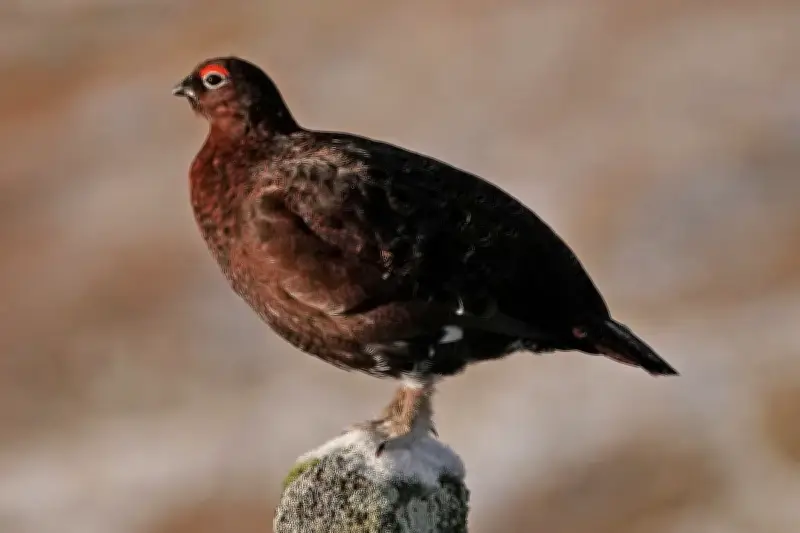
Conservationists have said a new study could shed light on why red grouse populations in Scotland have declined over recent years. Populations of the distinctive upland bird have seen a series of sharp declines over the last 10 years.
Sharp declines recorded
There have been several widespread breeding failures and sharp declines across grouse moors managed under a range of different systems. Monitoring by the Game & Wildlife Conservation Trust (GWCT) showed a poor 2024 breeding season led to an average 40% drop in pair counts across England and a 34% decline in Scotland. Summer brood counts then revealed a further fall in the number of adult birds, with a 36% drop in England and 29% in Scotland.
Project aims to understand breeding success
The GWCT said the maternal grouse project, which brings together more than four decades of research with field studies of hens, could help them understand what determines grouse breeding success. It hopes the findings can then be translated into practical guidance to help estates build more resilient grouse populations.
The announcement comes on August 12 – the so-called “glorious twelfth”, when the red grouse shooting season traditionally begins. Nick Hesford, director of GWCT Scotland, said: “For decades we’ve known what grouse populations are doing because we’ve monitored them consistently across the uplands.
“What the maternal grouse project allows us to understand is why some populations have remained consistently low and what’s been driving recent declines and failures to breed successfully.
“By following individual hens from before they lay until their chicks fledge, we’re beginning to uncover how nutrition, weather, habitat and disease interact to influence breeding success.
“It’s a level of understanding that simply hasn’t been possible before.”
Field studies and expansion
The study, which is now in its fourth year in northern England, sees researchers capture and radio-tag hens in the springtime before carefully following them throughout the breeding season. In March, the GWCT caught and tagged 60 hens across four long-standing study sites in the North Pennines and 51 hens across four new sites in the Highlands.
The team monitors nesting attempts, egg production, hatch success and chick survival while also measuring heather quality, cotton grass production, cranefly emergence, weather conditions and parasite burdens. By combining these detailed field measurements with decades of population data, the trust hopes to identify the subtle interactions that determine whether a breeding season succeeds or fails.
The study expanded into north-east Scotland earlier this year and will move into southern Scotland in 2027, allowing researchers to compare whether the drivers of breeding success differ between landscapes and regions.
Leah Cloonan, GWCT uplands adviser, has been monitoring red grouse as part of the project in the English uplands for the past four years. She said the study looks at bird body condition and “parasite burdens”, and also at the role of habitat and food sources, with samples of heather – the birds’ main food source – analysed in the lead-up to nesting season.
She said once the birds have nested and lain eggs, the team then uses small temperature data loggers to monitor egg temperatures, which tells researchers how many times the hen leaves the nest to feed. She continued: “Once hatched, we note the number of hatched eggs and we start invertebrate sampling in a typical brood foraging area to assess chick food availability in the seven days following hatching.
“This year we have introduced a new element to the study which is the capture of rainfall data on a site by site basis.
“Damp ground is important for the emergence of key invertebrate species, but too much rainfall can have a detrimental effect on the survival of chicks.”
Mr Hesford said: “The ultimate aim of the maternal grouse project is to identify factors limiting red grouse breeding success and translating this into practical guidance that can help estates build more resilient grouse populations and deliver more consistent grouse bags in the years ahead.
“This understanding will also help guide future, modern, sustainable grouse moor management and conservation in the face of climate change, poor breeding years and increasing legislation and regulation.”




