
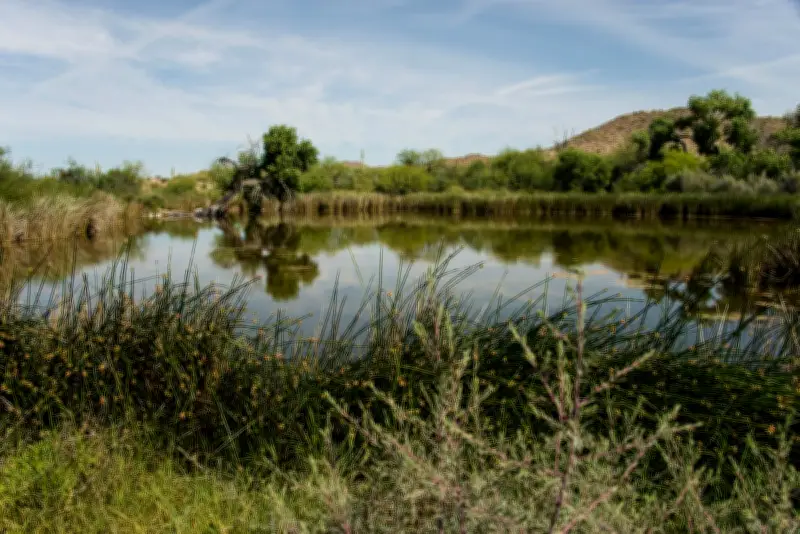
Quitobaquito Springs in south-west Arizona, a desert oasis and biological wonderland, faces a new threat from planned border wall construction. The spring, located within Organ Pipe Cactus National Monument, is the only place on Earth where Sonoyta pupfish and Quitobaquito springsnails live in the wild, and the only US habitat for the Sonoyta mud turtle.
The Trump administration completed a 30ft-tall border wall in this remote area in 2020, after which the spring flow dipped to an all-time low and the pond partially dried up due to a cracked lining. Now, plans are underway to build a second massive section of wall just 90-150 feet north of the existing one, despite negligible border crossings in the area.
Planned Construction Threatens Fragile Ecosystem
The planned secondary wall will be made of steel beams, also 30ft tall. Erick Meza, borderlands coordinator with the Sierra Club, said similar stretches are under construction at about six other locations on the Arizona-Sonora border. “I’ve never seen something of this magnitude,” Meza said.
The southern edge of the pond lies 190ft from the border, meaning part of it could be destroyed by heavy machinery. A grove of mesquite trees, part of federally recognized critical habitat for the mud turtle, would likely be leveled. Tara Harris, director of conservation and science at the Phoenix Zoo, fears the construction “could destroy the last remaining habitat for multiple imperiled species”.
Legal Waivers and Lack of Oversight
Normally, such construction would require extensive consultations under laws like the Endangered Species Act and National Environmental Policy Act. However, the 2005 Real ID Act allows the head of the Department of Homeland Security to waive these laws. Aaron Cooper of the International Sonoran Desert Alliance said CBP provided almost no information about its plans: “No outreach, no messaging, no comment periods, absolutely nothing. Radio silence.”
The Department of Homeland Security awarded a contract in late May to Sundt Construction to build the new wall section, and work could begin at any moment. Researchers are urgently making plans to save wildlife, including potentially moving all 250 Sonoyta mud turtles from the pond to artificial habitats.
Sacred Indigenous Site at Risk
The springs, called A’al Vaipia by the O’odham people, have been a home, gathering place, and sacred site for ceremonies since time immemorial. Wynona Larson Yazzie, an O’odham elder, called the plans “sickening”. Building a second wall would destroy much of an on-site cemetery and desecrate more than 40 gravesites, according to Hia-Ced O’odham leader Christina Bell Andrews.
In April, contractors destroyed a large chunk of a sacred earthwork known as an intaglia, a 200ft-long, 1,000-year-old fish-shaped figure. “Some people took that as a sign of what could happen at Quitobaquito. Such reckless behavior could destroy that place,” said Russ McSpadden of the Center for Biological Diversity.
Groundwater Pumping Concerns
Contractors use huge quantities of groundwater to create cement for the wall base. CBP previously estimated that a single mile of fencing built nearby in 2008 used 710,000 gallons of water. The aquifer feeding the springs is probably fed by both old groundwater and water from the Rio Sonoyta, so pumping could deplete it. CBP said they would not pump within five miles of the springs, but hydrologist Hector Zamora noted that a significant portion of the water probably comes from farther away.
“That’s the concern that keeps me up,” said Michael Bogan, an aquatic ecologist leading the recovery team for the Sonoyta mud turtle. The area has already suffered damage from the first wall’s construction, including cracked pond lining and reduced spring flow.




