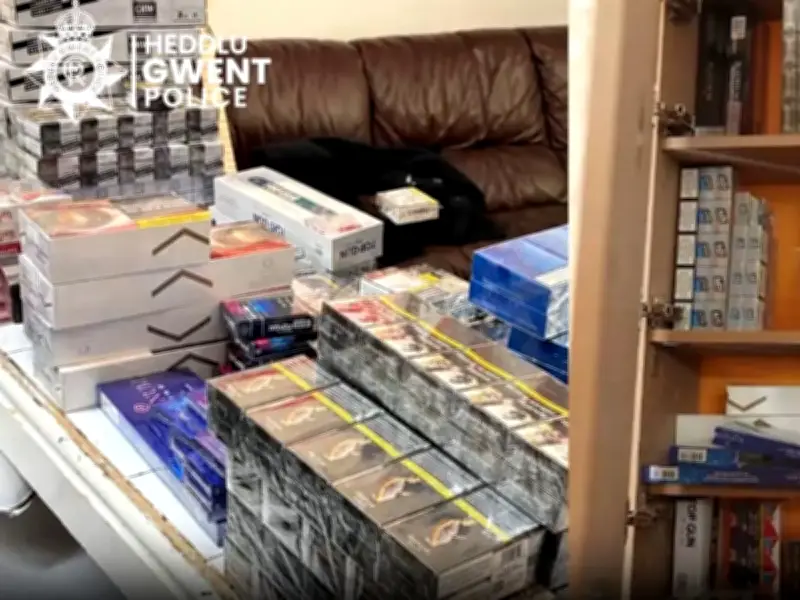
More than 10,000 illegal cigarettes have been confiscated from a shop in Newport as part of a UK-wide crackdown on criminals exploiting high street businesses, which has seen £19m worth of cash and goods seized in total.
Newport Trading Standards seized 10,481 illegal cigarettes, 3.1kg of illegal tobacco and a mobile phone from a convenience store on Commercial Street in the city last month.
The store has been served with a three-month closure order. According to the National Crime Agency (NCA), the property owner is being considered for a money laundering investigation, and an Account Freezing Order of £22k has been put in place relating to the nominal running the shop.
Operation Machinize Results
Operation Machinize was supported by Gwent Police, who say that in October 75 businesses were visited, with three civil fines issued, counterfeit or illegal products and cash seized, and four arrests made.
Across the UK, the operation resulted in 3,029 premises visited or raided, 349 arrests made, £2.2m cash seized, £3.7m account freezing orders obtained, and £4.2m in Duty Tax Evasion identified or prevented.
In addition, there were £6.8m of criminal commodity seizures, which included £2.6m worth of illegal drugs, 49,295 illegal vapes, 1,645kg of illegal tobacco and 6.3m illegal cigarettes.
Agencies and Official Comments
The operation involved enforcement action by every police force in the UK, as well as Regional Organised Crime Units, Home Office Immigration Enforcement, Trading Standards, HM Revenue & Customs, Food Standards Agency, Companies House and the Insolvency Service.
Sal Melki, deputy director of illicit finance at the National Crime Agency, said: “We are making a difference. Through our collective operations across the last 18 months we have raided over 6,000 businesses, arrested more than 1,300 offenders and seized £19m of criminal value.
“It is changing criminal behaviours and showing them the high street is no longer a safe place for them to operate. For a long time, criminals thought they could hide in plain sight, but those days are coming to an end.
“Through Machinize we have demonstrated what can be achieved through a joined-up national to local approach, bringing the specialist capabilities held in organisations such as the NCA together with local, on-the-ground expertise.”
Melki added: “We have engaged government at all levels and it is now recognised that we cannot turn the tide through enforcement action alone, and we are working together to develop policies, powers, attract investment, and build a whole of society view of what we want our high streets to look like.
“Operational enforcement is one piece of the puzzle - the burden to solve this problem for good is shared across government, the private sector and in our communities.
“There is much more to do. The threat is nuanced and not as straight forward as it seems.
“While we can identify the shops that don’t seem quite right, getting to the directors and criminal beneficiaries behind them is more complex and we are building the machinery required, with our partners, to do just this – identify them, shut them down, and take away their criminal profits at scale.
“My message to the criminals is this: the incentives to use our high streets for economic and organised crime are dwindling – Machinize is not a one off, it is happening now, any time and any place. We know who you are, and are coming for you.”
Broader Criminal Impact
According to the NCA, criminals being targeted are not just money laundering but are engaged across the full spectrum of high harm criminality, such as drugs, immigration and human trafficking offences.
Chief Constable Gavin Stephens, chair of the National Police Chiefs’ Council, said: “These results demonstrate British policing at its best, with local frontline officers working alongside high quality specialist capabilities to take down criminal networks that blight our communities.
“People across the country will recognise this problem all too well. These dodgy shops are a visible stain on our high streets, dens for drug dealing, exploitation and the sale of dangerous counterfeit goods, and often a front for criminal gangs to launder their money and fund even more serious organised crime.
“I am proud to see local forces working alongside the National Crime Agency, City of London Police and other specialist agencies to bring the full force of the law to bear on these criminal enterprises and take action against a problem that communities tell us time and time again is a priority for us to deal with.”