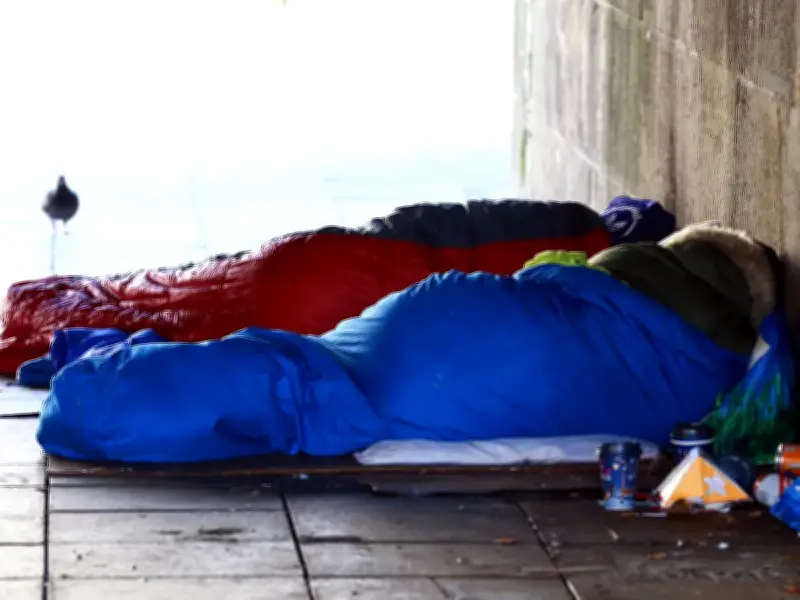
Homelessness charities have warned that a “massive shortage” of housing must be reversed if the government is to banish the growing scourge of rough sleeping in the North East. The Prime Minister announced plans on Wednesday to offer a route off the streets for everyone who needs it by this Christmas, alongside a £442 million funding uplift.
Andy Burnham made a pledge to end rough sleeping his first instruction after entering Downing Street last month. He had previously pledged to do so during his time as mayor of Greater Manchester, while Newcastle attempted the same through the Street Zero project.
Record levels of rough sleeping in the region
The number of people sleeping rough in the North East has increased to record levels over recent years. While the region actually has the lowest number of rough sleepers of any English region, experts have been left worried by a recent trend.

The number of people sleeping rough on a single night in autumn 2025 in the North East stood at 162, according to most recent Government figures, up from the previous high of 124 the year prior. That 31% jump was the largest rise in the country, while Yorkshire, London, and the East Midlands experienced a drop.
The situation in Newcastle is particularly stark. The city saw the second largest absolute increase in the estimated number of people sleeping rough on a single autumn night from 2024 to 2025 – up from 21 to 46, a 119% rise. Mr Burnham visited charity Changing Lives’ crisis accommodation at Alex’s Place, in Elswick, on Wednesday morning and spoke to some of its residents.
Charities call for sustainable housing and support
The charity’s CEO, Stephen Bell, told the Local Democracy Reporting Service that the Government and other bodies had to collectively develop long-term housing and support services to prevent people falling back into homelessness. He said: “The commitment to try and get people off the streets by Christmas is one thing. What we then need is sustainable housing to allow people to remain independent, with wraparound support. But when you have a Prime Minister who seems genuinely interested, it is brilliant.”
Mr Bell added: “We have never had a PM who has come out and said this. I was involved in Street Zero and when it was here in Newcastle, we had zero people on the streets. It was for a limited period, but we were the first major city in the UK which did this. It is now up to between 30 and 40 per night.”
Ruth Parker, of South Shields-based Emmaus North East, also welcomed Mr Burnham’s announcement but said that Christmas “is not that many months away and we really want to see the detail on how this is going to happen”. She told the LDRS: “We know there is a shortage of council homes, a lack of homes with social housing providers, and new-builds are desperately needed. I know some [measures to deal with that] are planned but it doesn’t happen overnight, it takes years. We have not got the hotel rooms available to us like they were during Covid, so how are we going to accommodate people? The detail is significant.”
Government plans and local concerns
The Government said that new accommodation and support for homeless people would be rolled out this winter, promising “practical help with housing, health and other needs, helping people build a more stable future”. A national rough sleeping summit is also planned in the autumn, bringing together leaders from business, charities, health organisations, and more to help devise solutions.
After Newcastle, the North East areas with the largest rough sleeper numbers in 2025 were Middlesbrough on 23, Durham on 20, Northumberland on 17, South Tyneside with 14, and Sunderland with 10. Gateshead, Hartlepool, Stockton, Darlington, Redcar and Cleveland, and North Tyneside all reported numbers in single figures.

Ms Parker has been left seriously concerned by the rising trend of rough sleeping in the North East in the past few years. She added: “We do have lower numbers than other parts of the country, but if the trend continues then we soon won’t have. Deeper in the data there is a rise in women and young people who are rough sleeping. There is a massive shortage of homes and because of that the private landlords have put up rents. People who can just about afford it and are desperate will pay, even if it means them absolutely living on the breadline. But anyone outside that just cannot afford to go into housing.”