
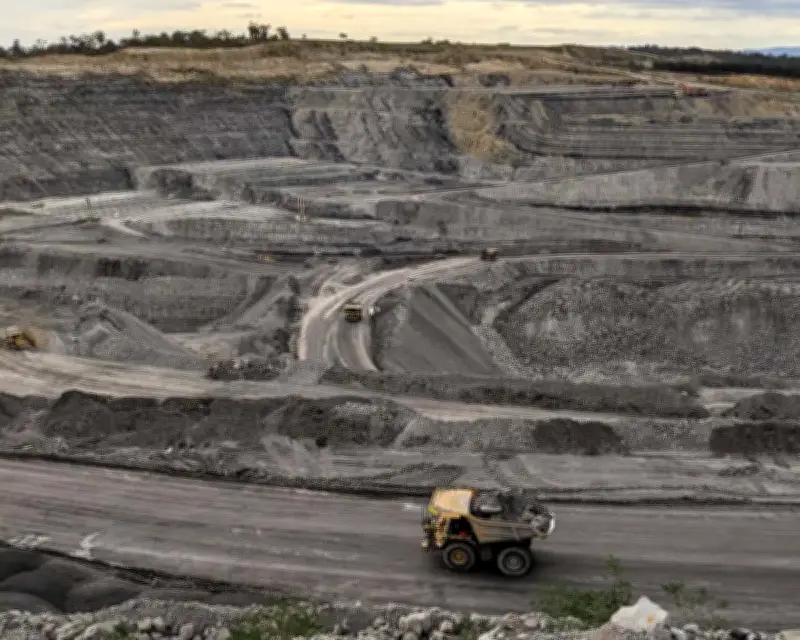
A new online tool, the Carbon Impacts Tracer, calculates the real-world climate effects of carbon dioxide emissions, translating figures like 809 million tonnes of CO2 into tangible impacts. For example, the Hunter Valley Operations (HVO) mine in New South Wales, if approved, would emit this amount, potentially exposing almost half a million people to unprecedented heat, killing nearly 15 million coral colonies on the Great Barrier Reef per bleaching event, and causing over 100 additional heatwave deaths in Europe by century's end.
How the tool works
The tool, developed by scientists at the Australian National University, the Australian Research Council Centre of Excellence for the Weather of the 21st Century, and the Lethal Humidity Global Council, with funding from the Minderoo Foundation, uses peer-reviewed studies to estimate impacts across eight metrics. These include lost food production, reduced crop yields, labour hour losses due to heat, glacier loss, and coral death.
Central to the tool is the Transient Climate Response to CO2 Emissions (TCRE) metric, which calculates that every billion tonnes of CO2 causes about 0.45C of global heating. Once an emissions amount is known, its contribution to global warming can be estimated and compared against published studies.
Accountability for emitters
Prof Sarah Perkins-Kirkpatrick, a climate scientist at the Australian National University and part of the team launching the tracer, said, "Small numbers in global warming can mean catastrophic impacts." She added, "Every tonne of CO2 matters and we've known this for decades. To pinpoint what this means with a high degree of confidence has taken us a long time. This [tool] is to hold big fossil fuel emitters accountable. It is not meant to be a blame game. It just shows that all emissions have impacts and now we can prove it."
Maria Nawaz, who leads the Australian Climate Accountability Project at the Australian Human Rights Institute at the University of New South Wales, a partner in the project, said the tool helps refute the defence that emissions are "just a drop in the ocean." She noted, "Governments and corporations have argued their emissions are 'just a drop in the ocean' and too small to measure. But we can now refute this defence and show the emissions of any state or corporation can be tied to a global warming figure and then human and ecological harms. It is transformative."
Implications for the Hunter Valley mine
The NSW Independent Planning Commission is expected to decide this week on the future of the HVO mine, with joint owners Yancoal and Glencore seeking to continue operations until 2045. The tool's estimates for the project include a reduction in crop production equivalent to the minimum dietary requirements of 276,129 people annually.
Elaine Johnson, a climate lawyer and director of Johnson Legal not involved in the work, said some governments and corporations will not welcome the tool's development. "Fossil fuel companies do not want people to be able to make that connection between their products and, say, deaths from heatwaves. But now the science is at the point where we can make those connections clearly. That is a story the industry does not want told." The Guardian approached Glencore for comment but received no response.




