
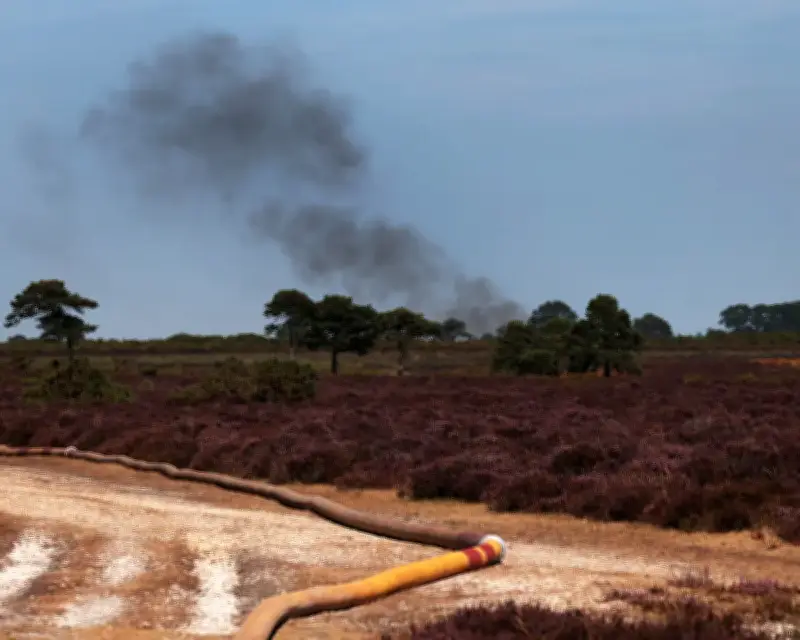
Firefighters are expected to battle a large wildfire in the New Forest for several more days, as wind changes and a parched landscape fuel the flames. The blaze has forced the closure of the A31, a key tourist route, and prompted appeals for visitors to stay away.
Fire spreads across dry heathland
Smoke billowed above the deserted A31 road, the main tourist route into the New Forest national park, late on Tuesday, while a helicopter flew above the blaze. Firefighters at the scene said they were trying to contain several hotspots across more than 247 acres of dried heathland as winds swirled over the area.
One source at the scene said: “They are really worried that as they dampen down the top, the peat underneath is still alight and spreading the fire. It is too dry, too windy, and it is a real struggle.”
Record wildfire season
July was the busiest month on record for wildfires, the National Fire Chiefs Council said on Tuesday. Its services have responded to 966 wildfires this year, including 458 in July alone. Parts of England are bracing for a fifth heatwave of the summer this week, and the Met Office said the UK was on course for its hottest summer on record by average temperature. On Monday, authorities declared almost three-quarters of England officially in drought.
Hampshire fire and rescue service said it was facing many challenges, including maintaining a water supply and dealing with difficult terrain and changes in wind direction. “Thanks to the efforts of firefighters, we are managing to contain the fire,” it said. “We have been using a mix of fire engines and off-road vehicles to damp down and cool the edges of the area … to prevent spread and escalation. The police drone is being used to enable us to priorities hotspot areas and manage flare-ups.”
Community support and calls for more firefighters
As emergency services worked through the night, a spokesperson for the Fire Brigades Union called for the recruitment of 5,000 more firefighters to cope with extreme climate conditions. Firefighters have been at the scene since Sunday evening when a lorry caught fire on the A31 at Ringwood at around 5.21pm, sparking the blaze.
Residents have rallied round to support the firefighters, many of whom are volunteers, collecting food and drink for them. On a community WhatsApp group, firefighters thanked the “amazing community” for the support.
Impact on tourism and environment
The A31 dual carriageway remained shut on Tuesday with no timetable for reopening. A yellow high-pressure water pipe stretched 5 miles along the empty highway from a stream near the village to the blaze, where more than 120 firefighters from stations across the country continued to try to contain the burning.
Debbie Tann, the chief executive of Hampshire and Isle of Wight Wildlife Trust, said: “It is devastating. It is just dry tinder across the whole forest. It has spread really quickly because of these dry conditions. The New Forest is one of the most important habitats in Europe. It has so many rare species in the heathland – reptiles, adders, lizards, and then the birds like night jars. This is going to have a devastating impact.”
Tourism is the largest single industry in the local economy, with leisure and recreation trips accounting for £107.6m in income each year. Forestry England, which manages about half of the national park, said the operation to contain the fire could last for several days. Its spokesperson Esta Mion said: “We are very much asking people to stay away … it’s unpredictable. We just don’t know how long this incident could go on for. We’re certainly thinking it could be the next few days, for sure.”
Emma Howard Boyd, the chair of the independent National Heat Risk Commission and a professor in practice at the Grantham Research Institute on Climate Change and the Environment, said: “As the prime minister tours every region of the UK, it will be hard to miss the impacts of this extraordinary summer: wildfires, drought, parched farmland and people struggling to work in extreme heat. The government must now act with urgency to prepare the country for a hotter climate, cutting emissions while investing in the resilience of our homes, infrastructure, farms and public services.”




