
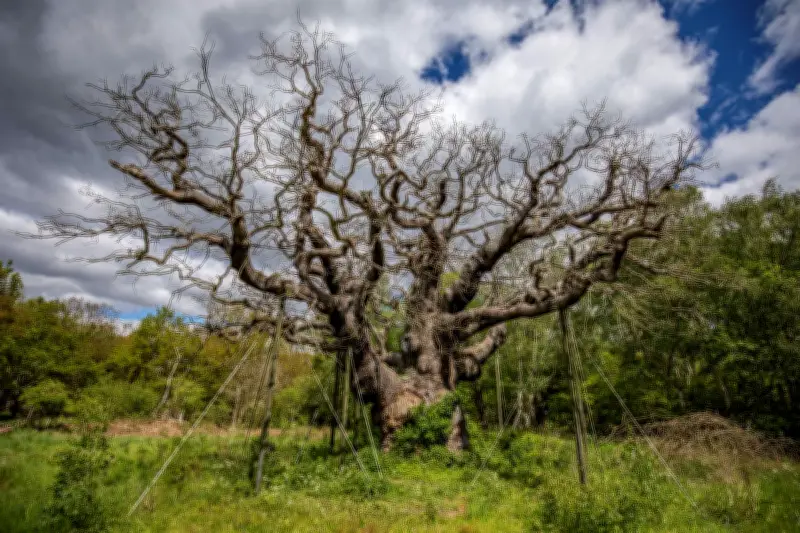
A vast ancient oak tree linked to the legend of Robin Hood is thought to have died after its first spring with no leaves, experts have said. The Major Oak, located in the heart of Sherwood Forest in Nottinghamshire, is believed to be up to 1,200 years old but has been in decline for some years, according to the RSPB, which manages the woodland.
Factors Behind the Decline
The conservation charity stated that the tree had been affected by a combination of factors: a century of “well-intentioned” structural interventions, massive numbers of historical visitors, and recent climate change-driven heatwaves and droughts. The soil around the tree became heavily compacted from the footfall of millions of visitors in the past, making it harder for rain to penetrate and for the root system to absorb necessary nutrients. Recent testing revealed that the soil was as solid as concrete in some spots.
These factors compounded the natural challenges the tree faced at its advanced age, leading scientists to conclude it has died after failing to produce any leaves this spring.
Legacy and Future
The tree, famous worldwide for sheltering the legendary outlaw Robin Hood, will remain standing in the forest as a monument for people and wildlife, the RSPB said. Hollie Drake, senior site manager at RSPB Sherwood Forest, described the tree’s failure to produce leaves this year as “heartbreaking for everyone.”
She added: “We know the Major Oak will have a lasting legacy, first and foremost because it is so inextricably linked to Robin Hood and Sherwood Forest. But beyond its cultural heritage, the Major Oak will continue to provide important habitat for wildlife, reminding us why these remarkable trees are so important and why protecting them for the future matters.”
Historical Significance
The Major Oak won the Woodland Trust’s annual Tree of the Year competition in 2014 and was the first to be recorded on the charity’s ancient tree inventory. However, the trust noted that recording trees would not “halt their catastrophic decline.” Ed Pyne, senior conservation adviser at the Woodland Trust, called for stronger legal protections for ancient woods and trees.
“Excessive tourism in Victorian times compacted the soil around the Major Oak’s roots, causing damage that could never fully be reversed,” he said. “Its decline is a warning – the way we treat ancient trees today will shape whether they survive for future generations.”
The tree has been alive since the Norman conquest and continued to grow while other Sherwood oaks were used to raise the roof of St Paul’s Cathedral, fuel the industrial revolution, and build Nelson’s navy. Its name stuck after being mentioned in a book by Major Hayman Rooke in 1790, which sparked the first significant waves of tourism to the forest, drawing millions over the next two centuries.
Human Interventions and Monitoring
Supports for some of its sprawling branches, in place since the early 20th century, are among the “well-intentioned” human interventions thought to have contributed to its decline. For years, visitors could walk right up to the tree and even climb into its large hollow trunk, but the area was fenced off in the 1970s, and since then the tree has been viewed from a distance.
Chloe Ryder, the RSPB’s estate operations manager at Sherwood Forest, said: “Previous surveys of the tree have shown concerning declines in its vitality over the past few decades, which is easily recognised in the appearance of the famous leafy silhouette. Recent years’ surveys have focused on what’s happening underground, and what we discovered was a surprising and grave situation; a strangled and starved root system in total disconnect to its surrounding environment, and a need to act much more urgently and innovatively than we ever anticipated if we were to reverse the fortunes of this natural wonder.”
Offspring and Conservation Efforts
Acorns and cuttings have been grown from the tree, and saplings from the oak have been planted in locations around the world. “We are planning work to ensure that its offspring will grow and generate their own acorns – and legends – for centuries to come,” Ryder added.
Simon Parfey, managing director of SoilBioLab, specialists in soil microbiology testing and part of the team caring for the oak since 2021, said surveys revealed the root system had been “quietly struggling for a long time” due to naturally poor soil and heavy ground compaction. Despite efforts to revive the environment around the tree, it appears the damage was “already too deeply entrenched to fully reverse.”
Reg Harris, director of Urban Forestry (Bury St Edmunds) Ltd, who has been monitoring the leaf canopy of the oak for the past nine years, added that the most recent decline corresponded with five hot, “droughty” years, including July 2022 when temperatures hit record highs above 40°C. While the tree’s demise had a range of factors, he said: “Sadly, it seems probable the lack of summer rainfall over the last five years, coupled with the unprecedented high temperatures, have had a significant hand in it.”




