
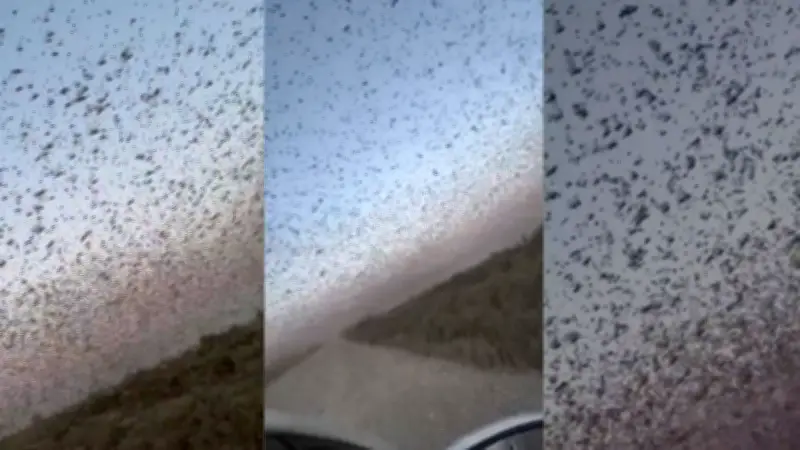
A massive swarm of locusts has been filmed sweeping across the sky in Dagestan, Russia, turning it black in scenes that many have described as "biblical." The footage, which has gone viral with over 90,000 views, shows thousands of short-horned grasshoppers filling the air.
In the clip, a local watching the swarm can be heard saying: "Where are they heading? What on Earth is this? Thank goodness they're not heading towards the town! They are going to eat us alive!"
Destructive Pests
The insects are Asian locusts, considered one of the world's most destructive agricultural pests. Their swarms can contain hundreds of millions of insects and are capable of travelling vast distances while stripping crops and vegetation in their path.
On Tuesday, Dagestan's Agriculture and Food Ministry confirmed pest control efforts were ongoing, with several large swarms already being tackled after they were spotted in a field in the region.
Challenges in Treatment
The ministry said: "The situation is complicated by the fact that migratory locust swarms travel from nature conservation areas and reserves, where chemical treatment is strictly prohibited by law. However, as soon as the pests move into areas where treatment is permitted, all available equipment is deployed."
Social Media Reactions
The footage has left social media users stunned, with many comparing the scene to something out of the Bible. One user, Margot, said: "Sounds very bad, in a Biblical way." Another joked: "When are the first-born due to be taken?"
Another user wrote: "You can eat them! They are high on protein." Someone else added: "They could use some seagulls."
About Asian Locusts
Adults are large, typically ranging from 35–50mm in length for males and 45–55mm for females. They generally appear green, brown, yellowish-green, or grey, and possess clear wings with a smoky tint and black veins.
They exist in two phases: a solitary phase and a swarming phase. In the Caucasus and Central Asia, they are typically univoltine (one generation per year), though they can produce up to five generations annually in tropical zones. Eggs are usually laid in sandy soils during late summer.
As polyphagous pests, they can feed on a wide variety of plants, with each individual consuming 300 to 500 grams of green forage over its lifetime. In the swarming phase, they form massive bands of flightless nymphs that develop into highly mobile swarms of adults capable of travelling huge distances and stripping vegetation, causing significant agricultural damage.




