
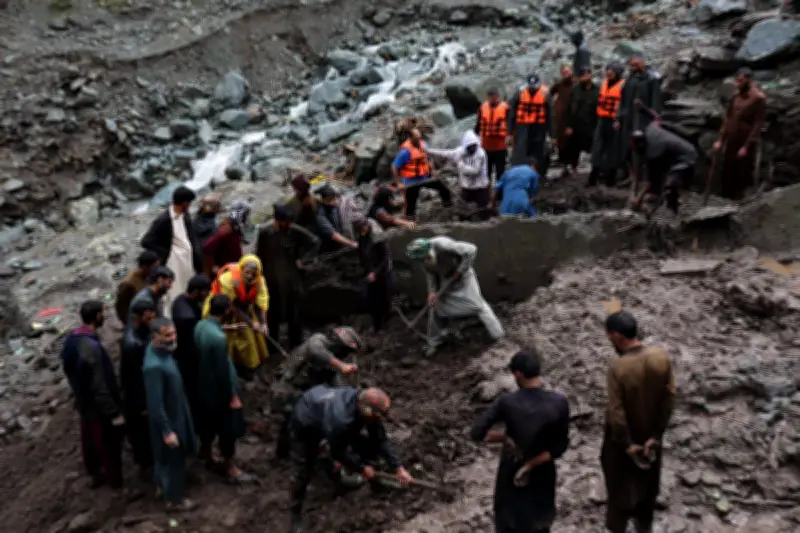
A cloudburst-triggered landslide in Murrah village, Indian-administered Kashmir, has killed at least 28 people across the region, with families still searching for the missing.
Village Devastated
On 19 July, Haji Mohammad Latief stepped outside his home as rain lashed the Pir Panjal mountains. His daughter had asked him to move the family car to a safer place. “I had only just parked it,” Latief recalled. “When I turned around, I saw the water coming.” Minutes later, a cloudburst sent mud, boulders and water crashing down the hillside.
Latief, 48, had spent years building the house where five generations of his Gujjar family lived. Within minutes, the torrent swallowed it, trapping eight family members inside. He survived only because he had stepped outside. By dawn, everything he had built lay in rubble.
Search and Rescue Efforts
When the Guardian reached Murrah four days later, electricity, roads and mobile networks were cut off. Floodwaters had washed away roads and footbridges, leaving only a 90-minute walk through rain and landslide debris. Residents carried sacks of flour, cooking gas cylinders and medicines across the broken crossing.
The hillside remained too unstable for excavators. Soldiers, disaster response teams and local volunteers searched the debris by hand while others combed the swollen Suran River for the missing.
Latief now lives in his brother’s house above the landslide. Inside, women gathered to mourn while men received visitors offering condolences. “I built that house for my family,” Latief said, holding up pictures of his 16-year-old son Sajjad Ahmed, an aspiring cricketer, whose body was still missing.
Among those searching was Mohammad Razak, 45, who had spent four days combing the river with a team of volunteers. “We’ve been searching every bend of the river,” he said. “We’re still hoping we’ll find them.”
Wider Impact
The destruction stretched far beyond Murrah. About 30 miles away in Rajouri, the Manawar Tawi River burst its banks, washing away roads, vehicles and the town’s main Bela bus station. Low-lying settlements were submerged, houses collapsed, livestock were swept away, and hundreds of families were displaced.
About 180 miles north, in Gurez Valley, a cloudburst in Achoora village damaged crops and blocked the valley’s only road. Residents say increasingly erratic rainfall is disrupting farming and making traditional livelihoods more precarious.
“People knew when the snow would come and when to plant crops,” said Aamir Asghar Khan, 26, a resident of Achoora. “Nothing seems predictable any more. The rain is getting more intense every year, and the frequent cloudbursts are threatening our livelihoods.”
Climate Concerns
The International Centre for Integrated Mountain Development (Icimod) said the western Himalayas were experiencing frequent bursts of intense rainfall capable of triggering floods, landslides and cloudbursts. Accelerating glacier melt is likely to increase flood risks in the short term before reducing water availability in coming decades.
“The challenge our mountain communities face is twofold – too much water at times and too little at others,” an expert from Icimod said. “Adaptation requires work on both fronts, managing flood risk and water scarcity together.”
Icimod said priorities included expanding community-based early warning systems, installing more weather stations in high-altitude areas, restoring damaged watersheds and designing infrastructure for future weather conditions.
Dr Suheel Rasool Mir, a Kashmir-based sociologist, said pastoral communities were among the first to bear the consequences of erratic weather. “For Gujjar, Bakarwal and Dard-Shin communities, these disasters are not simply natural hazards,” he said. “As climate extremes become more frequent, they lose not only homes and livestock but also the ecological knowledge and ancestral livelihoods that have sustained them for generations.”
For Latief back in Murrah, only one hope remained. “I just want to find them,” he said. “Then we can bury our family together.”




