
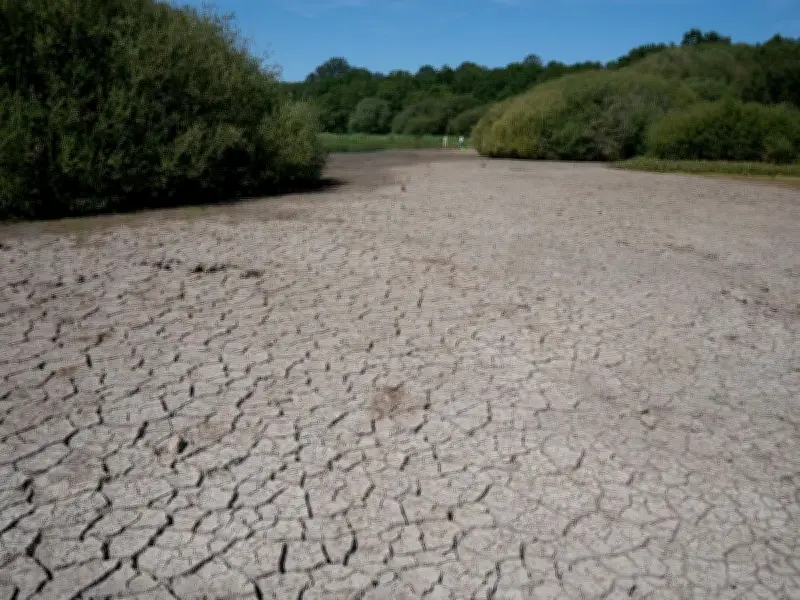
Stew Pond in Epsom Common, Surrey, has been left looking like a desert, with its water levels at record lows and local fishermen struggling to find water to fish in. The pond, a local nature reserve and habitat for diverse wildlife, has seen its water levels drop dramatically as persistent dry weather continues across southern Britain.
Drought conditions spread
Almost three quarters of England and all of Wales are experiencing drought conditions, following an exceptionally dry July and start to August. This, coupled with high temperatures, is putting strain on water resources for households, farming and the environment.
The UK is on track for its hottest summer ever, with only average conditions required for the remainder of August to surpass last year's record, according to the Met Office. Parts of the country are bracing for a fifth heatwave this summer, with amber "extreme heat" warnings issued for areas of England on Thursday, where temperatures could reach a scorching 38C in some places.
Water company seeks drought order
Southern Water has sought a seldom-used non-essential use ban drought order. If granted, this would mean businesses must cease using water for tasks such as car washing and filling non-domestic swimming pools.
In its application, the company stated that an "exceptional" lack of rainfall in the South East "demonstrates a clear threat to supplies within the Hampshire Southampton West (HSW) water resource zone, as well as the Isle of Wight (IOW)". It further noted that 165,000 people in the Southampton West supply area could "soon be significantly affected by a restricted water supply".
Environment Secretary Angela Eagle will now consider the application, with a decision anticipated as soon as possible. A non-essential use ban hasn't been imposed for 20 years, with the last one granted to Sutton and East Surrey Water back in May 2006.
Record temperatures expected
Preliminary figures from the Met Office reveal that the average temperature for this summer so far, starting from 1 June, is at 16.48C – a significant 1.88C above the average from 1991 to 2020. To match the record-breaking warmth of 2025's summer, which averaged 16.12C, the remainder of August would only need to be 0.21C below the long-term average. Any higher than this and we'd be looking at a new record for the UK, according to the Met Office.
For England and Wales, where temperatures have been more than 2C above average this summer, it's even more probable that the period from June to August 2026 will set new records. The Met Office has issued a rare amber warning for extreme heat covering London, parts of the South East, East Midlands, East of England, West Midlands and South Yorkshire from 9am to midnight on Thursday, with temperatures expected to reach a sweltering 37C or 38C in some areas.
Met Office chief forecaster Chris Bulmer commented: "While the peak heat will be more short-lived than recent heatwaves, temperatures widely into the mid-30s Celsius on Thursday brings the potential for impacts for some, which is why a Met Office warning has been issued. High pressure is now becoming dominant and temperatures will build day by day. Southerly and south-easterly winds will also tap into the hot conditions over Europe which helps develop this further notable heat in what has been a hot and dry summer so far for many in the south of the UK."
Amber health heat alerts are currently active for most of England, including the Midlands, South East, North West and South West, while a yellow alert will be in effect for the North East from Tuesday morning until Friday evening. Authorities have encouraged individuals to take simple measures to stay safe, such as drinking ample water, checking on vulnerable friends and family, and avoiding sun exposure during the peak heat of the day.




