
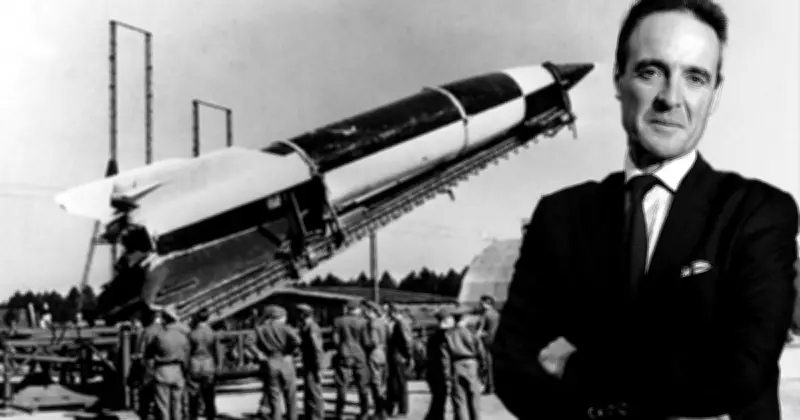
In May 1944, an object screamed out of the sky at nearly 3,000mph over occupied Poland, burying itself deep in a marsh beside the River Bug. German troops swarmed the area, sealing roads and questioning villagers, desperate to recover one of Hitler's most closely guarded secrets: a V2 rocket. But the Polish resistance reached it first, sparking an extraordinary intelligence race involving spies, scientists, and an audacious theft.
The V2 Rocket: Hitler's Last Hope
By 1944, the V2 represented Hitler's last great hope to strike a decisive blow against the Allies. Standing nearly 50 feet tall and powered by liquid fuel, it was the first ballistic missile. Once launched, it climbed into the atmosphere before plunging at supersonic speed, with no warning or defense possible. Victims heard the explosion before the rocket itself. According to Guy Walters' new book, Stealing Hitler's Rocket, the weapon seemed like science fiction even to Allied intelligence officers.
Development at Peenemünde
The V2 emerged from Peenemünde, the secret research center on Germany's Baltic coast, led by Wernher von Braun and General Walter Dornberger. While technologically advanced, the V2 was wildly expensive, carried a modest warhead, and had poor accuracy. However, its psychological impact was immense. Allied leaders feared what mass production could mean for the war's outcome.
British Intelligence and R.V. Jones
British intelligence, led by scientist R.V. Jones, pieced together evidence from resistance agents, forced laborers, intercepted intelligence, and aerial photographs. Despite skepticism from colleagues and even Winston Churchill, Jones' conviction that Germany was developing a giant rocket proved correct.
The Polish Resistance's Race
In occupied Poland, the German testing ground near Blizna saw experimental V2 launches. When one crashed intact near the River Bug, the Polish Home Army recognized the opportunity. Reaching the site before German recovery teams, they secured access, examined the missile, removed components, and gathered critical intelligence—all under threat of execution. The challenge then was getting the evidence to Britain.
Impact and Legacy
The first operational V2 struck London in September 1944, with no warning siren, causing devastating explosions. Over 1,300 V2s fell on Britain, killing thousands. More died during production at the Mittelwerk complex, where concentration camp prisoners labored in appalling conditions. The V2's technology later shaped ballistic missiles, nuclear delivery systems, and space travel. As Walters notes, the operation by Polish resistance fighters, spies, and airmen remains one of the greatest secret operations of WWII, ensuring Hitler's weapon never stayed as secret as intended.




