
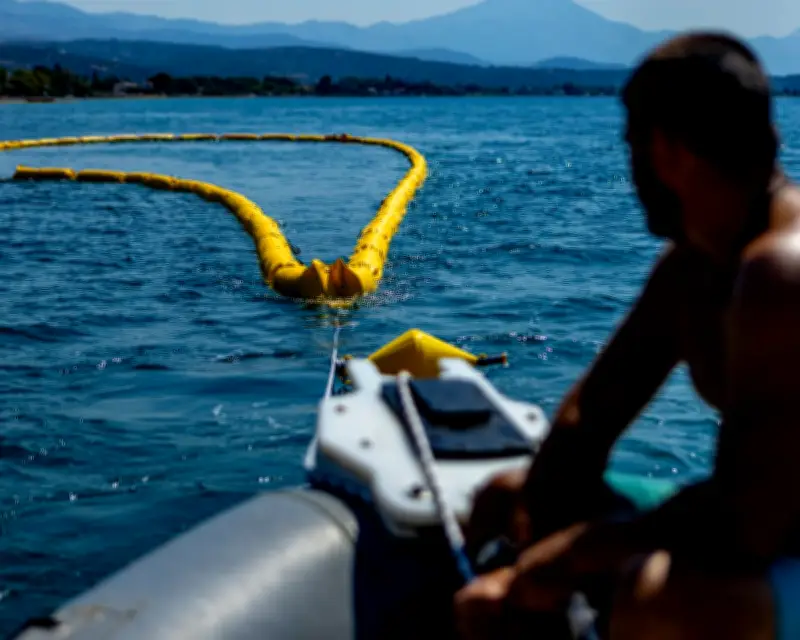
Greece has installed its first floating sea barrier in the Gulf of Euboea, off the island of Evia, to protect swimmers from toxic long-toothed pufferfish that have migrated into the Mediterranean due to warming waters. The barrier, anchored across a popular bay, aims to prevent attacks by the invasive species, which can cause severe wounds and carries a lethal neurotoxin.
New Threat from Warming Seas
Until last summer, the main marine hazard in the area was purple jellyfish. However, the arrival of the silver-cheeked toadfish (Lagocephalus sceleratus), capable of biting through bone and metal, prompted the Greek Red Cross to issue a public health warning in June. The fish's beak-like jaws can cause heavy bleeding, and its organs contain tetrodotoxin, a neurotoxin with no known antidote.
Antonis Spanos, vice-mayor of Chalkida, oversaw the barrier's installation. 'Our duty and primary concern has to be the safety of our citizens,' he said. 'It's better to be safe than sorry.' The barrier, made of tightly knit durable netting, is the first of its kind in Greece. Spanos noted that 2.5 kilometres of net will be set up around the gulf to allow for a carefree summer.
Proliferation Across the Eastern Mediterranean
The pufferfish, native to the Indo-Pacific, entered the Mediterranean via the Suez Canal, attracted by rising sea temperatures. In Cyprus, authorities introduced financial incentives in 2024, resulting in over 103 tonnes of the fish being removed from coastal waters. Katerina Georgiou, Cyprus's fisheries officer, described the species as having 'remarkable adaptability' and warned that its presence is a new reality.
In late June, Greece announced a similar catch programme offering €5.33 per kilogram of surrendered pufferfish, funded by the EU. Fishers will also receive fuel subsidies. The initiative initially applies to Crete and the southern Aegean, with collected fish frozen and incinerated. Agriculture Minister Margaritis Schinas said the plan may be expanded.
Mixed Reactions from Locals and Experts
Not everyone supports the eradication effort. A group calling itself the Initiative to Save Puffer Fish has emerged, arguing that the fish deserve protection and respect. Marine scientist Ioannis Batjakas from the University of the Aegean called the outcry overblown, stating he has only seen one pufferfish in over 15 years of diving and that attacks on humans are rare.
However, local resident Pavlos Beleyiannis, who watches his grandchildren swim near the barrier, remains cautious. 'I saw two jellyfish in the water just outside it this morning. Why not pufferfish? In life, you never know what's next,' he said. Nikos Choulieris, a diving instructor who helped install the barriers, expressed confidence in the net's durability, saying pufferfish would have to bite the same spot for a long time to tear it.
Wider Implications for the Mediterranean
The warming of the Mediterranean, often described as 'tropicalisation,' is driving the migration of species like pufferfish and lionfish. This poses challenges for fisheries and tourism across the region. While the floating barriers offer immediate protection for swimmers, the long-term solution remains uncertain. As amateur fisher Nikos Ayiaskoufitis noted, 'No measure is going to be effective because what we're seeing is part of the law of nature.'




