
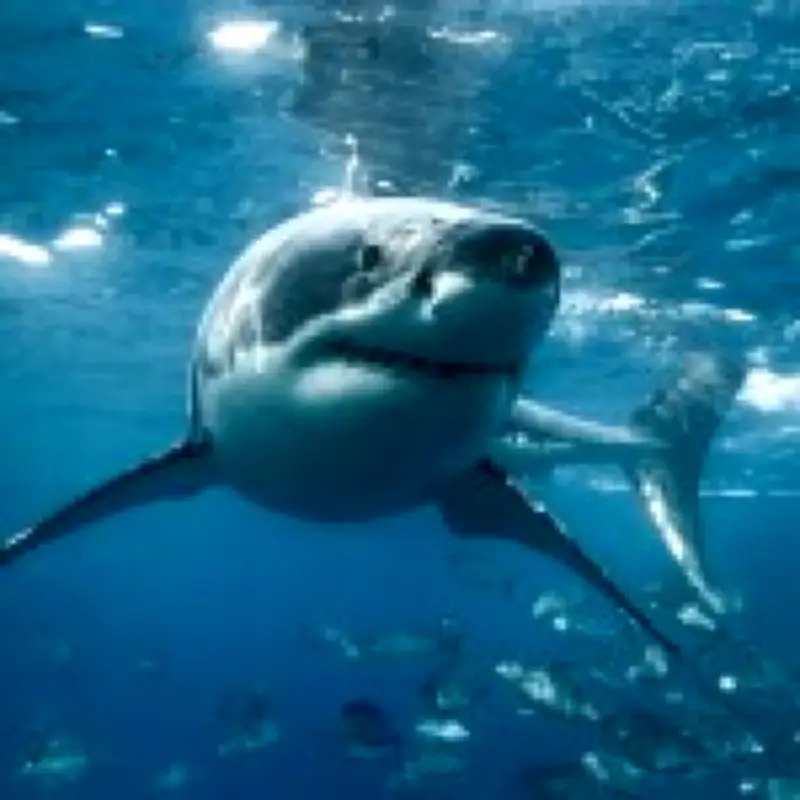
New research reveals that great white sharks are venturing further north than ever before, with experts suggesting they are 'already here' in UK waters. Two sharks tracked by scientists at OCEARCH have traveled towards the northern tip of Newfoundland, off the eastern coast of North America.
The discovery comes days after lifeguards in Jersey asked people to leave the water following a reported sighting of a large shark, reportedly between 10 and 12 feet, off St Ouen's Bay on August 1.
Sharks tracked heading north
Each summer, around 2,000 great whites are predicted to migrate from the North Atlantic to feed in Atlantic Canadian waters, attracted by plentiful food sources and protection efforts that scientists say are boosting numbers.
A nine-foot male great white named Quint has been moving north in the Strait of Belle Isle since July 26, while ten-foot female Bella was tracked in the area on June 29. Data scientist John Tyminiki says that while great white numbers dwindled between 1970 and 1990, this could be an example of the population 'rebuilding' and 'expanding their range'.
Climate change driving migration
However, the move is part of a wider trend of animals moving towards the poles, seeking preferred temperatures in the face of climate change. 'As the seas warm, things start to migrate,' says Tom 'The Blowfish' Hird, a marine scientist and shark expert. 'A shark who used to live at however many degrees of latitude can't stay there anymore because it's too hot. So they need to move somewhere typically cooler that's now increased to the temperature they like.'
The reason why great white sharks don't live permanently in UK seas has long been a mystery. The species looks for water between 12 and 24 degrees Celsius, while seas on the southern coast typically range from eight to 20 degrees. The UK also has a strong grey seal population, one of their main food sources.
Great whites 'already here'
However, 'just because we haven't seen them, doesn't mean they're not here already,' says a Shark Trust ambassador and presenter of All The Sharks on Netflix. 'We live on a very small island. It's easy for a great white to swim around in a matter of days. There's no requirement for them to stick in one area, which I believe is why they aren't usually spotted by scuba divers or picked up by fishing vessels. They're always on the move, and they have the biology to withstand our seas. The Mediterranean is just a spit and a cough away – certainly, if you're a shark, it's very close by.'
Tom says that from a nutrition perspective, it's not only seals that may attract great whites to UK waters. 'When they're younger, they feed on tuna, and there's lots of those on UK coasts. It's like humans stopping off at a service station. The visits are few and fleeting – they come in, they look, and they go – but we do have great whites in British waters.'
Future trends
Tom says that while right now UK coasts are at an optimal condition for great whites, as climate change worsens and sea temperatures increase, the odds of seeing a great white will fall as they eventually go even further north. 'It's going to be the Inuit and the Sami up in Norway that will start seeing great whites settling. We've seen untagged great whites swim from South Africa all the way to Australia so they can do massive migrations.'
Instead, Tom predicts that tropical species will start to migrate to UK waters, while the 20 native shark species will move on to look for cooler spots. 'Hammerheads might start moving in,' he says. 'They make these big open ocean migrations. Their big wide head allows for incredible GPS as they have these little sensory dots that allow them to detect the Earth's electromagnetic field, as well as the bioelectricity of life hiding under the sand. Our country sits on quite a shallow continental shelf; our seas are shallower, so these sensors would be really helpful for them in UK waters.'
Ecosystem impact
Though Tom would be excited to see more hammerheads in UK waters, it would be bad news for the ecosystem. 'When we talk about sharks accessing new areas, the phrasing sounds like it's good, like they are expanding. Actually, what's happening is they're being forced out of their true habitats into new ones. If a shark is being displaced from tropical to temperate, like hammerheads, and temperate species are being displaced to polar, like great whites, then the polar species have nowhere to go. It's like a bus – one person gets on, and everyone has to shuffle up. The person at the end is either squashed, or has to get off.'
Narwhals and walruses could be at risk in the Arctic, while icefish and leopard seals may be threatened in the Antarctic. 'We need to protect sea life,' says Tom.
'The biggest misconception is that sharks are out to kill you. That's not even close to true. Globally, each year, there's an average of 10 deaths due to sharks. To put that into perspective, nine people die a day sneezing while driving… just in America. When people need to be really, really worried is not when new sharks are coming in, but when there are no sharks. If we don't have healthy seas, we will not survive as a species. And for the sharks themselves, they've managed to withstand five major extinction events. Hopefully humankind won't be the sixth that actually gets them.'




