
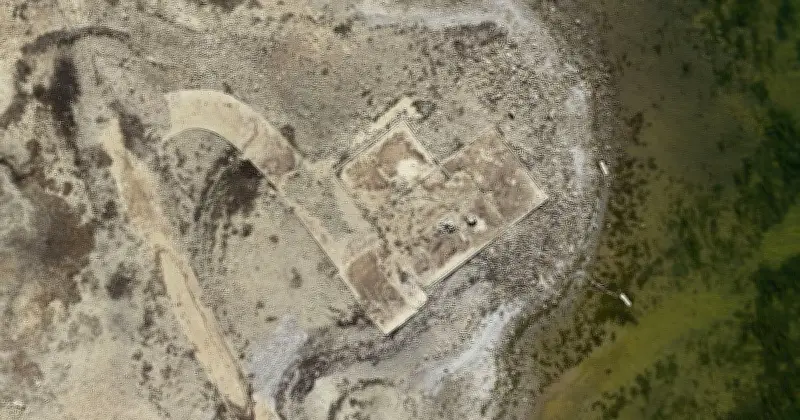
The remains of a lost village demolished and flooded to create a reservoir have been revealed by the record-breaking drought gripping England. Low water levels at Rutland Water in the East Midlands have uncovered the stonework of Nether Hambleton, a hamlet whose residents were relocated before the area was submerged in the 1970s.
Village demolished to create reservoir
Residents of Nether Hambleton and other small villages, including Middle Hambleton, were moved before the buildings were knocked down and the land flooded. More than 3,000 acres were submerged to create Rutland Water, one of the largest man-made bodies of water in western Europe.
Completed in 1976, the reservoir covers more than four square miles, with cottages, farms, and farmhouses all demolished to make way for it. At its maximum, Rutland Water is 34 metres deep, but falling water levels have exposed the stonework left behind.
Images show ghost village remains
Images of the ghost village show the outline of buildings, along with bricks and slabs of stone frozen in time. The Environment Agency (EA) said rainfall across the East Midlands has been below average for the past five consecutive months, with the spring and summer period the driest since 1995 and July the driest on record.
On Monday, the East Midlands, Lincolnshire and Northamptonshire, Kent and East Sussex, and Solent and the South Downs moved into drought status. An amber warning for extreme heat has been issued by the Met Office for Thursday, with temperatures in some parts of England expected to reach up to 38C.
Heat warning and drought outlook
The warning covers London, parts of the South East, East Midlands, East of England, West Midlands, and South Yorkshire from 9am to midnight on Thursday, with temperatures climbing to 37C or 38C in some places. The Met Office has also announced that the summer of 2026 is on course to be the UK’s warmest on record following weeks of high temperatures.
Tony Grayling, strategic drought lead at the EA and chairman of the National Drought Group, warned that “worsening” drought conditions are set to continue with significant rainfall.




