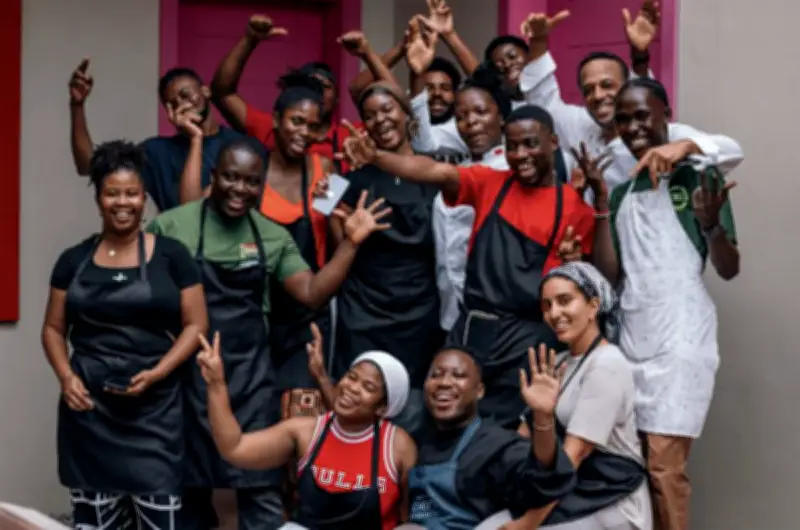
The Ghana Food Movement (GFM), a grassroots network founded in 2019, is championing nutritious, homegrown, climate-resilient produce over western imports, and this month won a Champions of Change title in the 50 Best Restaurants Awards.
From catering school to Indigenous food advocate
Abiro Wisdom, who graduated from catering school in Accra in 2019, found that his course focused on French, Italian and Mexican cuisine for international hotels, and did not feature the nutritious, homegrown food he had eaten while growing up in Bolgatanga, northern Ghana. “I didn’t see myself there,” he says of the big chain hotels. “I felt I wouldn’t be myself working there – I wouldn’t be able to talk about the food from where I come from.”
Instead, Wisdom joined the GFM, which was founded the year he graduated, and quickly became a champion for Indigenous foods. “We’re a community of food lovers, of believers in the potential of Ghanaian food,” he says.

Tackling Ghana’s broken food system
Ghana imports at least half of its food and is heavily influenced by foreign cuisine and ingredients, but Wisdom believes northern Ghana, the country’s agricultural heartland with its huge variety of nutritious and climate-resilient crops and vegetables, could be the secret to the country’s broken food system.
The GFM was initially a network of volunteers interested in food systems – chefs, farmers, entrepreneurs and experts in food security. In the early days they met in cafes and set up events in whatever space they could find to deliver three-course meals highlighting a single crop and the diverse ways it can be used. “[Traditionally] we make tigernut milk, but you can make so many different things, for example tigernut burgers and tigernut kebabs,” says Aimee Wallin, the group’s Malian-Swedish co-managing director. “We want people to taste what we are about, not just talk about what we are about.”
From pop-ups to school workshops
The group has been registered as a non-profit organisation for the past five years and now has its own kitchen where it brainstorms new recipes, many of them thought up by Wisdom. It runs monthly pop-ups and dine-and-dance nights, as well as panel discussions and recipe testing events for chefs and local businesses. “We might brainstorm ideas around a single food, such as moringa leaves, to show how it’s possible to sell – and make a profit from – dishes and drinks using Indigenous ingredients,” says Wisdom.
The GFM has started working with schools, helping children appreciate local ingredients. Wisdom hopes this multi-pronged approach will help instil more national pride in Ghanaian food. “My goal is that we have a generation of chefs who believe in Ghanaian food and its own identity,” he says. “I’ve come to understand how food contributes to politics, to the economy, how it contributes to self-identity. [Now I can] trace the impact of food on our society, on our land, to the sea, to the farmer, down to how the food gets to the market, then to our plates. As chefs, we have to be able to tell the story of the food.”
Postcolonial legacy and modern trends
Foreign, colonial influence has played a heavy role on African food systems, when ruling powers dictated land should be used for cash crops for export, such as cocoa or peanuts, at the expense of food for local consumption. At the same time, they put more value on imported ingredients such as rice, disrupting the sustainability of countries’ food systems. The impact has continued to modern times, making African countries heavily reliant on imports and vulnerable to price shocks when wars or other crises disrupt shipping.

But, as Wisdom discovered at university, there is also a lingering cultural influence, with western food still taught in culinary institutes and sought after in restaurants. “The narrative has always been that our practices are wrong and the west’s practices are right. It’s just super-stupid. Why would you do that when you can just grow your own food?” says Wallin. “Part of the postcolonial agenda is for us to still have to depend on other countries. If it’s not to buy their products, to buy their vegetables, then at least we need to buy their seeds and their pesticides and their fertilisers,” adds Wallin, who points out that many of the local ingredients they champion do not need extra agricultural inputs because they are adapted to the local environment. “The one who feeds us will control us and that’s how it is today. So, if we want to control ourselves, we also need to feed ourselves. It’s power. Taking back the power of our foods and using it to our advantage.”
For younger Ghanaians there is a new international pull towards heavily advertised trends and social media fads such as matcha lattes, bubble tea and smash burgers. Wallin says that also offers a culinary opportunity – to earn the interest of young people, by offering alternatives, replacing matcha with moringa lattes or making shawarma out of tigernut instead of meat.
Both Wallin and Wisdom believe that their movement has the urgent task of saving Ghana’s food heritage before knowledge is lost. “If we want to talk about what our future food system should look like,” says Wallin, “we need to talk to our grandmas, to our grandpas, to the farmers out in the communities because they sit on that knowledge. If we don’t talk to them now, it’s going to be too late. So it’s really now or never.”