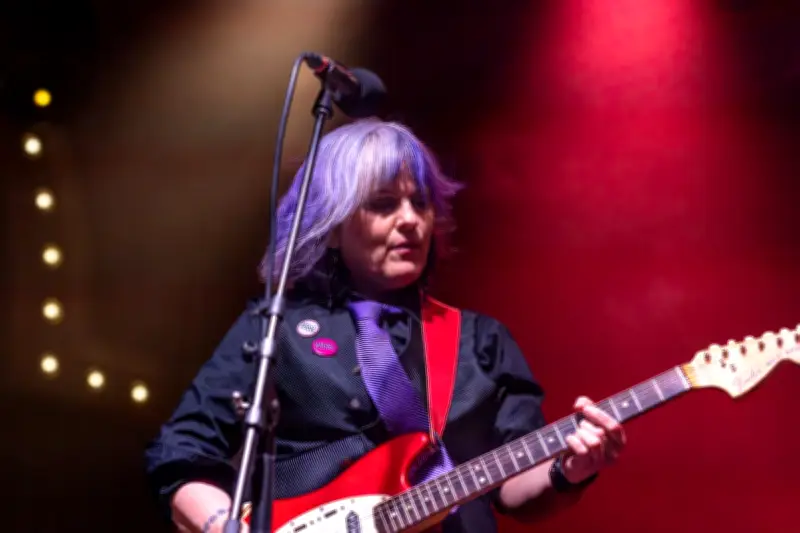
Menopunkapalooza, a music festival and resource fair, took place at McMenamins Crystal Ballroom in Portland, Oregon, in June 2026. The event began with the ceremonial application of an estrogen patch to the backside of drummer Teresa Esguerra and ended with riot grrrl pioneers Calamity Jane performing for the first time in 35 years. In between, 750 festivalgoers, a dozen pillars of the Pacific north-west punk scene, and medical professionals sang, laughed, and raged about menopause and hormone replacement therapy (HRT).
Punk Anthems and Hormonal Justice
The three-woman band Ménage àh Twats, dressed in glittery vagina costumes, performed a parody of Lorde's Royals with lyrics about night sweats, hot flashes, and dry skin. Gabalanch's Sara Lund and Rachel Blumberg played a chill drum-and-gong set, while Berzerk's Joanne Belesiotis performed in deer antlers. Teenagers and octogenarians cheered, “Hormones are healthcare!” A 10-point hormonal justice Bill of Rights was read aloud.
Founder's Mission
Alicia J Rose, 56, founder of Menopunkapalooza, hosts the podcast Menopunks and directs a documentary of the same name featuring Pat Benatar, Neko Case, Alice Bag, and Peaches. In a trailer, Bratmobile's Allison Wolfe says, “I didn’t know anything about menopause, including when I was going through it.” Peaches confesses, “It affected my confidence in my pussy.” Rose hopes to show the documentary at film festivals in 2027.
Riot Grrrl Roots
The festival drew on the riot grrrl feminist movement of the 1990s, which empowered young women to talk about sexism and abuse. Bands like L7, Sleater-Kinney, and Bikini Kill pioneered activism through music. Now, gen X rockers apply that defiant energy to menopause. “We were all around in riot grrrl and got to experience that wave of activism and community. That primed us for this. Now we’re all in menopause and we’re like, ‘What the F? This sucks,’” said Calamity Jane's Gilly Ann Hanner. “But we’re also like, ‘Well, no one’s going to do it for us. We got to fight.’”
Personal Struggles with Menopause
Rose began dealing with crippling fatigue and hot flashes three years ago, worrying she could not perform. “It went from decently shitty to holy-fucking-hell-my-life-is-over kind of shitty,” she told the audience. Hanner, 59, was caught off guard: “I was doing kung fu. I was jogging. I was just in the best shape of my life.” After Covid in 2021, she experienced a cascade of symptoms—joint pain, digestive issues, weakness—that doctors struggled to diagnose.
HRT and Misinformation
HRT is considered the most effective treatment for menopause symptoms, potentially reducing risks of heart disease, dementia, and osteoporosis. However, lingering misinformation stems from a 2002 Women's Health Initiative report linking HRT to increased cancer and cardiovascular risks. Follow-up research revealed flaws, but use of hormone therapy dropped from nearly 30% in 2002 to less than 5% by 2020, according to a 2024 study in Jama Health Forum. Dr Sara Kennedy, president of Planned Parenthood Columbia Willamette, noted that many doctors remain reluctant to prescribe HRT due to cancer fears.
Hanner eventually found a nurse practitioner who recommended HRT. “Isn’t that bad for you?” she asked. The nurse replied, “Well, yeah, that was the story, but new evidence has come to light, and quality of life benefits outweigh the risks.” Hanner's pain and stomach problems improved, and she regained energy to perform Calamity Jane anthems.
Medical Education Gaps
Despite over 1 million US women beginning menopause each year, it remains understudied. Kennedy said, “When I went through medical school in the early-, mid-2000s, I think I spent one hour learning about perimenopause, menopause care. One hour for a time of life that half the world will experience.” Her clinics now offer expanded training on HRT delivery systems.
Progress and Future
In November, the FDA rescinded 2003 guidance on HRT and removed black-box warnings. Legislation in multiple states and Congress aims to expand insurance coverage, workplace accommodations, and medical education for menopause. Pop culture has also addressed the topic in shows like BBC's Riot Women and the essay collection The Big M. Rose, Hanner, and the Menopunks hope other cities host similar events. “I think musicians see other people performing [again] and go, ‘OK, I’m not too old,’” said Hanner. “I mean, maybe I am, but who cares? I’m just going to play anyway.”