
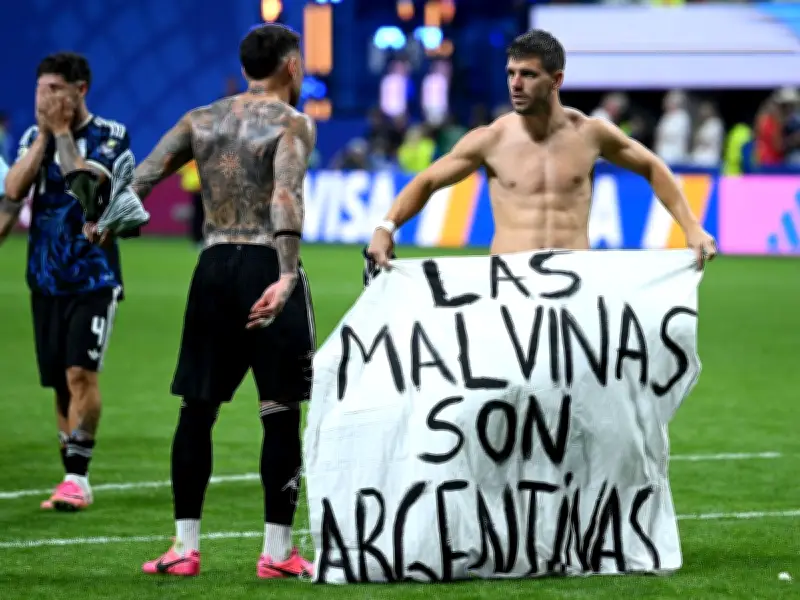
The Falkland Islands Government has formally called on FIFA to take disciplinary action against the Argentine national football team for displaying a political banner after their 2-1 World Cup semi-final victory over England on Wednesday evening. The banner, which read 'Las Malvinas son Argentinas' (The Falklands are Argentinian), was paraded by players following the match, reigniting a long-standing sovereignty dispute over the South Atlantic archipelago.
Background of the Dispute
Great Britain established control of the Falkland Islands in 1833, but Argentina has continuously claimed sovereignty. In 1982, Argentina invaded the territory, prompting then-Prime Minister Margaret Thatcher to dispatch over 100 warships in a counter-offensive. The ensuing 74-day conflict resulted in the deaths of 649 Argentine military personnel, 255 British armed forces, and three Falkland civilians, with the UK successfully defending the islands. Argentina has never relinquished its claim.
FIFA's regulations explicitly prohibit political statements in football, stating: 'For any offence the player and/or the team will be sanctioned by the competition organiser, national football association or by FIFA.' The Falkland Islands Government is now urging FIFA to uphold these rules.
Official Statement from the Falkland Islands Government
In an official statement to Mirror Football, the Falkland Islands Government expressed disappointment, saying: 'The Falkland Islands Government is disappointed - though regrettably not surprised - that the Argentine football team decided to tarnish the result of last night's World Cup football semi-final - a game that did not in any case involve the Falkland Islands.'
The statement continued: 'That said, it is hardly news to anyone that the people of the Islands were victims of an aggressive invasion in 1982, which left many traumatised. The banner displayed by Argentina last night, therefore, was particularly insensitive for many people in the Falklands.'
It added: 'It is the avowed policy of the Falkland Islands Government that we do not wish to see politics being brought into sport. Nor do we wish the Islands and their people to be used as a political football in every conversation about England and Argentina. We welcome the UK Government's supportive statement this morning. As Business Secretary Peter Kyle highlighted, the World Cup has as one of its central tenets that politics is separate from football. We hope FIFA will make good on their promise to keep politics out of sport, and sanction all behaviour of this nature in line with its own rules.'
UK Government Response
Business Secretary Peter Kyle also called for FIFA to act, stating: 'My reaction is that it was entirely inappropriate. Politics needs to be separate from football. In fact, the World Cup has one of its central tenets that politics is separate from football. That is now a matter for FIFA. I expect FIFA to do its investigation thoroughly.' He added: 'I think it was certain to happen because it was such an egregious violation of the rules of not having political activity as part of the football.'
FIFA's Stance
FIFA has acknowledged the incident, with a spokesperson saying: 'As is standard procedure, FIFA's independent disciplinary committee is currently assessing the match reports and considering the relevant circumstances before deciding on potential further steps based on the FIFA disciplinary code.' Any potential sanction is unlikely to be imposed before Sunday's World Cup final between Spain and Argentina at the MetLife Stadium, which kicks off at 8pm BST.
The incident has drawn widespread attention, highlighting the intersection of sport and politics. The Falkland Islands Government's call for action underscores the sensitivity of the issue, particularly for the island's residents who still bear the trauma of the 1982 invasion.




