Climate Change Could Determine Your Child's Sex, Oxford Study Reveals
Scientists from the University of Oxford have uncovered compelling new evidence that climate change may directly influence the sex of unborn children. Their groundbreaking research, published recently, demonstrates that higher environmental temperatures can significantly alter sex ratios at birth across different populations.
Massive Study Across Two Continents
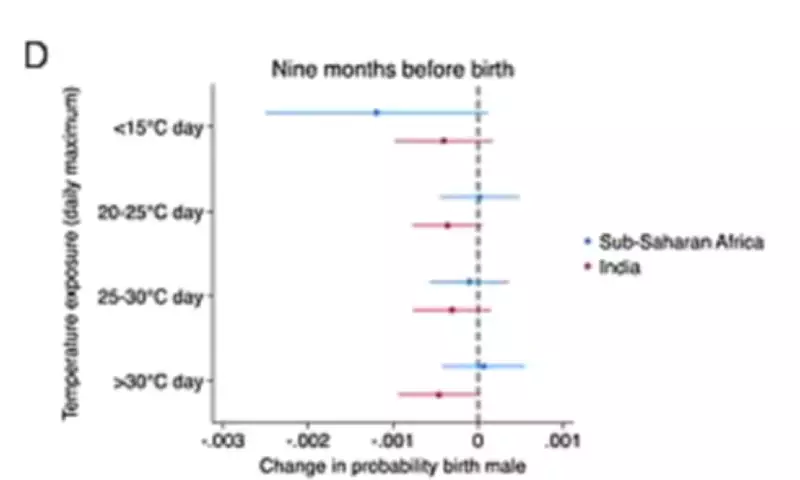
The Oxford research team conducted an extensive analysis of more than five million births across 33 sub-Saharan African countries and India. Their findings revealed a consistent pattern: temperatures exceeding 20°C were associated with increased numbers of female births in both regions. This discovery suggests that rising global temperatures could have profound implications for human reproduction and population dynamics worldwide.
Dr. Abdel Ghany, the study's lead author, emphasized the significance of these findings. 'Extreme heat represents not merely a public health concern but a fundamental influence on human reproduction,' he stated. 'Our research demonstrates that temperature shapes who is born and who is not born, with measurable consequences for fetal survival, family planning behaviors, and ultimately population composition and gender balance.'

Different Mechanisms in Different Regions
Interestingly, the study revealed that while the outcome was similar—fewer male births in warmer conditions—the biological mechanisms differed between regions. In sub-Saharan Africa, the decline in male births was primarily linked to prenatal mortality resulting from maternal heat stress during pregnancy. The extreme temperatures appeared to affect fetal survival rates differently based on sex.
In India, however, the effects manifested differently. 'Higher temperatures during the second trimester correlate with reduced male births,' the researchers explained, 'particularly among older mothers, high-parity births, and women without sons in northern states.' This suggests cultural and behavioral factors may interact with biological responses to temperature in complex ways.
Understanding Global Sex Ratios
The human sex ratio—typically measured as males per 100 females—naturally favors males slightly, with approximately 101 to 102 males for every 100 females globally. However, this balance faces multiple pressures, including cultural preferences for sons and now, according to this research, environmental factors.
'Sex ratios reflect underlying patterns of maternal health, prenatal survival, and in some contexts, gender discrimination,' the research team noted. 'In recent decades, skewed sex ratios have raised concerns in several regions, particularly where son preference and sex-selective abortion are prevalent.'
Broader Implications for a Warming World
The Oxford researchers concluded that their findings demonstrate 'a sex-specific response to temperature before birth driven by both biological and behavioral responses that lead to substantial impacts on reproduction and population composition.' Understanding these processes becomes increasingly crucial as global temperatures continue to rise.
Dr. Ghany emphasized the importance of this research for anticipating environmental impacts on societies: 'Understanding these processes is essential for anticipating how the environment affects societies in a warming climate.'
Parallel Research on Male Fertility
In related research, scientists from the University of Manchester have discovered seasonal patterns in male fertility that appear consistent across different climates. Their study of over 15,500 men in Denmark and Florida—two countries with dramatically different climates—found that sperm quality peaks during summer months and declines in winter, regardless of local temperature patterns.
Professor Allan Pacey, co-author of the fertility study, expressed surprise at the consistency: 'We were struck by how similar the seasonal pattern was in two completely different climates. Even in Florida, where temperatures remain warm year-round, sperm motility still peaked in summer and dipped in winter.' This suggests factors beyond ambient temperature alone influence reproductive outcomes.

The Natural Balance of Birth Sexes
Nature maintains a slight bias toward male births, with approximately 105 males born for every 100 females—a ratio that has long intrigued population scientists. Prevailing theories suggest this imbalance helps compensate for women's generally longer lifespans. In the United Kingdom, for instance, newborn boys can expect to live 79.2 years compared to 82.9 years for newborn girls, with women outnumbering men four-to-one among centenarians.
Modern societal pressures have sometimes exacerbated this natural imbalance, particularly in regions with strong cultural preferences for sons. China's former one-child policy, combined with parental desires for male children, created ratios as skewed as 118 males per 100 females in some areas. The Oxford research now adds climate change to the factors potentially influencing these fundamental population dynamics.