
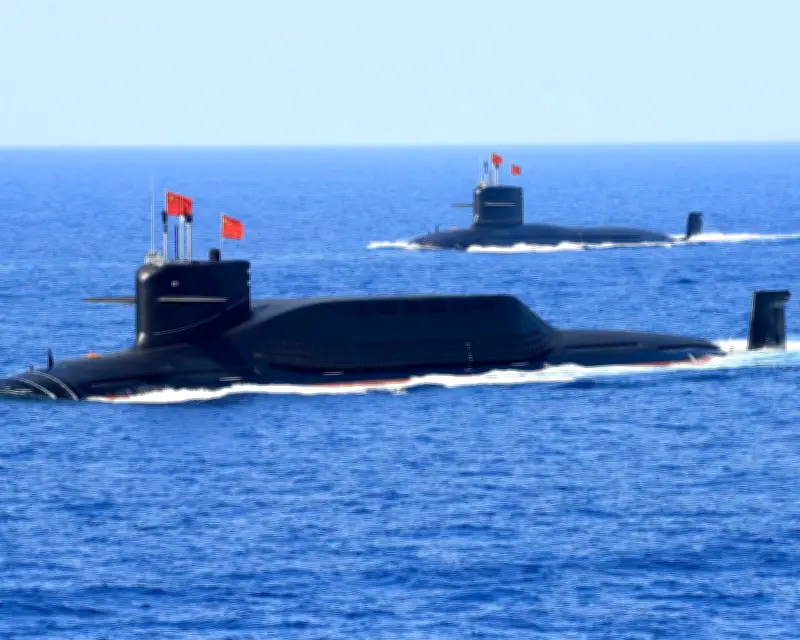
On Monday at 12.01pm, a People's Liberation Army Navy submarine test-fired a ballistic missile into the South Pacific nuclear-free zone. This marks the second Chinese ballistic missile test in the Pacific in two years.
Timing Raises Eyebrows
The test occurred on the same day Fiji became Australia's fourth formal treaty ally, after the US, New Zealand and Papua New Guinea, by signing the Ocean of Peace Alliance pact. David Vallance, a research associate at the Lowy Institute's international security program, described the timing as 'provocation at best, coercion at worst.'
Vallance noted that while the test was likely planned well in advance, the signing of the treaty may have caused China to move it up the timetable. China informed regional countries, including Australia and New Zealand, of the test but only hours beforehand, which Vallance said followed 'the letter of the law, but hardly its spirit.'
Details of the Missile
According to reports, the missile was a JL-3 submarine-launched ballistic missile (SLBM). This missile has a range of about 10,000km and can be armed with multiple warheads, each capable of carrying a nuclear payload and striking different targets. 'It is possible it was fired from a nuclear-powered ballistic missile submarine in the South China Sea,' Vallance wrote.
China operates six such submarines, and its Bohai shipyards can potentially build up to six per year. Images from Shanghai suggest a second shipyard has begun constructing nuclear-powered submarines.
Broader Military Posture
Vallance linked the test to other Chinese military activities, including a naval task group's circumnavigation of Australia last year with live-fire exercises and harassment of Australian patrol aircraft, helicopters and naval personnel. He argued this demonstrates China's increasing willingness to use military force to coerce states across the Indo-Pacific to adopt policies favorable to Beijing.
Since Mao Zedong's era, the PLA has carried out 'weishe' (coercion). Under Xi Jinping, this strategy has become more expansive, aimed at preserving Beijing's 'period of strategic opportunities' and actively shaping the region. 'This test is the latest evidence that China will resort to more overt shows of force as part of this strategy,' Vallance added.
Pacific nations, including Australia, have voiced their commitment to the Pacific as an ocean of peace. Vallance questioned whether China prefers 'pieces of shrapnel in the ocean.'




