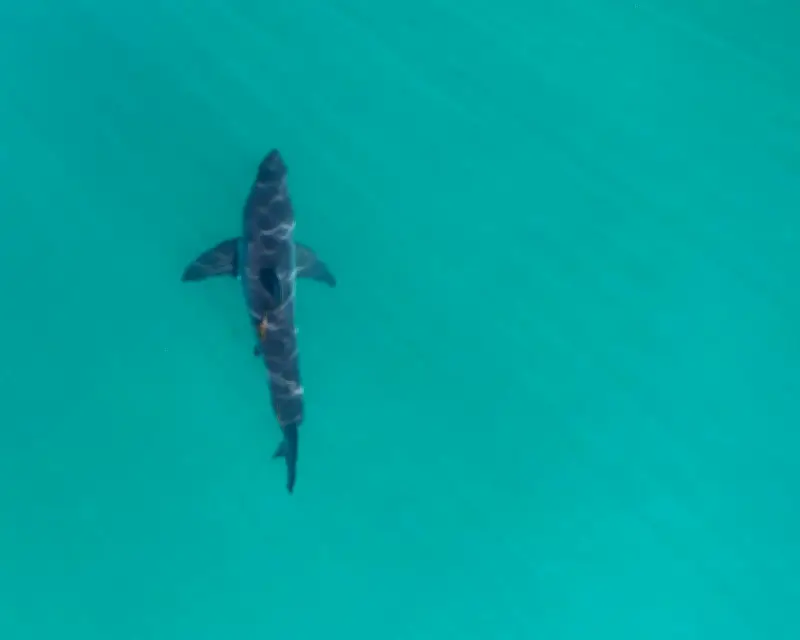
Juvenile white sharks are appearing along the California coastline in large numbers, fleeing warmer-than-usual waters in Mexico during what is expected to be an incredibly strong El Niño. This could make it the sharkiest summer in California in a decade, according to shark experts. However, they say beachgoers should not be overly alarmed, as the apex predators have learned over generations that humans are not prey.
Shark Behavior and Human Safety
Dr. Chris Lowe, director of the Shark Lab at California State University Long Beach, explained that humans do not resemble prey to white sharks. "Humans don't look like prey, they don't sound like prey," he said. "If it doesn't feel like prey, they ignore it. It's not a threat, it's not food." Lowe has spent 20 years monitoring white sharks using drones and tracking data. In 2015, the last time El Niño conditions were this strong, his team observed twice as many white sharks along the California coast than usual, with a shark nursery established near Monterey Bay.
Juvenile white sharks, between 6 and 9 feet in length, regularly migrate from Baja California in Mexico up the California coastline, staying close to shore to feed on fish, rays, and squid before venturing into deeper waters. Despite their increased presence, shark incidents remain exceedingly rare in the state. According to data from the California Department of Fish and Wildlife, there have been only 250 shark incidents since 1950, with just 17 fatalities. The number of deadly shark bites has remained stable at about 2.5 per decade.

Research on Shark Responses
Researchers at Lowe's lab tested white shark behavior around water-goers. They recorded audio of surfers, swimmers, and kayakers in the ocean and played it back to sharks at aggregation sites. The sharks showed little interest in the sounds of surfers or kayakers but responded to the sounds of a swimmer, possibly due to the dual sound of slapping arms and kicking feet. The sharks would investigate, get about 10 feet from a swimmer, and then leave. "Our conclusion is we think sharks can actually tell the difference between people, and because we don't smell like food, sound like food, look like food, they don't consider us food," Lowe said.
Comparison with Other Regions
In Florida, the shark bite capital of the world, reef sharks like blacktips are far more common. In 2025, Florida saw 11 incidents of unprovoked bites, 44% of the total in the US. Australia has seen a spate of shark bites, including fatalities, linked to bull sharks and white sharks, with climatic factors like warmer ocean temperatures bringing bull sharks closer to Sydney. Gavin Naylor, director of the Florida Program for Shark Research at the University of Florida, emphasized that species differences matter: "A white shark is about as different from a blacktip shark as a kangaroo is from a dog. You cannot compare bites in California with bites in Florida."
Even in shark havens like Florida, bites remain rare given the number of beachgoers. Naylor noted, "If sharks really did target people we'd have about 10,000 bites in the US alone. Humans are like little plump sausages, they're very easy to eat. It'd be a smorgasbord. What that tells you, the sharks are actually doing their level best to avoid people."
Safety Advice and Expert Perspective
Lowe acknowledged that limited science exists on why sharks sometimes bite, with mistaken identity being the leading theory for unprovoked attacks. In California, where bites are rarer, he hypothesized that white sharks may learn quickly even if they do bite. "Maybe the sharks that mistakenly bite people haven't been around people much, or maybe they don't make mistakes very often," he said. Two decades ago, Lowe advised that any shark bigger than a person could be a threat. Now, after years of drone data showing sharks getting curious but turning away, he swims with white sharks daily without qualms. "Flash forward 20 years … I swim with these white sharks every day and I have no qualms doing it because of the data that we collected."