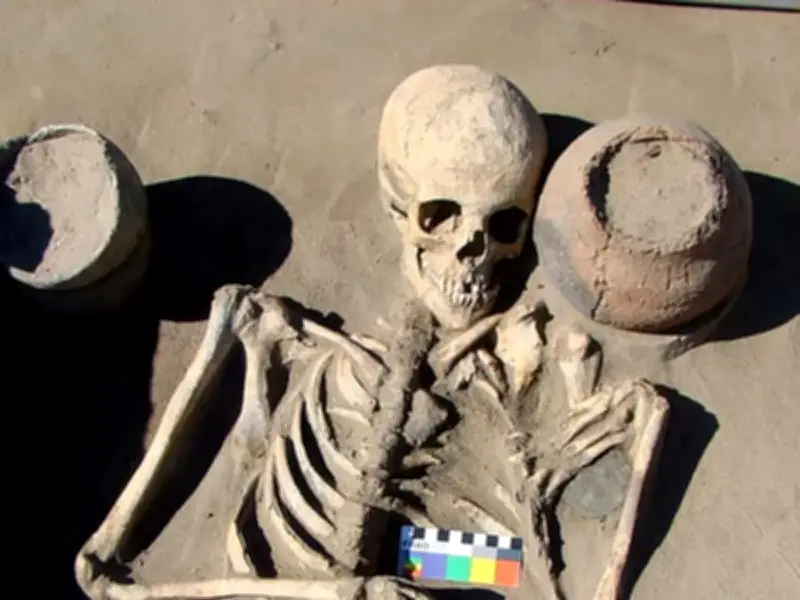
A 2,137-year-old woman buried with an object resembling an iPhone has been unearthed in Russia's so-called 'Atlantis' necropolis. The discovery was made at the Ala-Tey burial site, which is normally submerged under a reservoir near the Sayano-Shushenskaya Dam, Russia's largest power plant.
Discovery of 'Natasha's iPhone'
The woman, nicknamed 'Natasha' by archaeologists, was found holding a black gemstone buckle that looks strikingly like a modern smartphone. The buckle, made of jet (a type of black rock), features inlays of turquoise and red semi-precious stones and measures approximately 7 by 3.5 inches. It is believed to have been worn as a belt accessory.
Dr. Pavel Leus, who led the team of archaeologists in 2019, stated: "Natasha's burial with a Hunnu-era (Xiongnu) iPhone remains one of the most interesting at this burial site. Hers was the only belt decorated with Chinese wuzhu coins, which helped us to date it."
Historical Context and Dating
The woman lived during the Hunnu era (also known as Xiongnu) in rural southern Russia. Radiocarbon dating of the grave contents places her burial between 92 B.C. and A.D. 71. Similar jet buckles were found in three nearby graves, indicating a possible cultural trend among the Hunnu people.
The buckle had holes on its short sides: two round holes on one side for attaching to a belt and one oval hole on the other side, likely for clasping. This design suggests it was functional as well as decorative.
The 'Russian Atlantis' Necropolis
The Ala-Tey necropolis is part of the Tuva region, a mountainous area known for its natural beauty and frequent visits by Russian President Vladimir Putin. The site is often referred to as Russia's 'Atlantis' because it is submerged under the reservoir for most of the year, only accessible during dry periods.
Dr. Marina Kilunovskaya from the St. Petersburg Institute of Material History Culture, who leads the Tuva Archeological Expedition, described the find as "a scientific sensation. We are incredibly lucky to have found these burials of rich Hun nomads that were not disturbed by (ancient) grave robbers."
Other Discoveries and Preservation Challenges
The area contains graves from prehistoric civilizations dating from the Bronze Age to the time of Genghis Khan. In 2019, two more partly-mummified prehistoric individuals were unearthed, buried with tools of their trade. Scientists are racing against time to examine these sites and preserve priceless treasures from water damage caused by the reservoir.
The 'iPhone' buckle, initially mistaken for a modern device, has provided valuable insights into the craftsmanship and trade networks of the Hunnu people, who used Chinese coins for dating and decoration.