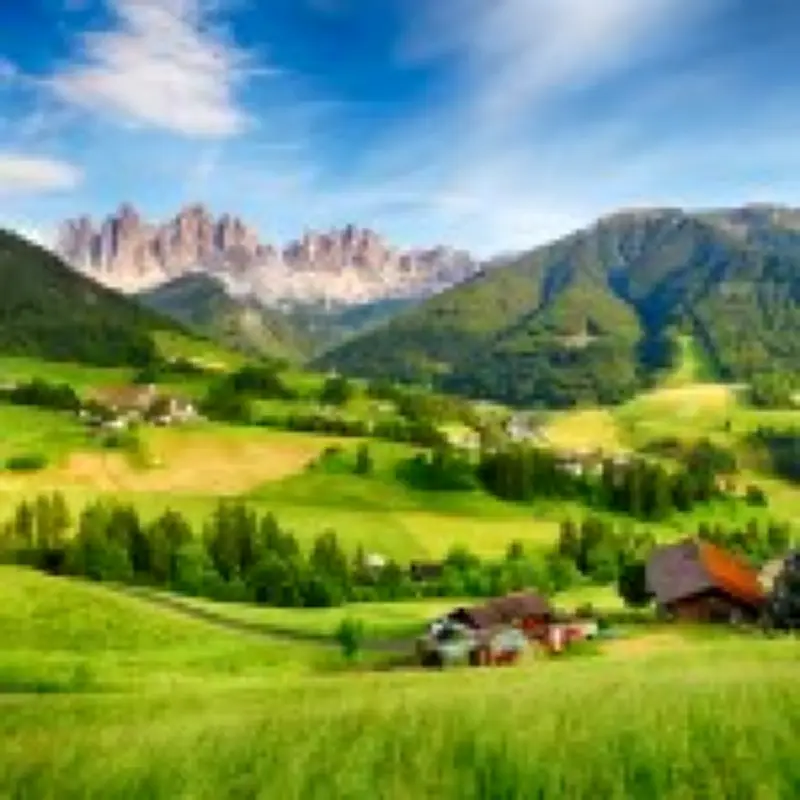
The Wolf Trail, a new 3,494km hiking route spanning six European countries, takes between four and six months to complete. The trail stretches across Poland, Germany, Austria, Switzerland, Slovenia and Italy, covering diverse landscapes from Baltic dunes to the Dolomites. The elevation gain is equivalent to ten times the height of Mount Everest.
What is the Wolf Trail?
The Wolf Trail was created by outdoor brand Jack Wolfskin, designed to 'show Europe in all its facets.' It is split into seven continuous stages from north to south, with each representing a unique part of the continent. The trail gives the option to join at different stages, so there is no pressure to complete the whole thing.
The Wolf Trail route, from Poland to Italy
1. Baltic start — 428 km
The route starts on Poland's Hel Peninsula, a 35km long sand spit in the north of the country. The area separates the Baltic Sea from the Bay of Puck's calm, shallow waters, and is renowned for its ancient pine forests and powdery sand beaches. This section takes you through the dunes in Słowiński National Park and heads towards Świnoujście on the Polish-German border.
2. Rivers and plains — 543 km
From Świnoujście, you'll make your way across the Usedom islands, which are divided between Germany and Poland. The Baltic Sea island has been dubbed 'Berlin's Bathtub' due to its close proximity to the German capital. Elsewhere, you'll cross Germany's Mecklenburg coast and the Elbe Valley in Saxony.
3. The green heart — 480 km
Next up is Lüneburg Heath, a nature reserve in Germany's Lower Saxony region. Here, you'll swap the Baltic coast for woodland, complete with purple heath and rolling countryside.
4. Forests and wine — 572 km
Moving through Germany into the Rothaar Mountains, stop here for glacial lakes and dense forests. Then drop down into the Palatinate wine regions, Germany's second-largest wine-growing region, and through to Soonwald hills.
5. High watch — 573 km
Before making your way into Switzerland, there's Germany's Black Forest. This area is as famous for Black Forest cake as it is for being the inspiration behind Brothers Grimm fairy tales. Head to Lake Constance, where Germany, Switzerland, and Austria meet, passing the Triberg Waterfalls and Freiburg.
6. Alpine Gateway — 373 km
You'll find yourself in the Allgäu Alps on the Germany–Austria border. The trail weaves through Innsbruck, the capital of the Austrian state of Tyrol. Take a day off to explore the city or ride the Nordkette Cable Car for views 2,300 metres above the city.
7. Alpine Crossing — 558 km
The 'most demanding' leg of the journey goes through the Italian Dolomites and Slovenia's Julian Alps. Italy's mountain range boasts sheer limestone walls and high alpine meadows, while Slovenia's features glacial lakes and emerald valleys.
When is the best time to complete the Wolf Trail?
Due to different weather conditions, it is recommended that travellers complete the trail between April and September. This is mostly because winter snow will have melted in the Alps, and before heavier blizzards set in come autumn.
The rise of 'thru-hiking'
Thru-hiking is a more extreme version of hiking that can last weeks or months. Hikers often map out their own version of a route, planning scheduled stops in nearby towns for groceries. Thru-hiking has boomed in popularity in recent years, thanks to social media content from TikTok and Instagram. For example, permits for the Pacific Crest Trail more than doubled between 2013 and 2016. The Appalachian Trail has recently recorded 16.9 million visits.
On Pinterest, searches for adventure tourism have surged by 75%, while trekking and mountaineering have seen a 69% rise year-on-year. The Adventure Travel Trade Association (ATTA) estimates the European adventure travel market is now worth approximately £345 billion.