A Changing Landscape for New Zealand's Backbone
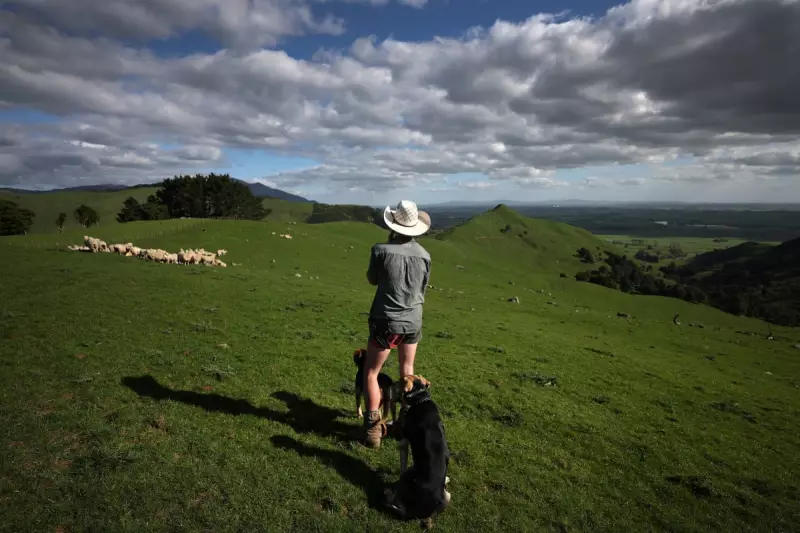
On a farm south of Auckland, Cam Clayton, 30, works with his trained dogs, breeding sheep and cattle. He surveys the knobbly hills and tree-filled gullies of Waikato, a stone's throw from where he was raised. "I have the best office, with the best views," Clayton remarks, a sentiment that belies the significant challenges simmering beneath the surface of New Zealand's iconic pastoral scenes.
The Startling Data Behind the Decline
Clayton is part of a sector in profound flux. Official data reveals a stark trend: the number of farms in New Zealand has been in steady decline, plummeting from 70,336 in 2002 to just 47,250 twenty years later. This represents a dramatic drop of 33%. Furthermore, the total land area dedicated to farming has also contracted, shrinking by 15% over the same period.
This is a major shift for a nation historically built on agriculture, where dairy, meat, kiwifruit, and apples remain cornerstone exports. While the total number of farms has fallen, a consolidation has occurred, with some operations expanding from small holdings into large-scale businesses. In a sign of the times, New Zealand's farmer-owned dairy co-operative, Fonterra, recently sold its consumer businesses to French dairy giant Lactalis for nearly NZ$4bn (approximately $2.3bn).

The Impossible Dream for the Next Generation
Despite record prices for dairy, the traditional pathway to farm ownership is becoming an impossible dream for young farmers like Clayton. The old model, where a young farmer would manage someone else's land for a share of the profits while saving to buy their own, is crumbling under the weight of soaring land prices.
"Someone buys the neighbour’s farm, then the next neighbour, suddenly you have a portfolio of five farms and Joe Bloggs the young farmer can’t buy a 150-cow farm to get started," explains Clayton, who currently leases the land he works. "You have to be really passionate and in it for the long haul."
This sentiment is echoed by Cheyne Gilooly, chief executive of the 98-year-old Young Farmers club. "The big challenge at the moment is helping people finance their way into farm or land ownership as land gets more expensive," Gilooly states, noting that fewer and fewer of their members under 31 own the farms they work on.
Take Cam Lowery, 27, and his partner Poppy Mitchell, 25. They are one year into a lease on a farm owned by Lowery's parents near Milton, south of Dunedin. Their operation includes 2,700 sheep, alongside cows, calves, and hoggets. After university and working as a shepherd across the South Island, Lowery saw no viable route to ownership. "I just couldn’t see a way into farm ownership through shepherding," he admits. Government-supported savings schemes like Kiwisaver can be used for a first home, but not to purchase a farm, making it "hard to build equity off-farm."
For now, the familial arrangement provides stability. Mitchell works as a physiotherapist in Dunedin during the week, while Lowery manages the farm, with days stretching from 7 am to 7 pm. Mitchell helps on weekends, noting that while the work is hard, it feels worth doing.
Back in Waikato, Clayton's life is a patchwork of agricultural jobs. He assists on his parents' dairy farm, manages a 600-hectare (1,480-acre) block, and breeds and sells his own livestock. His work is varied, "just hopping around farms," which could involve milking one day and mustering ewes or inseminating cows the next.
His skill was recently recognised as a finalist in the Bay of Plenty-Waikato Young Farmer of the Year contest, where he will now compete in challenges ranging from identifying horse tack to grading wool and demonstrating his communication with dogs. The contest, with its written tests on plant varieties and legislation, covers a "broad spectrum, looking at all things rural."

The long-term goal for Clayton and his partner, Emma, is to own their own farm. He acknowledges there is much to learn but loves the land's variety. "I can’t get out of bed fast enough to see what challenges the day will throw at me," he says, a testament to the enduring passion that persists even as the economic foundations of New Zealand farming undergo a seismic shift.