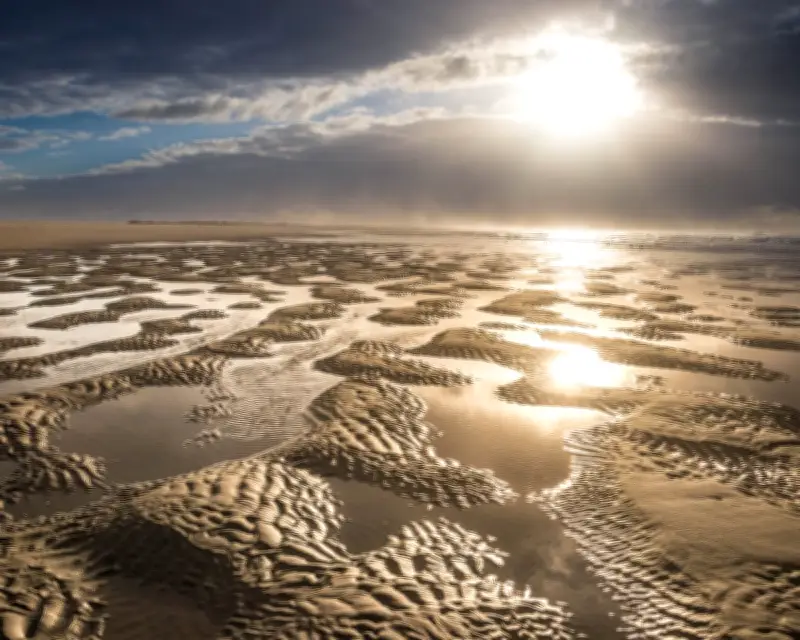
The seven inhabited East Frisian islands in Germany—Borkum, Juist, Baltrum, Langeoog, Spiekeroog, Wangerooge and Norderney—stretch more than 50 miles along the North Sea coast. They are part of the Wadden Sea Unesco world heritage site and the Lower Saxon Wadden Sea national park, established in 1986. Known for vast sandy beaches, grassy dunes and tidal mudflats, each island has its own character, from upmarket Juist with horse-drawn transport to the historic red brick houses of Spiekeroog.
Norderney: historic resort and modern dining
Norderney was one of the first German North Sea seaside resorts. It features historic seaside villas alongside modern hotels and restaurants such as Inselloft Norderney and Michelin-recommended Oktopussy, where summer scallops come with caramelised miso-cauliflower purée. A favourite spot is Marienhöhe, a dune-top pavilion built over 100 years ago, serving delicately battered fish with warm potato salad. Despite being one of only two islands where cars are permitted, the best way to explore is by bike.
Bike lanes run through the dunes, passing the popular Weiße Düne beach and a lighthouse built between 1872 and 1874. Roughly halfway across the island, a sign marks a Ruhezone (quiet zone), a highly protected area where visitors can only walk on marked footpaths. A rusty shipwreck lies on the sand, and seals bask in the sun at the far end.
Mudflat hikes and guided tours
Strict rules govern access in several sections to let nature thrive. Official guides lead Wattwanderungen (mudflat hikes), salt marsh walks, birding excursions and boat trips to see seals. The newly renovated visitor centre at Norderney harbour provides extensive information about local ecosystems. During a mudflat walk, guide Andrea Wellmeyer pointed out the crackling sound of mud shrimp, known as Wattknistern, and showed sand mason worm casings, marsh samphire, wild oysters and a crab.
Orange-beaked oystercatchers scurried on the exposed seabed, and spoonbills waded in shallow water. The mudflats are home to tens of thousands of mud shrimp and other creatures.
Birdlife on Langeoog and Spiekeroog
Spiekeroog and Langeoog are car-free islands east of Norderney. On Langeoog, national park guide Fiona Wettstein explained that many bird species need the Wadden Sea as a resting place during migration. “When they first arrive, they have completely burned through their fat reserves and practically drop down here,” she said. More than 10 million birds stop in the Wadden Sea every year, with spring and autumn the best times to see them. Species include red knots, redshanks, avocets, sandpipers, lapwings and short-eared owls. Geese with fluffy chicks strut around, hissing if approached too closely.
The shoulder season is recommended to avoid summer holiday crowds. On Langeoog, the design hotel Silt & Sand opened last year behind the dunes, offering access to an almost 9-mile-long beach dotted with Strandkörbe, traditional hooded wicker armchairs.
Getting around the islands
It is not possible to hop directly between islands; visitors must return to the mainland and use different ferry terminals, except for Juist and Norderney, which share a departure point in Norddeich. Walking from the mainland to some islands at low tide is possible only with a certified guide.
The weather on the islands is changeable, with dark skies moving quickly. The wind is constant, churning the sea and bending trees. As guide Andrea Wellmeyer said, “This connection to the elements is part of the experience. Your entire system is challenged and pushed out of its comfort zone, something that doesn’t happen so often these days.”