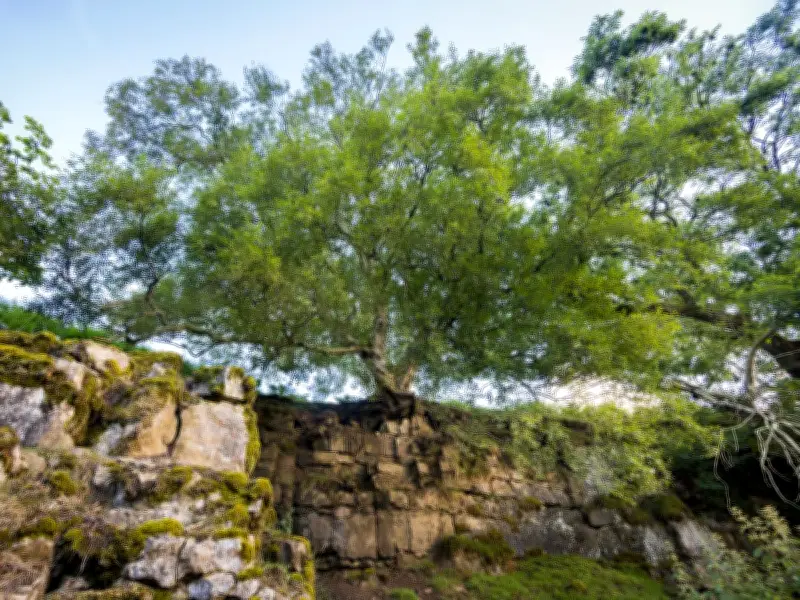
The Bollihope Burn Birch tree in County Durham has been shortlisted for this year's Tree of the Year award, recognizing 10 of the UK's toughest trees that are surviving against all odds. The downy birch, perched precariously off a cliff near Stanhope in an area once dominated by industry, quarries, lime kilns, mines and a goods railway, is among the contenders.
Public voting opens for Woodland Trust competition
Public voting opened on Wednesday for the Woodland Trust's annual competition, which aims to celebrate and raise awareness for rare, ancient or at-risk trees across the country. An oak tree in Rutland that survived a crash from a Second World War bomber and a yew in East Sussex that could be 4,000 years old and was hit by a cannonball in the English Civil War are among the final 10 contenders.
The trees have been chosen to highlight nature's great survivors in line with this year's theme 'against all odds'. A panel of experts selected eight trees of differing ages and species, while the public chose two as wildcard entries.
How to vote and what happens next
The public can vote for their favourite tree until late September via the Woodland Trust website. The winner will be announced in early October and will go on to represent the UK in the European Tree of the Year finals.
Actor and nature podcaster David Oakes, a Woodland Trust ambassador, said: 'Most things survive by fleeing. A tree, rooted for life to a single patch of ground, doesn't get that option. So trees have perfected the opposite: the art of weathering whatever arrives. But a few are frankly show-offs. The 10 nominees for Tree of the Year have all defied the odds in extraordinary ways, from clinging to cliffs and church towers, to enduring collisions and cannonballs.'
May Chemais, who runs the Ancient Tree Inventory at the Woodland Trust, said: 'Trees can be both tough and flexible, as the shortlist proves. We hope people will enjoy discovering all the incredible stories of resilience behind our nominees this year.'
Why the Bollihope Burn Birch is on the shortlist
The Woodland Trust says: 'Clinging to a cliff face above the Bollihope Burn, this tree overlooks a picturesque spot in the Weardale Area of Outstanding Natural Beauty. It's easy to see why the lush landscape, filled with the sound of birdsong and tinkling water, is popular with walkers. But this area was once dominated by industry, dotted with numerous quarries, lime kilns, mines and a goods railway. This ancient downy birch has stood through it all. Perched precariously on the rock's edge, its twisted trunk, far-reaching branches and sprawling roots give the impression the tree has almost walked, inch by inch over the years, to find purchase and save itself from the sheer drop.'
Other trees on the shortlist
One is the 'Bendy Tree' in Newcastle, Northern Ireland – a much-loved wych elm along the town's seaside promenade that grows almost horizontally after withstanding more than a century of harsh coastal conditions. The 'Bomber Oak' in Rutland features a slight dip in the top of the canopy as well as twisted misshapen branches after being hit by a Lancaster Bomber during the Second World War, and was nearly lost when a water company sought to install pipes in a field decades later.
Another shortlisted tree – the Crowhurst Yew in East Sussex – survived a direct hit from a Civil War cannonball that villagers later discovered in 1820. A different yew in Devon is up for contention because of its location after growing at the top of the church tower overlooking Culmstock Village for some 200 years.
The 'Earlstoun Lightning Oak' in Dumfries and Galloway survived a lightning strike, while the Wales Coast Path Oak in Ceredigion has lived through years of grazing and extreme weather while offering shade and shelter to walkers on the long-distance route. The 'Preston Twin' in Brighton – likely the world's oldest English elm – has lived four centuries despite the threat of Dutch elm disease, which killed another specimen of the same age that stood nearby.
One wildcard selected by the public is the Balloch Castle ash, standing on the lawn of the semi-derelict castle by Loch Lomond, which at more than 150 years old has experienced a lightning strike, multiple storms, ash dieback, footfall from millions of visitors, and an Oasis concert. The other wildcard is the Donnington Oak in West Berkshire, which stands between a small patch of forest and the ruined walls of Donnington Castle and, as a young but established tree during the English Civil War, seems to have survived unscathed the castle's gruelling siege and bombardment.