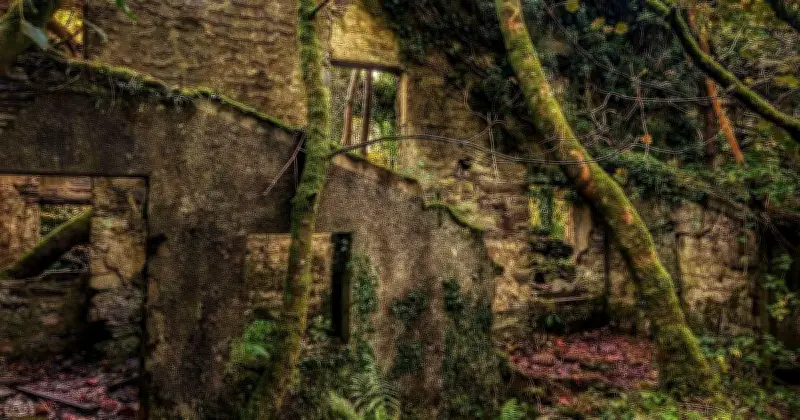
An abandoned village in North Wales, once home to thousands of slate workers, has been entirely reclaimed by nature. The deserted settlement of Talysarn, located in the Nantlle Valley of Gwynedd, was a thriving community until its residents were forced to relocate.
History of the Village
Talysarn was built to house workers from the nearby Dorothea Quarry. By the 1840s, the quarry produced 5,000 tonnes of slate annually, rising to over 17,000 tonnes by the 1870s. However, the quarry faced challenges, including a tragic flooding in 1884 that drowned several workers. To manage water flow, a Cornish beam engine was installed, which remains on site today.
The Relocation
In 1927, as the quarry expanded, the decision was made to rehouse all 2,000 residents in a new village. The old village was left to decay, and over the decades, nature has taken over. Buildings are now smothered in moss and ivy, with crumbling brickwork and graffiti-covered walls.
Present Day
Today, Talysarn is a popular destination for explorers and photographers. It lies within the UNESCO Slate Landscape of Northwest Wales, protected as a historical site. Daniel Start, author of Wild Guide Wales, compared the ruins to a Welsh Angkor Wat, saying, "Only the baboons are missing. It's a vast, wild site with many fascinating, overgrown ruins."
Photographer Tony Harnett, who runs Gems of Snowdonia, said: "I'd seen photos of Plas Talysarn, but I did not expect to find so many other old buildings. I could easily have stayed for the whole day."
The quarry closed in 1970 and is now a lake over 100 meters deep in places. The site continues to attract visitors intrigued by its eerie, overgrown beauty.