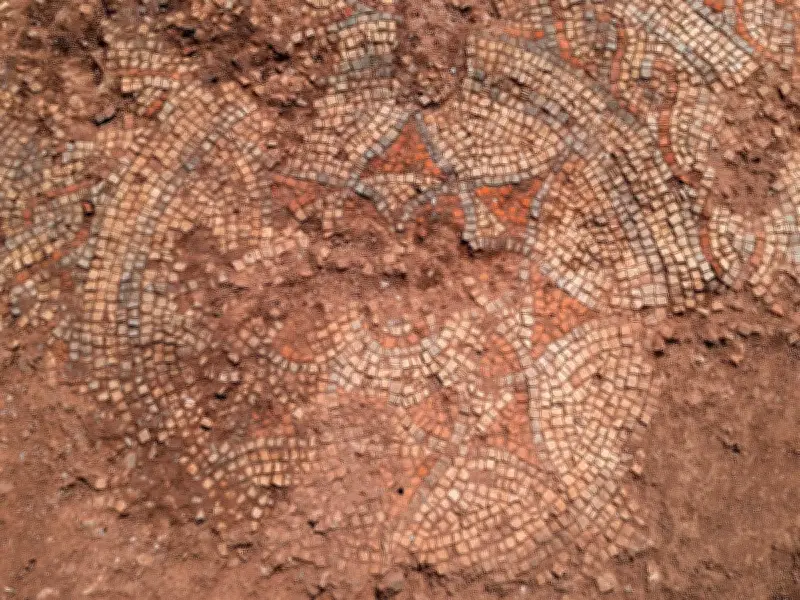
Archaeologists have uncovered a stunning mosaic floor from a fourth-century AD Roman villa on farmland between Halberton and Sampford Peverell in Devon. The discovery was made by the Saving Halberton's Ancient Roman Environment (SHARE) project, led by the University of Exeter and Cotswold Archaeology, following initial finds by local metal detectorist John Hill in 2004.
Rare Polychrome Mosaic Discovered
The mosaic features a central flower with eight overlapping teardrop-shaped petals, made from thousands of red, white, and dark blue stone cubes measuring just 12mm square. This polychrome mosaic is considered the most westerly example found in a Roman villa in Britain. The design includes interlaced squares forming a common Roman pattern of knotted lines.
Project lead Dr Susan Greaney of the University of Exeter said: “At the outset, we knew this villa was an important site for understanding the ‘Romanisation’ of Devon. But from day one, it has offered us a wealth of interesting and sometimes surprising finds in addition to this striking polychrome mosaic.”
Elaborate Bathhouse and Plunge Pools
The villa complex includes a bathhouse with at least two plunge pools, indicating the occupants were of wealth and high status. Two additional stone-built buildings were excavated: one containing large water tanks likely used as a plunge bath, and another rectangular building possibly used for agriculture, where animal bones and a worked antler were found.
Dr Greaney added: “We did not expect to find such an elaborate bathhouse, for example. This villa was undoubtedly home to people of wealth and high standing.”
Artefacts and Community Involvement
Other finds include a delicate copper alloy bangle atop the mosaic, a fine silver-plated spoon in one room, an intaglio depicting the goddess Victory, and numerous pottery pieces including an indented beaker for serving drinks. Specialists are carefully lifting the mosaic for display at Tiverton Museum of Mid-Devon Life, alongside other artefacts.
Bill Horner, county archaeologist at Devon County Council, said: “This, and the other trappings of Roman civilisation and evidence of affluence that have been found, show how much even this far-flung part of the province had been integrated into the Roman Empire.”
Funding and Public Participation
The dig was funded by The National Lottery Heritage Fund, and the SHARE project involved community volunteers and University of Exeter archaeology students. Councillor Jacqi Hodgson, Devon County Council’s cabinet member for the environment and biodiversity, said: “This has been a once-in-a-lifetime chance for local people to get involved in a ground breaking excavation of a Roman villa. Thanks to National Lottery players, local volunteers, schools and community groups have helped uncover and will protect an extraordinary piece of Devon’s Roman past.”