
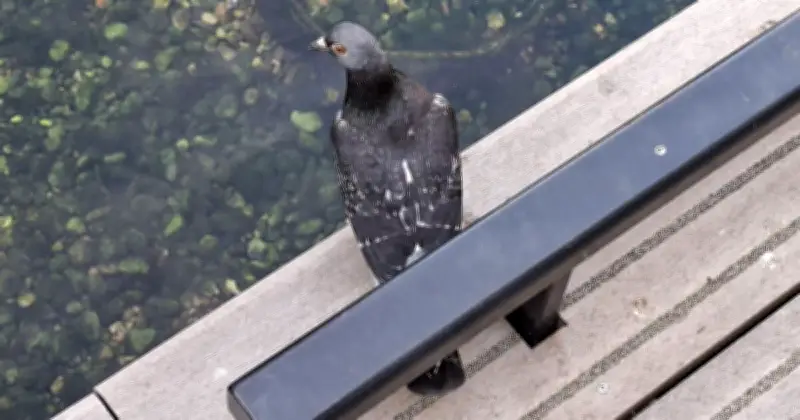
Pigeons may not seem the most attractive members of UK urban wildlife. Often seen eating crumbs off the floor on high streets, flapping about under bridges or perched along concrete ledges, they may not be the most inspiring sight. But the animal champions at the RSPCA say you may want to think again about these urban birds. They actually have a host of attributes, and have been faithful companions flying alongside humans for generations.
Why pigeons are misunderstood
RSPCA ambassador and bird expert, Dr Mya-Rose Craig, said: "It's amazing how smart and complex pigeons really are yet they are so misunderstood. It is heartbreaking to see the welfare issues pigeons face every day."
"Pigeons are sensitive and intelligent birds and they deserve our kindness and respect, just like any other animal."
7 reasons to appreciate pigeons
Super navigators
Feral pigeons are descended from wild rock doves, and have lived alongside humans for 5,000 years. They were domesticated for sport and to carry messages, as they have amazing GPS abilities. They use the sun, their sense of smell, and an inbuilt compass to read the Earth's magnetic field and find their way. Top-performing racing pigeons can fly at more than 100mph and can travel up to 700 miles a day.
Wing war heroes
Homing pigeons were crucial in saving thousands of lives during the two World Wars, as they would carry important messages across enemy lines. They helped British troops in alerting the army to the position of the enemy, or telling them when they needed to retreat. This was a very dangerous job as enemy soldiers would try and shoot them down to stop these messages getting through. Such was their skill on the battlefront that 32 individual pigeons were awarded the Dickin Medal, the highest honour for animals that served in war.
Science pioneers
Pigeons were crucial in shaping Charles Darwin's work on the theory of evolution. The scientist famously studied domestic pigeons in his garden, experimenting with cross-breeding to generate different features. This helped him gather the evidence he needed to develop and defend his theory of natural selection.
Soaring intelligence
Pigeons have a brain the size of a cashew, but they certainly put it to good use. They have been able to pass the 'mirror test', as they can recognise their own reflection. This means they have the same cognitive complexity as other intelligent animals, such as chimpanzees, dolphins, and elephants.
Artistic tastes
The science suggests pigeons are able to recognise and categorise different art styles. Researchers at Keio University in Japan used a reward-based system, which found they could distinguish between the abstract, sharp-angled lines of Cubism, like Picasso, and the more soft-focus brushstrokes of Impressionism, such as Monet. The research team won the Ig Nobel Prize in psychology for their efforts. The Ig Nobel prize recognises unusual and surprising scientific efforts that help spark public interest in science.
Modern parenting
Pigeons have a fair share approach to parenting. Both the mother and father take turns incubating their eggs, protecting the nest, and nurturing their young. This shared responsibility even goes as far as feeding the youngsters 'milk', as both male and female pigeons produce a high fat and protein secretion to nourish their offspring. Baby pigeons, called squabs, will stay in the nest and away from human eyes until they take on adult appearance. A pigeon chick is yellow in appearance.
Medical application
Researchers were able to train pigeons using food rewards to identify cancerous breast tissue and microcalcifications on mammograms. The pigeons were able to identify these with 85 per cent accuracy. A study at University of California, Davis and the University of Iowa found that, when the 'votes' of multiple pigeons are combined, their diagnostic accuracy can soar to 99 per cent. This is on par with how well-trained human pathologists typically do.




