
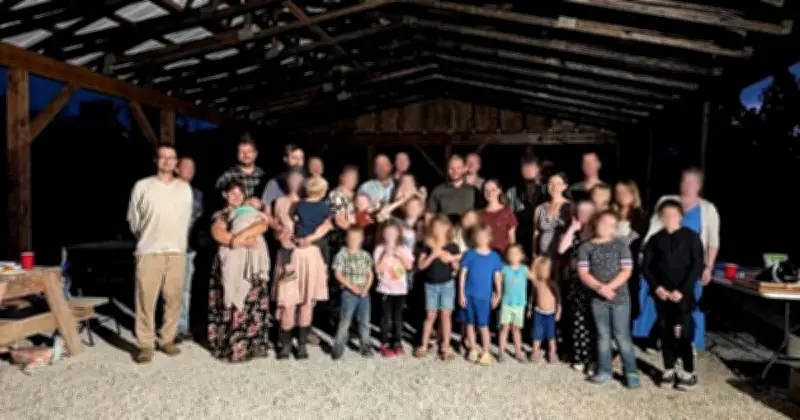
Deep in the Ozark Mountains of Arkansas, a small settlement of around 40 residents follows strict membership rules. Applications are accepted only from white people of full European ancestry who reject homosexuality and support what founder Eric Orwoll describes as traditional European values.
Orwoll leads Return to the Land, a private white-separatist membership association with more than 1,000 members nationwide. Only a handful of families are chosen to live on the group's 165-acre settlement near Ravenden, where social media videos show goats and chickens roaming, children playing and members building wooden homes and churches.
Behind those idyllic images, leadership figures promote hard-Right ideology online. Children in the community are homeschooled and taught subjects including the Holocaust and slavery from what Orwoll calls an "even-handed" perspective.
Rejecting the 'racist' label
Asked about accusations of racism, Orwoll said the group's aim is to preserve European identity rather than promote white supremacy.
"I think what we actually advocate is tolerance, free association, and self-determination. I don't think the movement itself is white supremacist. Are there people within the association who hold white supremacist views? Probably. It's a large organisation, and some people undoubtedly believe their own group is objectively the best."
On religion, Orwoll said the organisation accepts members with a range of views, but those with what he considers "non-traditional" religious beliefs are unlikely to be accepted.
"We wouldn't automatically reject someone for being Christian, pagan, or agnostic, but if someone holds what we'd consider a non-traditional religious outlook - for example, they're a militant atheist who is intolerant of traditional religious beliefs - they're probably not a good fit for the association."
Screening and online rhetoric
Prospective members complete a questionnaire before a 15-minute telephone interview covering issues such as same-sex marriage, gender identity, vaccines and abortion.
"The interview also focuses on values. It's not solely about race. For example, we ask how often someone thinks about the Roman Empire because we see it as part of a shared European heritage and want people who value preserving it," Orwoll explained. "After the interview, the association's board votes on the application. If accepted, members are added to our online discussion groups and can attend our national events."
However, content shared in those online groups paints a different picture. Senior members have shared Holocaust denial, references to "Jewish infiltration" and rhetoric that downplays racial segregation.
Peter Csere, a close associate of Orwoll, has shared the number "1488" on Telegram - a symbol combining the "14 Words" white supremacist slogan with "88," a code for "Heil Hitler."
Orwoll has also spoken about the prospect of a "second Hitler" and has praised former Ku Klux Klan leader David Duke. He is linked to a wider network of hard-Right commentators, including white nationalist influencer Nick Fuentes.
Posts within the movement's channels frequently refer to "Jewish propaganda" and "Jewish infiltration." One post reads: "Generations of men raised on Jewish propaganda and consumer culture have been taught to be soft, weak, and self-indulgent." Another states: "Even though towns are apparently White, the effects of Jewish infiltration and subversion can be seen, heard and felt."
An X user called "Sheltered Max," who claims to live on the compound, has written in favour of "cannibalising" and "eradicating" Jews and posted that "Jew hatred is the great unifier."
Demographics and personal history
Orwoll uses the name Aarvoll online and has amassed almost 100,000 followers across social media platforms. He has repeatedly argued that changing demographics pose an existential threat to white Americans.
The 36-year-old says his upbringing in a multicultural neighbourhood near Los Angeles, including an arts high school and neighbours from many backgrounds, including Jewish families, helped shape his views.
"As I started learning about demographic change and correlating it with my own experience growing up in California, and seeing that different groups of people have different behaviors and tendencies, I concluded that things would continue moving toward greater racial diversity, and that this would affect the ability of white Americans to preserve the kind of lifestyle we've built over the last few centuries."
"If current demographic trends continue, I think Europeans should ask what their societies will look like in the future," he said.
He also cited what he called "sociological data" suggesting ethnic diversity weakens social cohesion. "If you can't predict what someone is going to do, you can't really trust them. That's an observed characteristic of multiracial societies. It's really about preserving some sense of sovereignty and maintaining control over our own culture and society," he said.
Education and Holocaust claims
On education, Orwoll said: "I think the problem with public education is that it's very focused on what it presents as the sins of Europeans throughout history, whereas I think there are multiple sides to these issues."
On slavery, Orwoll said he would also teach children about the Barbary slave trade, in which many white Europeans were enslaved and sold into Africa. On segregation, he said: "I'd explain that America was explicitly founded as a white country. Once formerly enslaved Black Americans became citizens, society faced the question of how to reorganize itself, because that wasn't part of what many people originally envisioned for the country." He added that the "separate-but-equal system was one attempt to address that, but that it went too far by coercively imposing segregation," while "integrationist policies that followed also overstepped."
On the Holocaust, Orwoll claims the number of deaths has been "exaggerated" and that children are taught "a very one-sided narrative" shaped by "Hollywood propaganda."
"In my view, many people who advocate violence against Nazis haven't actually read the writings of figures such as Rosenberg, Goebbels, or Hitler. Instead, they're relying on portrayals from films and popular culture."
He also said many Holocaust victims died because of "terrible conditions" and argued there is "less evidence of an intentional, centrally directed campaign to exterminate all Jews."
"I don't believe there's an order from Adolf Hitler explicitly directing the killing of all Jews. I also believe that some stories commonly associated with the Holocaust - for example, claims about lampshades made from human skin - have been shown to be false, and I think some survivor testimonies include accounts that are physically impossible."
"I'd also explain what I see as the German perspective toward Jewish people at the time, namely that they viewed Jews internationally as opponents in a military conflict."
Orwoll added that the Nazis had "redeeming qualities" and that children should receive "all the evidence" before forming their own opinions rather than being "brainwashed."
Homeschooling concerns and critics
Last autumn, the Daily Mail spoke to Tess Ulrey, executive director of the Coalition for Responsible Home Education, who said Arkansas law leaves children in the community particularly vulnerable.
"In a radically insular group like Return to the Land, the educational environment may uphold white supremacy ideology, promote speculative and fictionalised sciences, encourage harmful and unhealthy practices, and easily deny children access to the tools to form their own beliefs, or hear from a different viewpoint," Ulrey said. "We believe that kind of homeschooling is a violation of children's rights, and harms their ability to thrive in a diverse and connected world."
Concerns about extremist influences were also fuelled by reports that Adolf Hitler's Mein Kampf was seen on Orwoll's office bookshelf during a media visit last year.
The movement also discourages interracial marriage. "There's a fair amount of evidence that interracial marriages tend to have worse outcomes. They don't last as long, have higher rates of domestic abuse, and are more likely to result in single-parent households. I simply think the more typical and adaptive pattern is for there to be continuity between extended families, traditions, and psychological tendencies. When people are more similar in those respects, I think things tend to harmonise more easily."




