
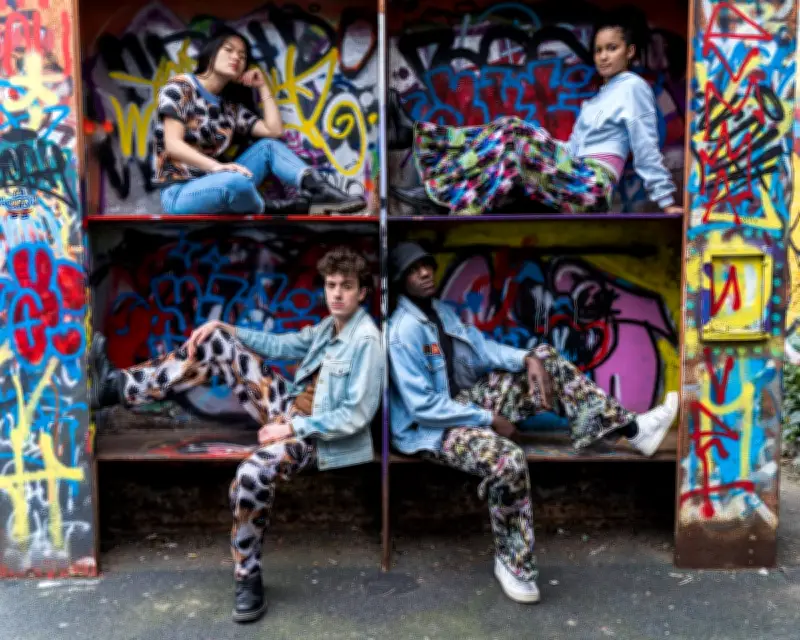
As facial recognition technology is rolled out across Britain’s public spaces, a new generation of designers says privacy could be the next big fashion trend. Companies have started incorporating “adversarial patterns” in their garments – carefully designed arrangements of shapes, colours and repeated motifs said to exploit weaknesses in some computer vision systems.
How Adversarial Clothing Works
The designers say advances in computing have made it easier to incorporate such patterns into commercially viable garments. Experts caution that the effectiveness of the patterns depends on the surveillance system and the conditions in which it is used, but Nick Tidball, the co-founder of the clothing brand Vollebak, thinks “adversarial clothing” could be on the cusp of going mainstream.
“Anti-surveillance feelings are so widespread that all it would take is for a single celebrity to wear one of these garments, currently popular in the countercultural fashion world, to a high-profile event for it to take off,” he said.
“So-called ‘adversarial clothing’ wins on many levels. As well as the practicality of protection, it’s fashionable and fun, it makes a powerful, public statement that many are in agreement with, it spreads even more awareness about the importance of privacy and it helps encourage public debate.”
The Rise of Surveillance and Public Concern
Unlike traditional CCTV, modern computer vision systems can identify faces, follow individuals across cameras and search footage at scale. Recent advances in generative AI have made this type of automated identification cheaper and more widely available to police, retailers and private businesses, an expansion recently warned against by Britain’s biometrics watchdogs, which have called for more laws and a regulator to clamp down on misuse.
Evidence of misuse and that black and Asian people are more likely to be incorrectly identified than white people has led to increasing public concern. A recent poll showed almost 60% of people believed facial recognition was “another step towards turning the UK into a surveillance society”.
Fashion as a Statement of Resistance
Dr Jennifer Bell, a senior lecturer specialising in creative AI, fashion and digital culture at Nottingham School of Art & Design, said clothing with anti-facial recognition designs was increasingly available at high street prices and was being marketed to a wide demographic. “That growing awareness combined with a lowering of cost often precedes the tipping point towards a real cultural moment,” she said.
Daniel Preuß, the co-founder of the Urban Privacy clothing brand, said new technology meant you could now “combine smart, striking style with invisible protection”. He emphasised that because surveillance systems are so powerful, no design can guarantee security from detection, but said “the added value of fashion is to spread awareness and help propagate public discourse”.
Preuß said his designs used large-scale prints, asymmetrical cuts and streetwear-inspired silhouettes to confuse facial recognition algorithms. The company said its Urban Ghost coat integrates LEDs into the hood that emit infrared light to dazzle night-vision surveillance cameras.
Preuß, who co-founded his company after reading about the whistleblower Edward Snowden’s revelations about US surveillance in the Guardian, said his designs played with the fact that “facial recognition systems freak out when they see multiple faces at once”. “Our patterns play with that chaos, confuse algorithms and make it way harder to pin you down,” he said.
Bell, however, said “none of these products are tried and tested, and a lot of these surveillance technologies can deal with a little resistance … [but] even if the designs don’t necessarily work perfectly, fashion is also a visible sign of resistance. This is consumers collectively coming together to make a visible statement.”
Growing Interest and Future Outlook
Rachele Didero, the founder of Cap_able, which creates clothing marketed as making AI recognition more difficult, said interest in her brand had rocketed in the last few years. “When I started doing this in 2018, people thought I was designing masks to rob banks,” she said. “But now these concerns are no longer niche. New generations are increasingly afraid of AI and concerned for their privacy,” she said. “Those wearing these products are the vanguard. The mainstream is quickly coming up behind them, helped by the fact that bigger companies will see the potential for profit and will push the trend into the popular, public domain, changing the way we dress on a large scale.”
Tidball, however, said that whether anti-surveillance fashion became mainstream may ultimately depend less on designers than on governments. “If such clothing genuinely proved effective, it could get political very quickly,” he said. “Then this type of clothing could find itself banned.”




