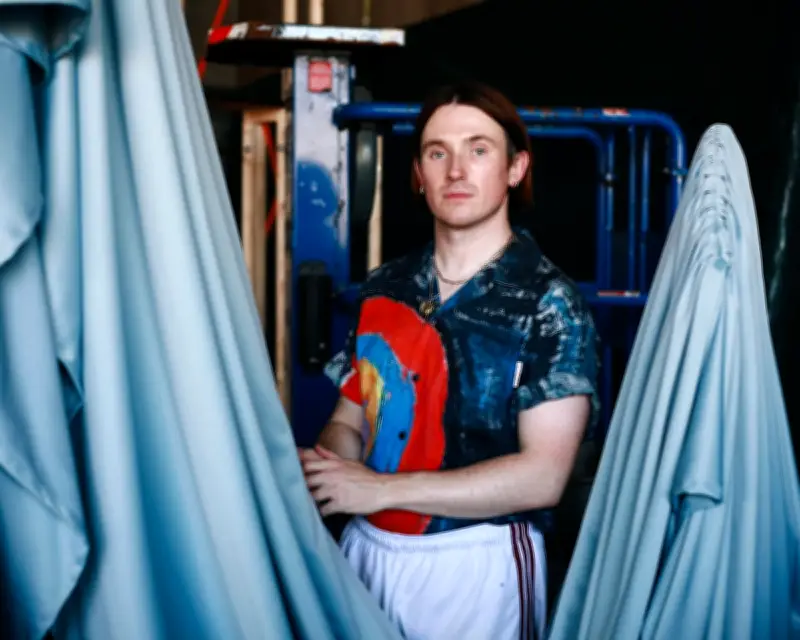
Richard Malone, the Irish artist known for his bold fabric sculptures, has installed his latest work at the Council of the European Union's Justus Lipsius and Europa buildings in Brussels. The installation, titled Cuimhne agus Séadchomhartha (Memory and Monument), coincides with Ireland's assumption of the EU presidency this month. The five-metre sculptures, made from colourful draped fabrics, resemble mythical creatures and aim to rewrite the story of Irish identity.
Challenging the art establishment
Malone criticises the historical erasure of queer and female artists and craftspeople in Ireland. 'A lot of artwork in Ireland was predominantly made by one type of man,' he says, pointing out that many traditional crafts like quilting and stitching have been excluded from museums and curricula. He draws a parallel to British grand tourists who cut through ancient Egyptian quilts to reach gold, ignoring the textile artistry.
His work questions why certain stitch samplers or quilts are not collected and why certain artists are not taught. The EU installation includes soft sculptures alongside works by contemporary Irish artists, makers, and craftspeople, such as sofas, rugs, and burnished wood vessels.
From Wexford to the EU Council
Born in Wexford to a working-class family, Malone learned practical skills from his decorator father, including driving a car by age seven and painting on building sites as a teenager. 'I'm very sensitive to colour because I spent so much time literally watching paint dry,' he says. His love of sewing came from his grandmother, and he studied sculpture in Carmarthen, Wales, before attending Central Saint Martins in London as a fashion student.
After graduating, he made bespoke pieces for wealthy women and collaborated with Björk, designing the dress she wore in the video for Atopos. 'We're on a similar wavelength, so it's all been very natural – no PR involved or brand deals,' he says. Despite success in fashion, he became disillusioned with the industry's sustainability issues and lack of integrity, noting that peers and celebrities often promote unethical brands. 'All you have to do when they email is say no. I think everyone needs a bit more integrity.'
Transition to fine art
Malone's shift to the art world was challenging, as people struggled to categorise him. In 2017, he designed a jumpsuit for MoMA's Items: Is Fashion Modern? exhibition, easing the transition. In 2023, the Royal Academy of Arts in London commissioned him to create the centrepiece of their summer exhibition with just six weeks' notice. He produced a brilliant blue hanging sculpture titled Filiocht Faoi Bhron, as an Dorchadas (Poem in the Dark About Sadness), using welding skills taught by his father.
His father, James, who died earlier this year, assisted on many exhibitions, including laying carpet underlays and making vitrines for a show responding to modernist architect Eileen Grey's work at her villa E-1027 – a building famously vandalised by Le Corbusier.
Installation at EU headquarters
The EU headquarters presented unique challenges. 'There's a lot of red tape around the security and safety of the building in terms of bomb threats and things that need to be cleared when there's a global emergency,' Malone explains. Previous presidencies commissioned polished sculptural works, but Malone's pieces are 'fragile and delicate, in conflict with all the glass and steel.'
Malone's studio is currently a farm in Stradbally, County Laois, where he works in lambing sheds surrounded by lambs and dogs. The installation will be on display at the Council of the European Union's Justus Lipsius and Europa buildings in Brussels from 14 July to 31 December.