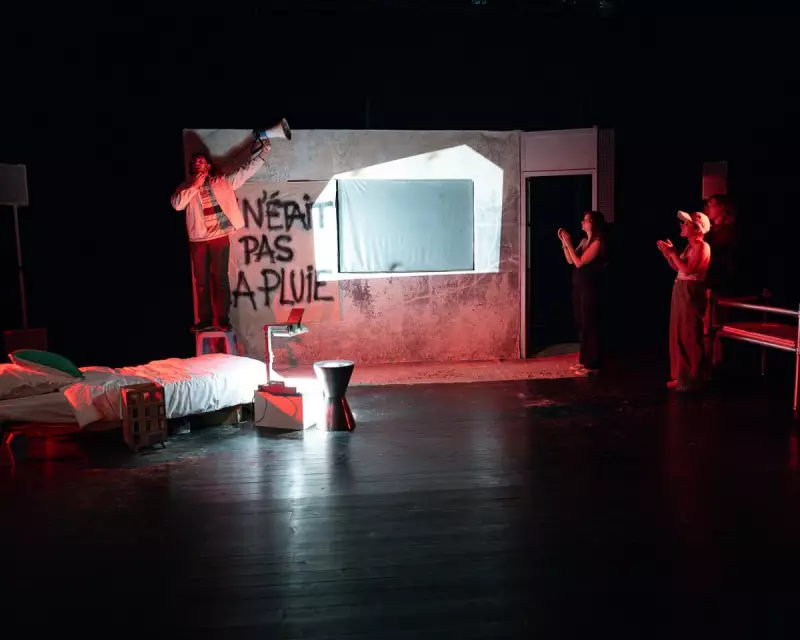
A powerful new theatrical production in Marseille is forcing France to confront a national tragedy often described as its 'Grenfell moment'. Playwright and director Mathilde Aurier has created 65 Rue d'Aubagne, a hard-hitting play that dissects the catastrophic collapse of two dilapidated buildings in the city's Noailles neighbourhood on 5 November 2018.
A City Shattered: The Collapse and Its Aftermath
The disaster on Rue d'Aubagne, just metres from Marseille's Old Port, resulted in eight fatalities and triggered a nationwide outcry over urban decay, social deprivation, and political failure. The immediate aftermath saw the emergency evacuation of over 4,000 residents from similarly precarious housing, laying bare a profound urban crisis.
Aurier, 29, who grew up in Marseille and whose grandfather still lives near the collapse site, describes the event as a pivotal turning point. "It was a turning point for Marseille," she states, highlighting how it exposed the often-ugly politics of France's second city. Yet, within the catastrophe, she also witnessed remarkable human resilience. "All catastrophes are ambivalent," Aurier reflects, "because they're an opportunity for strength in a moment that is completely fractured and difficult."

Art as Reckoning: Documenting Trauma and Solidarity
The play is Aurier's contribution to the civic response that emerged from the rubble. It is anchored by Nina, a fictional resident based on a real survivor Aurier met by chance on a Marseille beach in 2022. Nina's profound survivor guilt became the emotional core of the piece, embodying the city's own psychological reckoning.
"When she told me her story, what struck me was the sense of psychological trauma," Aurier explains. "I wanted this to be the through-line of the piece – and how she was reaching out for a kind of healing."
Following this encounter, Aurier conducted eight months of intensive research, weaving together a cacophony of voices from survivors, activists, and ordinary citizens. Her approach is "documented" rather than purely documentary, blending stark reality with lyrical and surreal elements. These include dreamlike conversations between Nina and her deceased friend Chiara, and the symbolic use of an inflatable crocodile to represent the then-mayor, Jean-Claude Gaudin, whose tenure was marked by the clientelism that choked infrastructure reform.
A Theatre of Catastrophe: Form Mirroring Collapse
The play's structure is intentionally fragmented, mirroring the sudden disintegration of the buildings and the chaotic aftermath. Divided into five sections named for the phases of a breaking wave, it jumps between perspectives and timelines. "It's the most chaotic thing I've written," Aurier admits, "which comes from the sense there was a before, a during and an after to this drama. I thought it would be interesting if the dramaturgy mirrored the housing collapses."
Aurier cites British playwright Howard Barker and his 'theatre of catastrophe' as a key influence, particularly his exploration of power, violence, and strong female figures. This philosophical grounding helps her navigate the play's still centre: the limbo of dealing with indifferent officials, grasping at memories, and struggling to find meaning in loss.
The public fury that followed the collapse, including a protest by 8,000 people organised by the 5 November Collective, contrasted sharply with the judicial outcome. Aurier criticises the 2024 trial verdicts as not "up to scratch", pointing to light prison terms—often under house arrest—and weak fines for landlords and inspectors.
Despite national schemes announced to assess Marseille's housing stock, change is slow, and the social divide widens in a fast-gentrifying city. With a new mayor to be elected in March, Aurier fears housing is slipping down the political agenda. "I don't feel housing is such a fundamental thing now. It was, but other issues are taking its place."

65 Rue d'Aubagne is at the Théâtre de la Criée in Marseille until 18 January, with a TV series adaptation in development that will incorporate the subsequent trial. For Aurier, whose work consistently orbits catastrophe, the psychic reverberations in a city of failed promises remain her ground zero. "I've always been a tragic author," she concludes, "and I think I'll be one until the end."