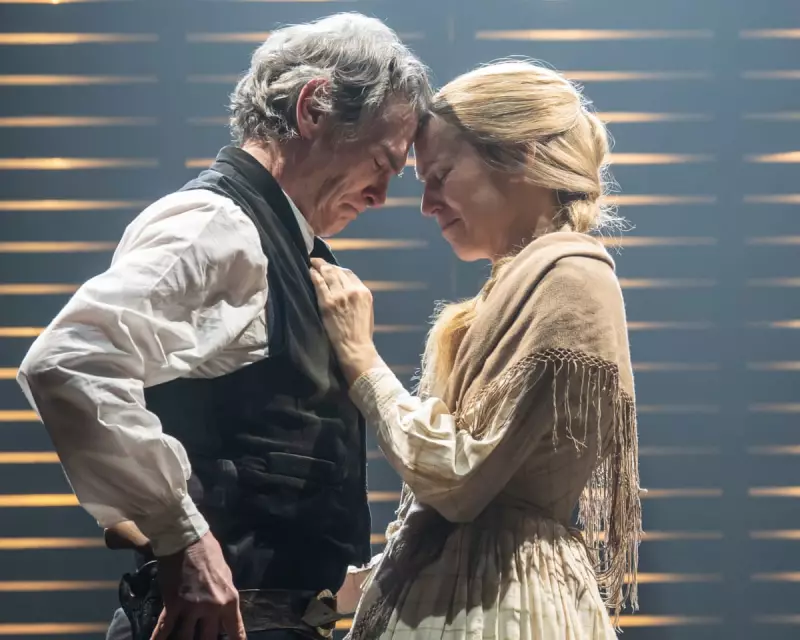
A classic Hollywood western has been dramatically reimagined for the London stage, with Billy Crudup and Denise Gough leading a tense and politically charged adaptation at the Harold Pinter theatre. Thea Sharrock's production of High Noon transforms the iconic 1952 film into a gripping debate play, its roots in the McCarthy era finding uncanny and urgent relevance for a modern audience.
From Silver Screen to Stage: A Reluctant Musical?
The journey from cinematic classic to West End spectacle is an ambitious one. This version incorporates songs by Bruce Springsteen, whose anthems like 'Land of Hope and Dreams' and 'The Rising' bring their own layer of American politics to the narrative. Initially, the production feels somewhat disjointed, shifting between brief, filmic scenes against a handsome clapboard set. However, as a piece of theatre, it soon finds its rhythm and gathers a formidable, locomotive energy.
The core of the story remains the showdown between the vengeful outlaw Frank Miller (James Doherty) and the marshal who jailed him, Will Kane (Billy Crudup). On what should be his wedding day, Kane, having just handed in his 'tin star', must mobilise a defence after the townsfolk he once protected abandon him. Eric Roth's script retains many lines from Carl Foreman's original screenplay but expands the debate around a community's ethical failure in the face of wrongdoing.

A Timely Allegory for a Divided Age
Originally an allegory for the cowardice of McCarthyism—Foreman was himself blacklisted—the play's examination of collective inaction strikes a powerful chord today. The production vibrantly comes to life in these arguments, seeming to speak directly to contemporary dilemmas, notably in 'the cowboy country of Trump’s America'. This resonance gives the classic tale a fresh, compelling edge.
Crudup steps into the role immortalised by Gary Cooper, evading that long shadow by portraying Kane as an upstanding, earnest, and increasingly desperate man. Opposite him, Denise Gough delivers a grittier, more modern take on Amy Fowler, the Quaker bride played by Grace Kelly on screen. Gough is also a strong singer, delivering several of Springsteen's songs a cappella with a voice full of desolation, though 'I'm on Fire' is perhaps reprised once too often.
Supporting Cast and Staging
While the central couple are convincing, some supporting characters feel underdeveloped. The percussive music and sound design are consistently arresting, and Neil Austin's lighting provides emotional clarity and intrigue. Central to Tim Hatley's set is a large clock, ticking down to the thrilling arrival of the noon train and the subsequent showdown, which is staged with remarkable tension despite the challenges of a cross-town shootout.
For all its initial stiffness, the production builds to a moving and powerful climax. The political message ultimately speaks loudest, harnessing the McCarthyist fear of the past and the Trumpian tensions of the present. High Noon proves that this story of one man's stand against the cowardice of the many remains a sizzling and essential piece of drama.
High Noon is at the Harold Pinter theatre, London, until 6 March.