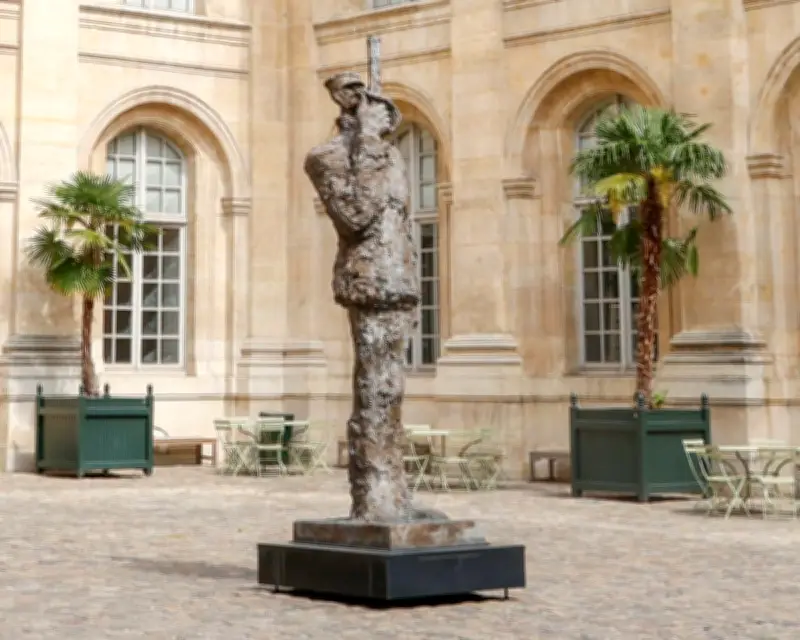
After four decades of being moved around Paris, a statue of Captain Alfred Dreyfus will finally receive a permanent home in the French capital. On July 12, a national Dreyfus commemoration day, President Emmanuel Macron and Paris Mayor Emmanuel Grégoire will unveil the 3.5-metre (12-foot) bronze figure on Rue de Harlay, on the Île de la Cité. The statue will stand in front of the Cour de Cassation, France's highest civil court, which exonerated Dreyfus on July 12, 1906.
Long Journey to a Rightful Place
The statue, created by sculptor Louis Mitelberg in 1985, was originally intended for the courtyard of l'École Militaire, where Dreyfus was stripped of his rank in a humiliating public ceremony in 1895. However, the French army twice refused to allow its placement there. Other proposed sites, including a spot opposite the Palais de Justice, were also rejected. For years, the statue was placed in the Tuileries Garden, then moved in 1994 to Place Pierre Lafue near the former Cherche-Midi jail, where Dreyfus was imprisoned. It remained there, largely unnoticed, for nearly three decades.
Significance of the New Location
Ariel Weil, the mayor of Paris Central and a descendant of the Dreyfus family, has been a key advocate for the statue's relocation. He described the previous attitude of authorities as "out of sight, out of mind." Weil said: "It's been wandering around Paris for years. The general idea seemed to be: we'll put it in a corner of Paris where it won't embarrass anyone and won't be seen and we can forget about it." He added that the new location is "incredibly powerful" and fitting, as it places the statue outside the court that exonerated Dreyfus, rather than at the military school where he was disgraced.
The Dreyfus Affair
The Dreyfus affair remains one of the most notorious political scandals in French history. In 1894, Dreyfus, a Jewish army officer, was falsely accused of passing military secrets to Germany and convicted of treason in a secret court-martial. He was publicly cashiered—his sword broken and insignia ripped from his uniform—and sentenced to life in solitary confinement on Devil's Island, a penal colony off French Guiana. Three years later, evidence emerged that the accusations were based on forged documents, and that another officer was the real traitor. Despite this, the military covered up the discovery. The novelist Émile Zola published his famous open letter "J'accuse" in 1898, galvanizing public opinion. In 1906, the Cour de Cassation exonerated Dreyfus, and he was reinstated in the army, awarded the Légion d'honneur, and later served in World War I. He died in Paris in 1935 at age 75.
Commemoration and Legacy
President Macron wrote last year that from now on, every July 12, a commemorative ceremony will honor Dreyfus, "celebrating the victory of justice and truth over hatred and antisemitism." The statue bears the inscription: "If you want me to live, help me regain my honour," from a letter Dreyfus wrote to his wife Lucie while imprisoned. In 2002, vandals painted a Star of David and the words "dirty Jew" on the statue. Weil noted that the affair raised fundamental questions about the influence of the army within the state and the values of the republic. "This puts right a final injustice," he said.