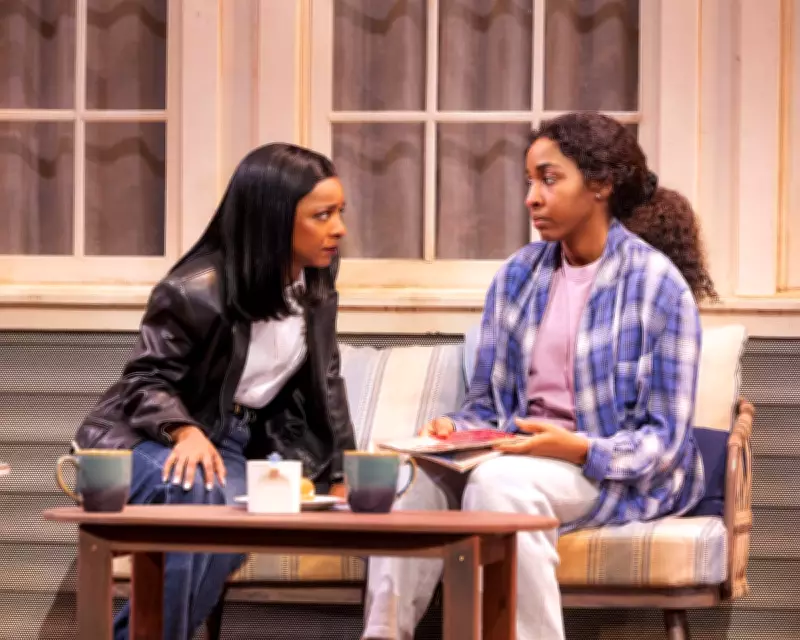
Broadway Revival of Proof: A Mixed Bag with Kara Young's Standout Performance
For theatre enthusiasts who studied drama in the early 2000s, David Auburn's Pulitzer Prize-winning play, Proof, likely served as a masterclass in structure and accessibility. This work, celebrated for its elegant blend of humor and sorrow, realistic dialogue, and subtle poetic touches, has long been hailed as a near-perfect template for aspiring playwrights. Its commercial appeal and gripping first-act cliffhanger have made it a staple in productions worldwide. Now, the first Broadway revival, directed by Thomas Kail, puts Auburn's sturdy construction to the test, with results that highlight both the play's resilience and some significant performance challenges.
Star-Studded Cast Faces Uneven Execution
This production aims to be a star vehicle for Emmy winner Ayo Edebiri, known for The Bear, and acclaimed film actor Don Cheadle. Edebiri portrays Catherine, a 25-year-old woman grappling with the legacy of her late father, Robert, a mathematical genius who suffered from severe mental illness. Catherine fears she has inherited his instability without his brilliance, having abandoned her own career aspirations to care for him. Cheadle plays Robert, appearing as a ghostly figure in her memories.
Initially, Edebiri captures Catherine's petulant, adolescent-like demeanor convincingly, embodying a character stuck in defensive mode against life's pressures. Her interactions with Robert's former student, Hal (Jin Ha), and her sister, Claire (Kara Young), are marked by quips and aloofness. However, as the drama intensifies, Edebiri's performance falters, devolving into stammers and tics that distance the audience from Catherine's humanity. This overacted approach clashes with Auburn's naturalistic writing, making Catherine seem like a caricature of mental distress rather than a nuanced character.

Don Cheadle's Understated Role and Supporting Strengths
In contrast, Don Cheadle delivers a curiously flat portrayal of Robert, barely hinting at the character's mental turmoil. While this might be an attempt to balance Edebiri's excess, it results in a lack of chemistry between them, undermining the play's exploration of generational legacy. Thankfully, Kara Young, a two-time Tony winner, steps in as a late replacement and provides much-needed clarity. Her performance as Claire is crisp and focused, capturing the guilt and frustration of a sister who financially supported her family but missed their most difficult years. Young's no-frills approach anchors the production, much like Claire does for her family in the narrative.
Jin Ha also shines as Hal, blending sweetness with calculation as he navigates attraction to Catherine and ambition to uncover mathematical secrets. Despite these strong supporting roles, the play's emotional core relies heavily on Edebiri, who struggles under the weight, causing the production to wobble.
Direction and Design: Minimalist with Minor Flaws
Director Thomas Kail generally allows Auburn's text to speak for itself, with a few stylistic choices that vary in effectiveness. Kris Bowers' original music adds a wistful, weary tone to scene transitions, enhancing the emotional landscape. However, Teresa L Williams' set design includes strip lights that glow during these transitions, evoking a cold, flashy aesthetic reminiscent of some London productions. This unnecessary embellishment detracts from the play's intimate, realistic setting.
Despite these technical missteps and the central performance issues, Auburn's writing proves remarkably durable. The play's mild mysteries remain engaging, and its recurring motifs still elicit rueful chuckles. This revival demonstrates that even with messy execution, the fundamental strength of Proof endures, a testament to its clever and simple design.