Lord Mackay of Clashfern, who has died aged 99, was unique in modern legal history in being made lord chancellor at the head of the profession in England and Wales despite having spent his entire career as a lawyer in the Scottish courts system rather than the English. He was also almost certainly the last to be appointed for his legal expertise and distinction, rather than his party political qualifications.
A man of unbending rectitude
A man of unbending rectitude, deep religious faith and high principles – inscrutable, in the words of Kenneth Clarke, one of his successors – Mackay was lord chancellor for nearly 10 years, from his appointment by Margaret Thatcher in October 1987 following the resignation of Lord (Michael) Havers, until the fall of John Major’s government in 1997, when Mackay was succeeded by another Scot, Lord (Derry) Irvine, who had been Tony and Cherie Blair’s pupil master and had spent his career as a barrister in England.
The office of lord chancellor, one of the oldest and the most senior in government – outranking the prime minister, dating well back into the middle ages – has since been drastically reformed. Holders now also hold the post of justice secretary and still oversee the judiciary, but no longer chair the House of Lords and have lost their judicial function.

Thatcher's resignation
It fell to Mackay at the cabinet meeting at which Thatcher resigned in November 1990 to read out a tribute to the prime minister on behalf of the cabinet. In fact he nearly had to read out her statement as well, since she was on the verge of tears. Cecil Parkinson urged her to let the lord chancellor, sitting on her left, read it, but Mackay demurred. “I felt she would regret it all her life if she did not do it herself,” he said later, and Thatcher struggled through the two sentences she had prepared.
Early life and education
Mackay’s career eminence was not a result of long antecedents in the legal profession. Indeed he might well have spent his career as a mathematics academic instead. Born in Edinburgh, he was the son of Janet (nee Hymers) and James Mackay, both from the far north of Scotland. His father was a railway signalman originally from the village of Clashfern in Sutherland – Mackay would many years later take it as part of his titular name in tribute to James – and his mother had moved south from Caithness in search of work. An only child in an impoverished but devout Presbyterian household, the young James secured a scholarship to George Heriot’s school and went from there to Edinburgh University, where in 1948 he obtained a first in mathematics and philosophy.
Mackay tutored in maths for two years at St Andrews University before moving to Trinity College, Cambridge, to take a second degree, where he again received a first and became senior wrangler – the highest scoring maths undergraduate. Despite this, he switched to law, explaining later that this was the result of seeing that his colleague Michael Atiyah – a future president of the Royal Society – was a better mathematician than he would ever be, and of a chance visit to the court of session in Edinburgh. He took a law degree back in his home city, graduating in 1955.
Legal career
His diligence as an advocate and his perceptiveness and persistence soon became recognised in Scottish legal circles. Mackay became a law commissioner, a member of the law reform committee and eventually vice-dean and then dean of Scotland’s Faculty of Advocates. He might then have become a Scottish law lord but for the advent of the Thatcher government in 1979, when the new prime minister was faced with a choice for the post of lord advocate – Scotland’s chief legal officer and prosecutor – between him and the erratic and bibulous Scottish MP and lawyer Nicholas Fairbairn. Mackay was chosen and given a peerage on becoming a member of the government, with duties that took him not only regularly to appear in the Scottish courts but also to Westminster, the House of Lords and the courts of the European Community.

Glasgow rape case
His most severe challenge came in 1982 over the notorious Glasgow rape case, which arose after a woman was abducted, raped and slashed with a razor by three men while walking home after a night out. Despite abundant forensic and witness evidence of the men’s identities, a decision was made not to prosecute them, with Fairbairn as solicitor general weighing in to a journalist about the woman’s credibility as a witness. In the face of a public and media outcry, Mackay authorised permission for a very rarely used private prosecution. The woman stood up to cross-examination and the men were duly convicted.
Lord chancellor
Mackay became a Scottish judge and was appointed a lord of appeal in the House of Lords, but his surprise appointment as lord chancellor came following the early retirement of Havers through ill health. Mackay’s relative lack of experience in England meant he had few allies in London, and he faced fierce opposition from members of the bar, especially as Thatcher was pressing for reforms to the legal system, including a revision of their fees. He nevertheless largely devised and steered through the Courts and Legal Services Act of 1990, which implemented wide-ranging changes to the judiciary, ended solicitors’ monopoly on conveyancing, and gave them the right to appear in higher courts alongside barristers.
This last reform of the barristers’ closed shop provoked particular outrage from what one of Thatcher’s advisers called the middle-class equivalent of the National Union of Mineworkers, with one of Mackay’s predecessors, Lord (Quintin) Hailsham, declaring that “solicitors, barristers are not like the grocer’s shop in Grantham”. The reform was passed for England, but paradoxically not in Scotland.
Religious controversy
Mackay’s lifelong membership of the Free Presbyterian Church of Scotland, of which he had become an elder, also aroused controversy that was harder to understand south of the border. Throughout his career he had declined to work, travel or give interviews if they were to be broadcast on the sabbath, which caused difficulties. It was his decision, however, to attend the memorial masses for two Roman Catholic judges, Charles Ritchie Russell in 1986 and then his friend John Wheatley in 1988, that caused conniptions because of Presbyterian rules forbidding any support for the “spurious and idolatrous” doctrines of Catholicism.
Mackay’s excuse – that he was merely paying his respects to dead colleagues – cut no ice. He was denounced as sinful, suspended from membership of the kirk and, when later told not to attend further popish services, he chose to withdraw from the church instead. He latterly worshipped with the breakaway Associated Presbyterian Church. Mackay remained president of the Scottish Bible Society.
Later life and honours
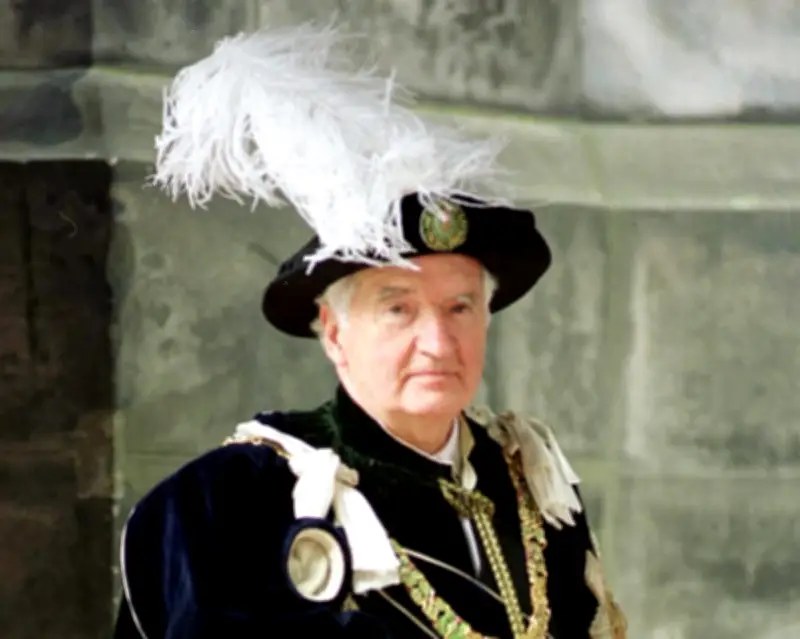
He retired as lord chancellor following the election of New Labour in 1997, becoming instead editor-in-chief of Halsbury’s Laws of England and a lord high commissioner of the Church of Scotland between 2005 and 2007. In 1999 he was installed as a Knight of the Order of the Thistle at St Giles’ Cathedral in Edinburgh; he was appointed to the order by Queen Elizabeth II in 1997. Latterly he held the largely ceremonial posts of lord clerk register and keeper of the royal signet. He finally retired from the Lords in 2022.
He was garlanded with honorary degrees from 16 universities including Edinburgh, Dundee, Strathclyde, Aberdeen, St Andrews and Cambridge, where he was also an honorary fellow of his old college. He married Elizabeth Hymers, a cousin, in 1958. She survives him, along with their son, James, and two daughters, Elizabeth and Shona.