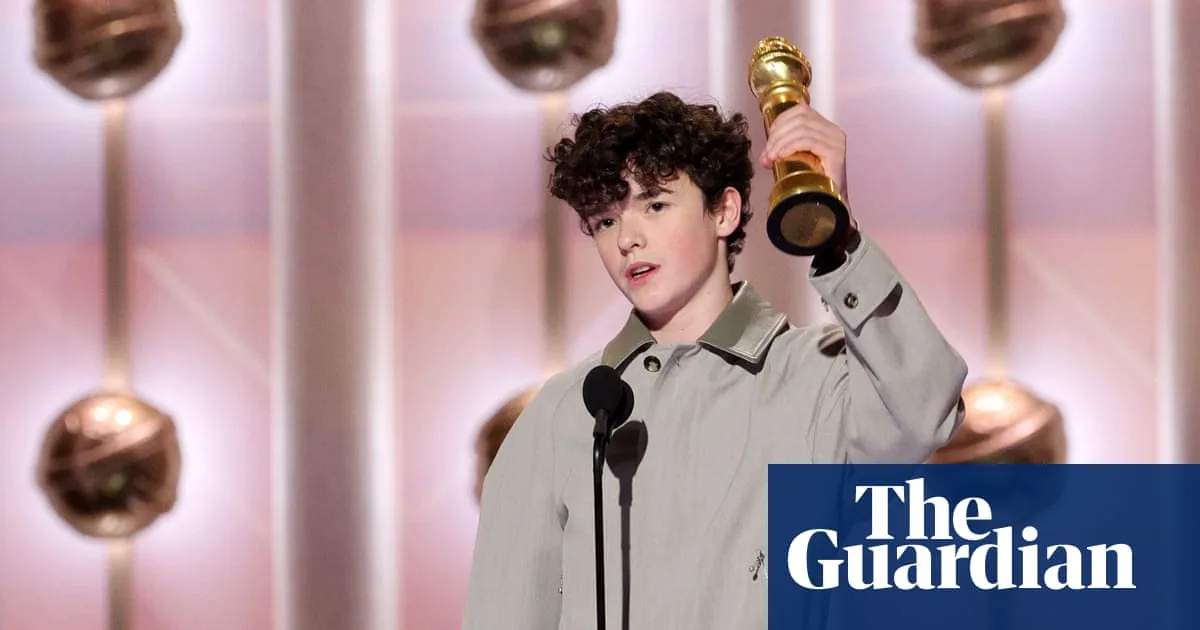
Owen Cooper, the 16-year-old from Warrington who won best supporting male actor at the Golden Globes for his role in Netflix's 'Adolescence', has described the experience as 'not feeling real'. The drama, which also triumphed at the Emmys with six awards, has been a cultural phenomenon, sparking conversations about male toxicity.
Cooper's former drama teacher, Esther Morgan, co-founder of the Drama Mob, recalls that his talent was evident early on. 'You could tell he definitely wanted it,' she said. 'He wasn’t messing around when it came to listening, taking direction and learning his lines.' Morgan emphasised that Cooper's success did not come from nowhere, as he had trained with the Drama Mob for two years before being cast.
Co-writer Jack Thorne noted the intense pressure during rehearsals for episode three, where Cooper played a teenager being interviewed by a psychologist. 'He came in word perfect and ready to work,' Thorne said. 'Slowly but surely – with help from the director and Erin Doherty – he sort of subsumed himself. By Friday he was Jamie.'

Morgan is a passionate advocate for northern actors, who she says are being cut out of an industry increasingly centralised in London. 'More shows need to be made and produced up here,' she argued. 'We need more casting directors working here because for some of our young people they don’t have the funds to travel up and down to London for castings.'
Cooper's success is already inspiring more boys to take up drama, according to Morgan. 'Since Owen going on to be so successful, we have had more boys coming to drama,' she said. 'I think he’s helped with that [by] having that role model of saying, ‘yeah, I went to drama classes, I gave it a go’.' This comes amid a national drop-off in boys taking drama GCSEs, with only 17,000 boys compared to 35,700 girls in 2025.
'Adolescence' has broken UK viewing records, with its first episode pulling in 6.45 million viewers in its launch week. Thorne is cautiously optimistic that the show's success could usher in a new wave of working-class British dramas, though he acknowledges the industry's conservatism. 'TV remains quite a conservative industry and they may go back to thinking a man speaking in RP on a horse is a better bet,' he said.