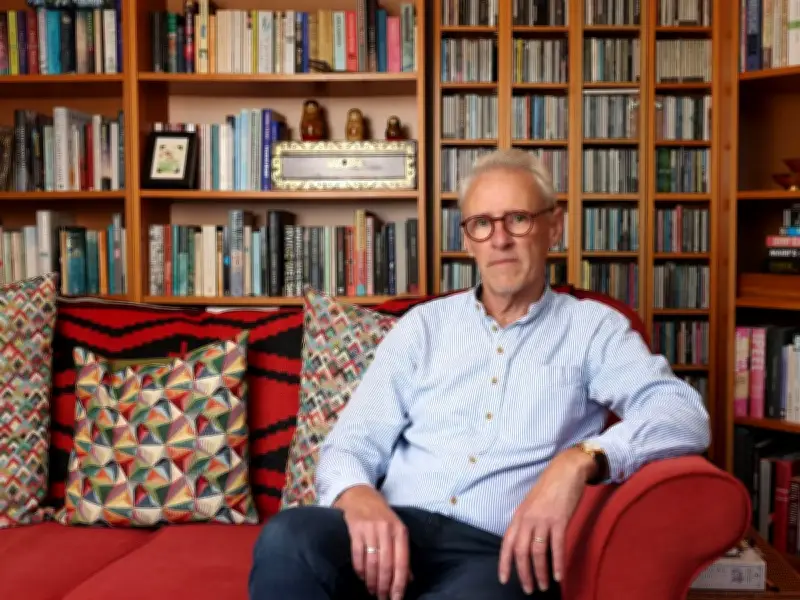
Peter Davies, who was selected for the groundbreaking Seven Up! documentary series as a six-year-old in Woolton, has spoken about his childhood, his political awakening, and the emotional end of the 70-year project.
The series followed a group of ordinary children, returning to film them every seven years. Peter, now 69, was among those chosen by Granada Television researchers at his primary school in 1964. He attended Woolton Primary School before moving on to Gateacre secondary school.
A childhood in front of the cameras
Peter told the ECHO: "I just remember they sat us down in classrooms and just chatted to us. We were only six years old so we have no idea what was going on it was just exciting." He added: "It was still the early days of television so the idea of doing a documentary on ordinary kids was just unheard of. No one had ever done that before."
Due to being academically bright, Peter skipped his final year of primary education and started secondary school when he was just 10. He said: "It's a big step for any kid but when I made it I was only 10 years old so I was the youngest kid in a big school, and I was the smallest kid."
By 14, when the cameras returned, the experience became more difficult. He said: "When you watch Seven Up! all of us are just talking away. You couldn't shut us up but when you get to 14, it's the opposite problem." He recalled classmates saying, "Oh you're the film star", and noted that Neil, who he went to school with, was also on the programme.
Ordinary upbringing, changing times
Away from the cameras, Peter described his childhood as ordinary. His parents were Ken and Joyce. His dad was a police officer who had moved to Liverpool from North Wales for work. Peter said: "I think my upbringing was pretty much the same as the kids I hung around with. It was just fairly standard, you know, living in Woolton, which is a nice place to grow up."
He reflected on opportunities available in the 1960s: "I was one of the kids who got the opportunity to take advantage of a properly functioning welfare state and state education system." He added: "I think the gap between the very rich and the rest of us has got wider again. I think it's harder for kids to come out of university and get decent jobs now and to get on the housing ladder."
He acknowledged progress, saying: "Back then, it was illegal to be a gay man. It was illegal to have an abortion. You could put a sign up in your window saying 'no blacks or Irish need apply' and it wouldn't be illegal." But he stressed: "It's not correct to say that social and economic divisions have gone away. They're still there."
Political awakening and stepping back
His political views became more pronounced while studying political history at university in London, which featured during 21 Up. When he criticised Margaret Thatcher's government during filming for 28 Up!, while working as a schoolteacher, the reaction from some tabloid newspapers came as a shock. He said: "I got some quite nasty, vitriolic comments in some of the tabloid papers, which quite shocked me."
That experience contributed to his decision to step away from the series for several installments, returning for 56 Up! after qualifying as a solicitor. He married his wife Gabrielle Monk in 1992 and went on to have two children who are now aged 33 and 30.
He also grew uneasy about how editing could shape public perception, feeling he had sometimes been reduced to a caricature of "the angry young man from the north". He said: "I think for a long time I was very unhappy with it and quite suspicious about the motives, because I felt I'd been reduced to a caricature."
Liverpool's influence and creative pursuits
Peter believes Liverpool shaped him significantly. He said: "I also think there's something about this city which, it's geographically in England, but it has a very individual, almost a Celtic feel to it." He added: "People think sometimes, 'oh, you're from Liverpool,' and people just think, 'Oh, the Beatles and football'. There's a lot more that comes out of Liverpool than the Beatles and football."
He has since pursued music, writing and theatre, forming a band called The Good Intentions with his wife, writing his debut novel, Valediction Records, and co-writing the stage musical Under the Mersey Moon, due to be staged at Liverpool's Epstein Theatre in November.
Reflecting on the final installment, which brought participants together for a private screening before the programme aired in September, Peter said: "It was a mix of emotions because they brought us all together for a private screening before it went on TV. I mean I won't miss the intrusion into my life but the fact it was the final one made me think, 'Oh god this is the end of it then'."
He added: "It's all I've ever known. It's been there my whole life." Despite the difficult moments, he said: "It's a mix of emotions really. Relief it's over, but definitely a degree of emotion, and feeling that you were actually part of something enormous in history of television." Looking ahead, he said: "What I'd really like to do now is just go back to all that stuff, because whatever jobs I've done in the past, my main interests have always been in writing and music. I just want to get back to that."