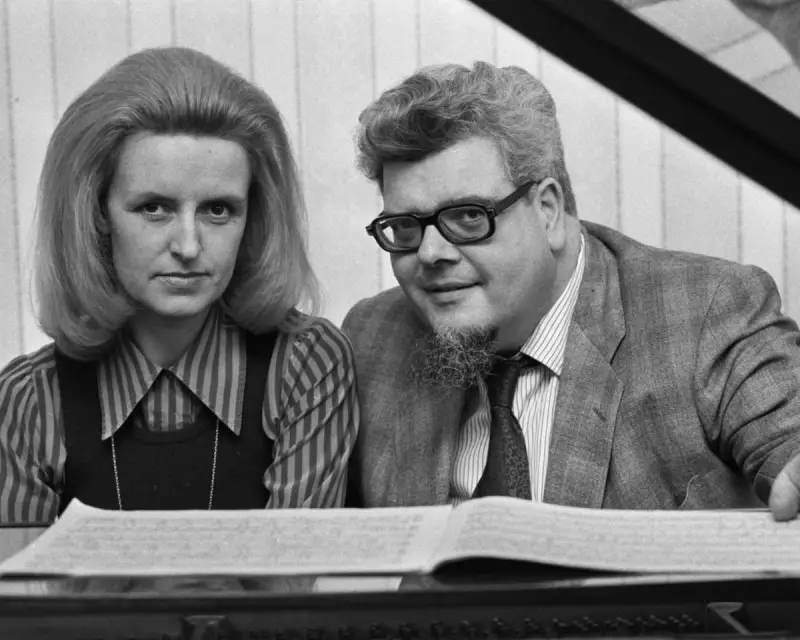
The pianist Brenda Lucas Ogdon, who has passed away at the age of 90, is remembered for her significant contributions to classical music, particularly through her duo performances with her husband, the acclaimed pianist John Ogdon. Her life was marked by artistic collaboration, personal sacrifice, and a steadfast commitment to preserving her husband's musical heritage.
A Promising Musical Partnership
Brenda Lucas Ogdon achieved greatest prominence in the duo with her husband John Ogdon, one of the most dazzling performers of his era. The couple began playing as a duo at the suggestion of the conductor John Minchinton. In 1962, Lord Harewood invited them to perform Bartók's Sonata for Two Pianos and Percussion at the Edinburgh International Festival, a performance that proved to be a notable success. They repeated this achievement at the following year's festival, solidifying their reputation.
John's joint victory at the Tchaikovsky International Competition in 1962, sharing first place with Vladimir Ashkenazy, led to international tours for the couple. In Australia in 1964, Brenda balanced separate performing schedules with duo performances while caring for their infant daughter, Annabel. Later tours included several visits to the United States and the Soviet Union, where they performed notable works such as Mozart's Concerto for Three Pianos in Houston with conductor André Previn.

Notable Recordings and Performances
In 1968, the Ogdons gave the premiere of Alan Rawsthorne's Concerto for Two Pianos and Stravinsky's Concerto for Two Solo Pianos at the Proms. Their recording of the Bartók Sonata was released that same year, and they performed the work again in their second Proms appearance in 1969. Other celebrated recordings included Rachmaninov's two Suites for Two Pianos in 1975 and Messiaen's Visions de l'Amen in 1971, showcasing their versatility and skill.
Personal Challenges and Literary Work
John Ogdon's struggles with mental illness, along with Brenda's efforts in coping while raising a family, were documented in the book Virtuoso (1981), which she co-wrote with Michael Kerr. The book was revised just before John's death in 1989 at the age of 52 from pneumonia, exacerbated by undiagnosed diabetes. In the BBC Screen Two docudrama of the same year adapted from the book, the couple were portrayed by Alison Steadman and Alfred Molina.
Brenda wrote in Virtuoso, "John, impossible, adorable John, has dominated every aspect of my adult life." In an interview four years ago for the booklet notes of A Life in Music, a double-CD reissue of her recordings with John or of his compositions, she recalled being nominated for a Women of the Year award based on the book. She was disconcerted at being designated "Brenda Lucas, author" on the place marker for the lunch, highlighting her multifaceted identity.
Early Career and Musical Inspiration
Brenda had a promising solo career prior to her marriage to John in 1960 and in the years immediately following. She was initially inspired by the Australian pianist Eileen Joyce, whom she described as "larger-than-life and very glamorous." She made her first appearance with the Royal Liverpool Philharmonic Orchestra at the age of 21 and went on to give solo recitals for the BBC from their Manchester studio. A critically well-received recital at the Wigmore Hall in London in 1962 further established her reputation.
Born in Hyde, Cheshire (now in Greater Manchester), Brenda was the elder daughter of Martha (née Ratcliffe), a headteacher, and Jack Lucas, who worked for the then National Assistance Board. While their home was not particularly musical, her father was a keen ballroom dancer and her mother could play the piano "a little." At age seven, Brenda started picking out tunes by ear on an upright piano, leading to lessons with a local music teacher, Mrs Round.

Education and Musical Development
At 11, Brenda moved to the convent-run Harrytown high school in Bredbury, Stockport, where her musical talents were encouraged by Sister Mary Angela. At 13, she scored the highest mark of anyone in the entire country at Grade VII and was awarded the Associated Board's gold medal. Offers of scholarships at the Royal Academy of Music and Royal College of Music in London proved impractical when she was 14, so she attended the then Royal Manchester College of Music (now the Royal Northern) in 1952, studying with Iso Elinson.
She gained a reputation as an accompanist for wind and string players, including the violinist Martin Milner, later leader of the Hallé Orchestra. In 1956-57, she attended summer school courses at the Salzburg Mozarteum in Austria. It was at the Royal Manchester College of Music that she met John Ogdon, where fellow students included composers Harrison Birtwistle and Peter Maxwell Davies. She graduated with honours in 1957, and the couple moved to London, where in the early 1960s she had lessons with Ilona Kabos.
Sacrifices and Later Career
After the birth of their second child, Richard, Brenda put her performing career on hold to care for her children and husband, as John became increasingly ill and intermittently violent through the 1970s. Although he resumed performing a decade later until his death, Brenda found it harder to pick up the pieces of her own career, despite touring again with him in the Soviet Union in 1985.
However, she later resumed touring to the United States and, in 1996, to Hong Kong. She made fine recordings in later years of music by Bach, Debussy, and Ravel. In 1993, she established the John Ogdon Foundation, dedicated to preserving his legacy, and became a noted teacher, influencing future generations of musicians.
Legacy and Survivors
Brenda Lucas Ogdon is survived by her children, Annabel and Richard, and four grandchildren. Her life was a testament to artistic dedication, personal resilience, and the enduring power of music. Through her performances, recordings, and the foundation she founded, her impact on the classical music world remains significant.