
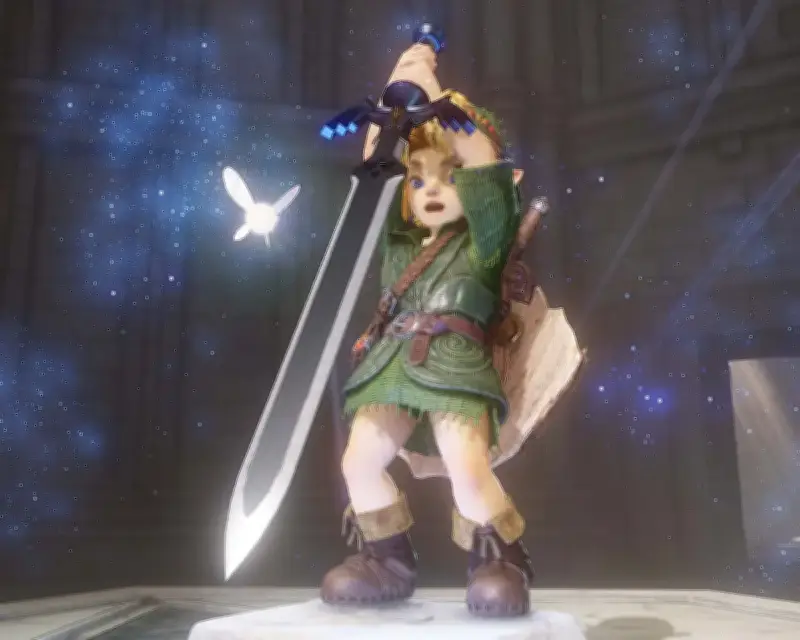
The Legend of Zelda: Ocarina of Time for Nintendo Switch 2 has been revisited with a prettified Hyrule, a newly orchestrated soundtrack, and a hero who feels strikingly different under the thumbs. A hands-on demo of the remake, set for release on 5 November, shows the 1998 game-changer updated for the 4K era.
In the original 1998 version, the shooting gallery owner in Castle Town would rip off players as they funnelled rupees and fudged the analogue-stick aiming. But in 2026, more responsive frame rates and a motion-controlled slingshot allow precision adjustments. His targets tumble on the first go, and with them his entire business model.
Improved mechanics and familiar dungeons
Link can now sprint, preventing the ignominy of endless roly-polies to zip across grassy plains. He has a manual jump, a free-rotating camera, and a scrolling inventory bar that replaces menu screen faff. Crucially, a fatter wallet holds all those gems he fleecs from struggling shooting gallery owners.
The dilemma facing any remake is how closely to hew to the past. As with this year's Star Fox revamp, Ocarina of Time finds Nintendo in a celebratory mode. For newcomers, it means seeing what the fuss is about without scrutinising the N64 original on unflattering flatscreen TVs. Hyrule Field may not conjure the awe it did in 1998, but seeing the sun catch in puddles and grass growing from the floor helps mask an obviously artificial pen compared to Breath of the Wild's sprawling continent.
For some returning fans, the more controlled shape is precisely the appeal. After the “make your own adventure” ethos of Switch's open-world Zeldas, there is comfort in slipping into traditional dungeons, where every room has a characterful beast to chop up or a mechanism to unpick with a growing kitbag of tools. The puzzles, designed in 1998 as many designers' first attempts at a 3D level, remain fiendish, requiring players to hold complex architecture in their heads.
Orchestral soundtrack and controversial look
The newly orchestrated soundtrack gives melodies that once fought through compressed N64 instrument samples their own galloping freedom. The tentative brass when locking an enemy into a duel is the musical equivalent of gnawing your lip.
Link's look is more contentious. His large glassy eyes and fat cheeks, which reflect the light as if varnished, have led critics to accuse Nintendo of crudely pursuing a textbook next-gen sheen. In the past, eager fans who attempted to remake Zelda in more capable game engines were ridiculed for mistaking technological grunt for artistry. In truth, Ocarina of Time looks coherent in motion on Switch 2, evoking Twilight Princess, another attempt to apply a more mature, realistic lens to Hyrule.
Some corners of the internet scoffed at the newly “yassified” hero. Nintendo veteran and former Legend of Zelda art director Takaya Imamura wondered if the character model drew from Zelda creator Shigeru Miyamoto's own tastes. “[His] love of ningyogeki (puppet drama) is strongly reflected here,” Imamura wrote on X. Porcelain doll skin would certainly explain the uncanny sheen.
Puppetry influence and timeless appeal
Writer and translator Paul McQuade explains it is not an impossible leap. “In Japan, puppetry is not considered an art form strictly for children, which is largely how it's perceived elsewhere,” he says. “It's a rich art and is highly respected.” He thinks Miyamoto could easily have been influenced by puppet shows aired by Japanese broadcaster NHK in the Shōwa postwar era.
“It's doll-like and intentionally juvenile,” McQuade says of Link's chubby features and blushing nose. “It captures the essence of that forest where the children don't ever grow up. Miyamoto, as a fan of puppetry, would of course draw on the vocabulary of dolls to make characters in that mould.”
The idea of Nintendo honouring a community frozen in time is poetic, while acknowledging that time has moved on outside the game. In an adventure where a boy can magically become a man and back again with the toot of his ocarina, it makes sense for timelessness and timeliness to be in conversation. With virtual bones this strong, it would be difficult to argue that anything has been truly ruined. Unless you run the shooting gallery, of course. The Legend of Zelda: Ocarina of Time is released for Switch 2 on 5 November.




