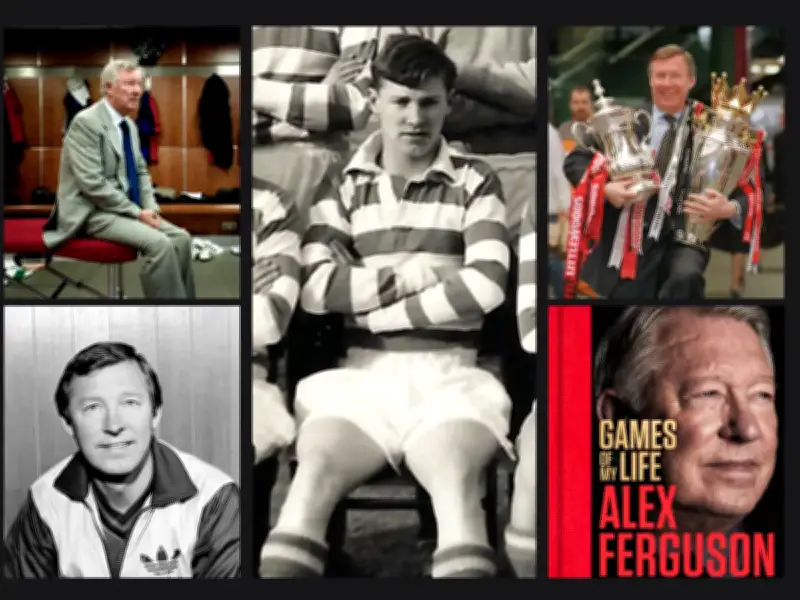
Sir Alex Ferguson has said he hopes Manchester United's planned 100,000-seater stadium is built quickly, as he wonders whether he will still be "around" to celebrate its opening.
In an extract from his memoir, Games of My Life, the former United manager writes: "I'm not one to dwell on what my Maker has in store for me, nor am I afraid of dying. Yet, every now and again, death crosses my mind."
"I hope they get to break ground quickly, because if it takes five years to complete, I'll be pushing ninety," the extract continues. "However, I know I'll be at the ceremony one way or another - in person or spirit."
Return to Old Trafford after brain haemorrhage
The memoir, released today, opens with United's 1-1 draw against Wolves at Old Trafford in September 2018, a match stirred with emotion as Ferguson returned to the directors' box after recovering from a brain haemorrhage, which he had initially dismissed as a headache.
Ferguson's world came "perilously close to ending", so much so that on the day he was operated on, four other patients also had surgery for the same complaint, but only Ferguson and one other lived to tell the tale.
The road to recovery wasn't easy. It took Ferguson four or five days to fully recover his speech with the help of a therapist, and it took the whole of the summer of 2018 for him to recover with plenty of physical therapy. "Painful though it was, no red wine," he recalls of following the doctor's orders.
When the doctors finally decided Ferguson was fit enough to return to Old Trafford, he went to the ground a week before the game for a dummy walk from the directors' lounge to his seat in order to prepare himself. Ferguson invited the medical staff who helped him, along with their families, to the game: "I wanted to show my appreciation. We laid out little gifts for them at their tables. It was one of the most memorable days of my life."
United fans who attended that day will remember the incredible reception Ferguson received. The man himself was moved to the extent that he could "hardly breathe". "I felt like I was being greeted as if I had returned from the dead, which, in a way, was true because so many of the stories that were printed had read like premature obituaries," he says.
Tribute to Lady Cathy Ferguson
Ferguson survived because his late wife, Lady Cathy Ferguson, was downstairs in their home when she heard the shoes clattering off the shoe rack following his fall. Lady Cathy, who married Sir Alex in 1966, passed away three years ago, aged 84. In the memoir, Ferguson recalls how the 2023 FA Cup final between United and Manchester City had a "black cloud hanging over it" because of his wife's increasing "frailty and pain at that time."
That day Ferguson was reluctant to leave his wife overnight, so he returned to Manchester from London after the match. A little over four months later, she passed away, and the funeral was held in Glasgow.
"I might have managed Manchester United, but Cathy was the one who managed Ferguson United. Cathy was not just the manager, but also the CEO, assistant manager, team doctor, kit woman and club ambassador," he writes in tribute.
Memoir choices and the evolution of football
The 2024 FA Cup final was a happier time and is included in the memoir. Ferguson did not approach the game with confidence, given United had blown a 3-0 lead against Coventry in the semi-final, but the Reds stunned City with a 2-1 victory. "Kobbie, calm player that he is, popped in our second," Ferguson recalls. "The whole build-up should have been accompanied by a heavenly chorus and, in my own mind, it was."
Ferguson could have filled the memoir with Premier League title deciders, European triumphs, or FA Cup finals, but he has chosen games that take him back to personally significant moments in his life, charting his journey from the shipyards of Govan to the summit of football. United are still responsible for 13 of the 21 games, including the first time Ferguson recalls watching the club: Rangers 1-2 United in May 1953. Ferguson admits he didn't pay "much attention" to United growing up as he pursued a career as a professional footballer, but one moment changed everything - the Munich air disaster.
"Like everyone, I was captivated when United became the first English team to win the European Cup 10 years later," he says. "It stirred up all sorts of emotions. There was a flare of Scottish pride, since Sir Matt was at the helm, but most of all, it was a fantastic comeback story."
Ferguson later describes himself as "United wrapped up in the blue of Scotland" as he reflected on Scotland's win against Israel in October 2021, the same month he was finally officially recognised for playing for his nation. The 84-year-old never forgot where he came from, and many of his finest speeches as a manager tapped into heritage and a sense of belonging. The house where Lady Cathy and Ferguson lived for a long time in Manchester was named 'Fairfields' after the shipyard where his father worked, while he still gets Scottish newspaper The Sunday Post delivered every week to keep up to date with happenings in his home country.
Although there is no room in the memoir for the magical 1999 Champions League final when United made history by completing the treble, the 3-2 win against Juventus in the semi-final is included. Ferguson, as many others will agree, believes United's win in Turin on their way to the Champions League final was Roy Keane's "greatest night in red."
United's 2-1 win against Arsenal in the FA Cup semi-final in the treble campaign also features. The Ferguson-Wenger rivalry defined the modern Premier League with both managers ahead of their time in revolutionising United and Arsenal.
Ferguson remains fascinated by changes in today's game, despite being sceptical of the shift to using data. "You don't need computers to tell you that the chance of scoring a goal is better from eight yards out rather than from thirty yards away. I was telling that to players forty years ago," he says. "The other changes - medical and health routines, better training facilities, VAR and the explosion of podcasters - are part of the continuous evolution of football. The trick, as always, is to adapt and move with the times."
Ferguson's willingness to adapt was one of the secrets to his success. Changing was a strength, not a weakness.
Life after retirement
These days, Ferguson likes to keep himself busy by attending the races - he is a prominent racehorse owner - and following United. Despite regular autograph requests, he "rarely finds it irritating" because he believes it means he did something that left a positive imprint on others.
There is a remarkable humility about Ferguson, one of the most successful managers of all time, neatly summed up by the line that still means the most to him from his retirement speech at Old Trafford in 2013. "You have been the most fantastic experience of my life," he said to the club's supporters. Ferguson reflects in the memoir: "It was as heartfelt as the tribute I paid to my own family. United would not have all the triumphs we experienced during my years at the club without them."
When Ferguson was in the hospital after suffering his brain haemorrhage, he feared the rest of the world had forgotten he existed. There is no chance of that ever happening. Games of My Life by Alex Ferguson publishes on 8th October by Macmillan.