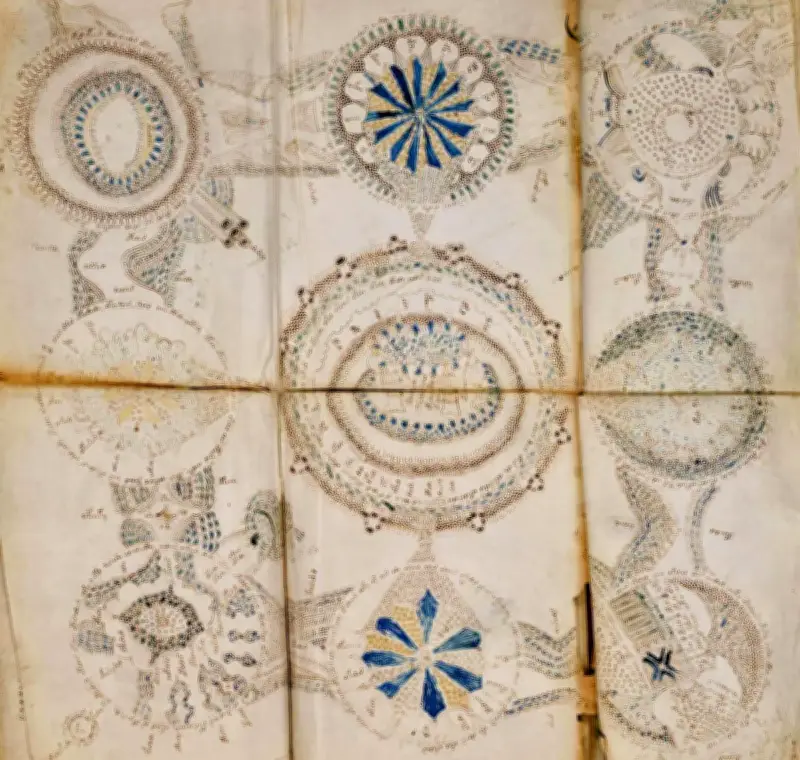
New research suggests the Voynich manuscript, a medieval set of pages filled with botanical drawings, astronomical diagrams, pictures of nude women, and indecipherable text, may have been mis-bound, with its pages in the wrong order. This finding, published in the peer-reviewed journal Digital Medievalist, could explain why scholars have struggled to reach a consensus on the manuscript's meaning.
Mis-binding hypothesis
Colin Layfield and Lisa Fagin Davis argue that the manuscript's folded sheets may have originally been piled on top of each other as “singulions”, like a stack of Christmas cards, but were mis-bound in a more typical “nested” arrangement in the mid to late 15th century. While this does not immediately decode the script, known as “Voynichese”, the authors say it radically changes our idea of the manuscript's function.
“There are a lot of people who wanted the Voynich to have been created by one mad genius working in their attic in medieval London or wherever,” said Davis. “In fact, the evidence suggests we’re talking about a more communal object, perhaps a set of booklets through which information was passed down from one generation to the next – the ‘lone genius’ idea is kind of out of the door.”
Evidence from analysis and visuals
For their article “Singulion Structure and the Voynich Manuscript”, Layfield and Davis used a numerical analysis tool to compare blocks of text and found that many attached pages scored highly for coherence even when there were many intervening pages, suggesting mis-binding. Visual clues also indicated a different reading order: some illustrations of streams or pipes run into the gutter, the blank space along the inner margins where pages are bound, but don’t fully match with pictures on the opposite page.
“Once you treat them as loose pages stacked together, all these artistic anomalies suddenly join up”, said Layfield, a senior lecturer in information systems at the University of Malta. Davis, an expert on medieval handwriting, said the hypothesis “fixes a lot of problems with the structure of the manuscripts in a really elegant way”.
Manuscript's origins and possible purpose
The manuscript's provenance has been debated since it surfaced in book collectors' records in the 17th century. Bought in 1912 by Wilfrid Voynich, a Polish revolutionary and book dealer, it was once thought to be a scientific diary by the 13th-century polymath Roger Bacon, while others credited it to Leonardo da Vinci. However, recent chemical analyses, carbon-dating its parchment to between 1404 and 1438, have ruled out these famous authorships.
Davis noted that the only other known medieval manuscripts preserved in a singulion arrangement were Qurans from north Africa, likely meant to be handed out as small booklets for instruction. “I think it’s likely we are looking similarly at an object that was made by a community that wanted to pass its knowledge forward,” she said, adding that paleographical analysis suggests the manuscript was written by up to five different scribes.
Some drawings resemble the female reproductive system, while others hint at herbal lore and astrology. “When you put all of this together, it starts to feel like a book of women’s folk knowledge that’s being preserved,” said Davis. “But you cannot prove that yet.” She added that it wasn’t out of the question that other manuscripts written in Voynichese existed, noting that few medieval manuscripts survived because they weren’t bound. “The irony is that whoever mis-bound this manuscript still did us a huge favour by ensuring its survival.”