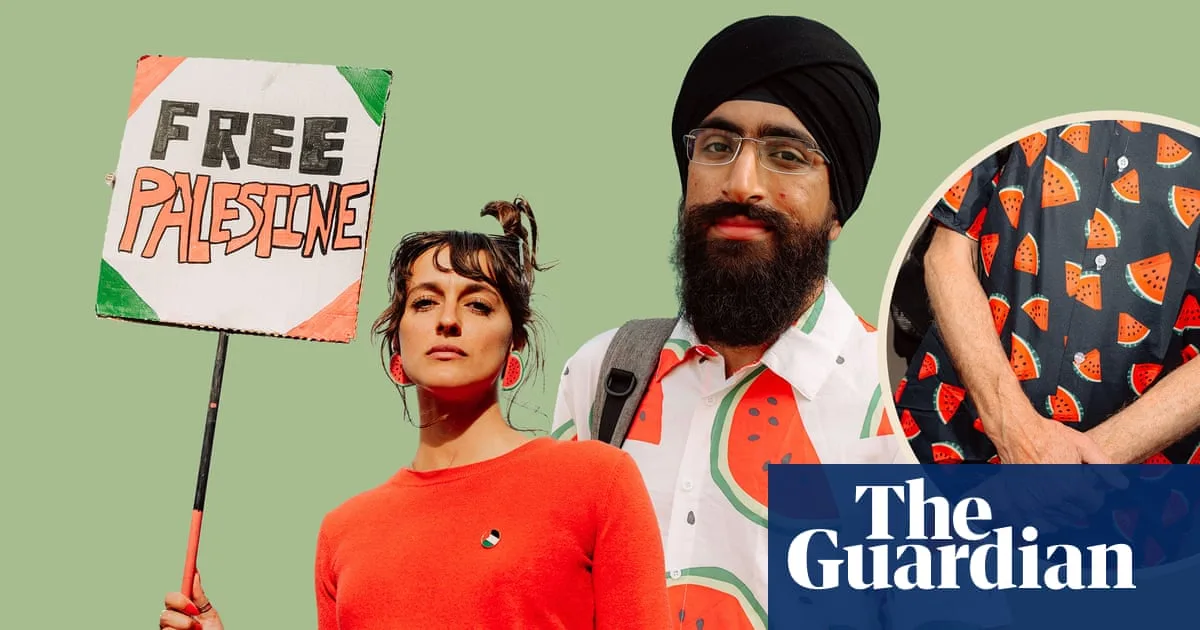
At the latest national march for Gaza in central London, demonstrators are using their clothing to convey political messages. One man, who wishes to remain anonymous, wore a sweatshirt featuring a photograph of Hind Rajab, a five-year-old girl killed in the conflict last year. He said it was his attempt 'to keep her memory alive, until we get justice'.
Protest dressing has become a significant aspect of these marches, with people wearing symbols and colours of solidarity to express grief and call for action. Mariama, an NHS worker from Nottingham, wore a football-style shirt with a Palestinian flag instead of a club crest, alongside the words 'viva Palestina'. Reverend Poppy Hughes, 65, wore a Palestine Solidarity Campaign pin badge to identify herself as opposed to 'the occupation and the genocide and the starvation'.
Common items include keffiyehs, badges, and watermelon symbols, which have been used since public displays of the Palestinian flag were outlawed by Israel. Jaiman, 28, from Bexley, wore a shirt covered in watermelons, while Tony, 71, from London, chose a Hawaiian shirt with the fruit. Lamdy, 65, customised an old white shirt painted with a watermelon, saying 'words are not being heard'.
Historically, protest dressing has been a powerful tool. Camille Benda, author of Dressing the Resistance, describes it as 'using objects in the form of garments to send a non-verbal visual message'. Richard Ford of Stanford University notes that it is effective when people 'choose a common style of dress as a symbol of their political struggle', citing suffragettes wearing white and civil rights activists in their 'Sunday best'.
The power of such clothing is evident in how authorities have tried to suppress it. During the first Palestinian intifada, women stitched symbols of resistance onto 'intifada dresses', which were forbidden. In the UK, a man was arrested at a protest in Parliament Square last August for wearing a T-shirt with the slogan 'Plasticine Action', though he was released shortly after.
Ayham Hassan, a Palestinian designer and Central Saint Martins graduate, understands the role of protest clothing. His graduate collection this summer made waves, reflecting the ongoing significance of dressing for a cause.