The Metamorphosis of Fashion Week: From Style to Spectacle
Fashion week, once a revered institution dedicated to the artistry of style and design, has undergone a profound transformation. Today, it resembles less a celebration of aesthetic innovation and more a traveling circus of spectacle, where shock value and notoriety overshadow traditional notions of glamour and taste.
Tech Titans Take the Front Row
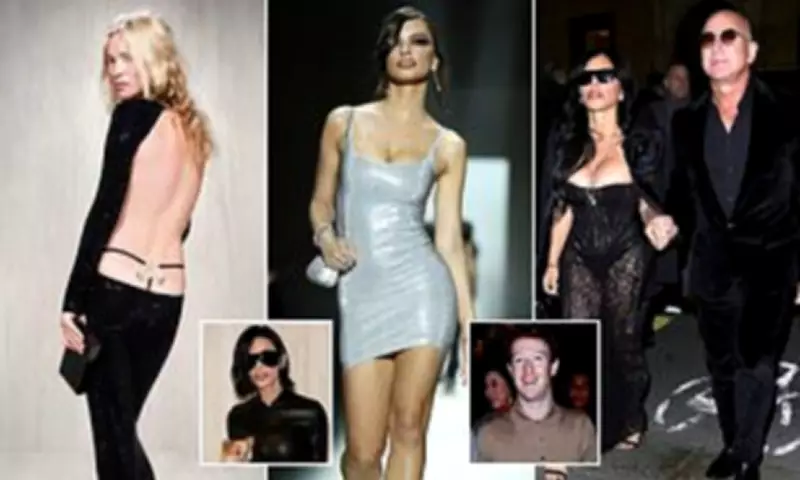
The infiltration of technology billionaires into this world marks a significant shift. Consider Jeff Bezos, the Amazon founder who built his empire in unassuming off-the-rack button-downs and khakis. His recent rebranding is stark. Last month, he was paraded by his wife, Lauren Sanchez, at the Paris Spring/Summer 2026 shows for Schiaparelli and Dior. The couple appeared in meticulously coordinated outfits that seemed less a display of personal style and more a calculated brand activation.
Bezos, once the epitome of a schlubby, carefree aesthetic, now finds himself posing at couture shows and accepting honorary chair duties at events like the Met Gala alongside icons such as Nicole Kidman and Beyoncé. It appears his journey from tech domination to fashion mascot is complete.

Milan's Surreal Theater and Unexpected Guests
Milan, still basking in the afterglow of hosting the precise and prestigious Winter Olympics, has swiftly returned to its role as the stage for fashion's most surreal theater. The current Milan Fashion Week has been populated by a cadre of nepo-influencers, including Kendall Jenner, Amelia Gray Hamlin, and Romeo Beckham. Jessica Alba even brought her 14-year-old daughter as her date to the Fendi show.
However, the true jolt came from Mark Zuckerberg. The Meta CEO, famously loyal to a uniform of identical gray T-shirts, was spotted front row at Prada with his wife, Priscilla Chan. Clad head-to-toe in Prada—a taupe knit polo, dark brown slacks, and chunky loafers—he and Chan, in a subdued gray sweater and navy skirt, looked less like fashion insiders and more like tourists who had stumbled into the wrong venue. Yet, there they sat, positioned near Vogue's Global Editorial Director Anna Wintour.
Provocateurs and the Pursuit of Notoriety
This new era is defined by power, notoriety, and exhibitionism, a tension masterfully embodied by designer Demna, now the creative director at Gucci. This is the same provocateur behind Balenciaga's infamous campaign featuring children with teddy bears in BDSM harnesses, which sparked global outrage. He also dressed Kim Kardashian in a full-body black mask for the 2021 Met Gala, a faceless silhouette that now feels eerily prescient in an age of AI and surveillance.
Fashion's memory, however, is notoriously short. Demna's Gucci debut in Milan was hailed as triumphant. The show culminated with Kate Moss, now 52, closing the runway in a sparkly black dress that plunged low enough to reveal her Gucci thong—a deliberate callback to Tom Ford's notorious 1997 original. Once the embodiment of effortless cool, Moss appeared less an icon and more a relic deployed for nostalgic shock value.
A Fever Dream of Casting and Contradictions
The Gucci show felt like a fever dream of stunt casting. Emily Ratajkowski shimmied down the runway with an exaggerated, va-va-va-voom energy more suited to camp cinema than high fashion. Vivian Wilson, Elon Musk's estranged transgender daughter, made her runway debut. Demi Moore, 63, appeared in a skin-tight leather ensemble, cradling her micro Chihuahua, Pilaf, her visage so youthful it fueled rampant speculation, mirroring a character from her recent horror film.
This surreal landscape, where age, relevance, and irony collapse, demands constant boundary-pushing. Actress Teyana Taylor appeared at Schiaparelli in Paris in a completely sheer black lace dress with a diamond crown, as if auditioning for a reality television show rather than a haute couture presentation.

The Lost Ideal and the Engineered Moment
This grotesque maximalism exists in stark contrast to a burgeoning cultural fascination with understated elegance, seeded by shows like Ryan Murphy's Love Story and its homage to Carolyn Bessette-Kennedy. Bessette, who helped launch Kate Moss's career, represented an ideal built on mystery, restraint, and quiet luxury—an ideal that seems utterly extinct.
Today's fashion week is meticulously engineered for viral consumption. Models are leveraged for shock, designers manufacture outrage for headlines, and celebrities arrive with dogs, daughters, and diamond crowns. This is not an evolution of style; it is pure exhibition. The freak show has become the entire point, and everyone—from Bezos and Zuckerberg to Moss and the provocateurs—is playing their assigned role in the spectacle.