Jess and Morgs' Arena and Morau's Étude Dazzle at Paris Opera
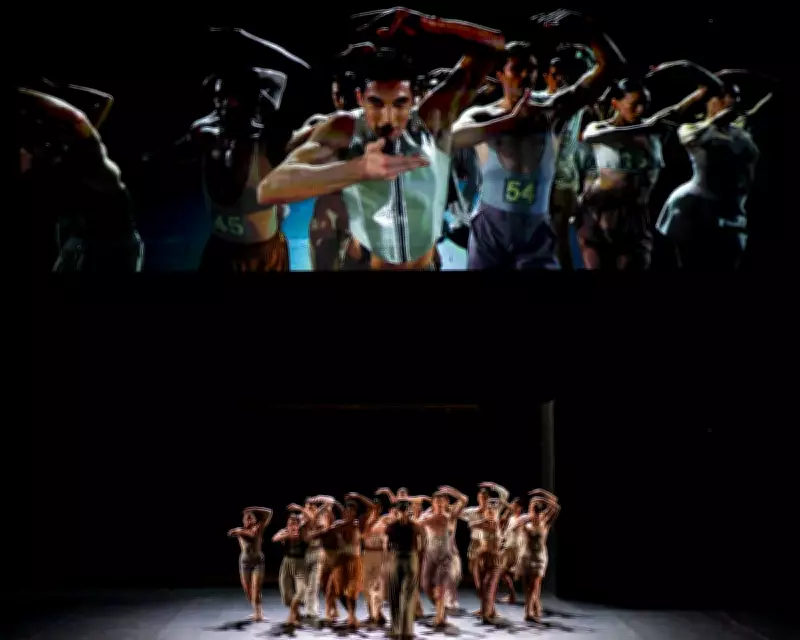
What an absolute delight to witness Jessica Wright and Morgann Runacre-Temple, the dynamic London-based duo known as Jess and Morgs, granted complete creative freedom within the magnificent Palais Garnier in Paris. Their bold new production, Arena, masterfully merges innovative choreography with cutting-edge live camerawork, featuring video design by Jakub Lech. The piece reaches a breathtaking climax with a stunning sequence where dancer Loup Marcault-Derouard exits the stage, appearing on a massive screen as he sprints through the opera house's grand halls and sweeping staircases. Arena radiates the exhilarating energy of choreographers unleashed in a creative playground, building upon their acclaimed, technology-driven revival of Coppélia for Scottish Ballet in 2022.
Arena: A Gripping Exploration of Modern Competition
The performance commences with a subtle, percussive coolness, evoking hints of A Chorus Line, as an athletic ensemble warms up with both individual poise and collective assurance. A commanding voiceover calls "Next please!" while a camera operator smoothly navigates the line, capturing intense gazes, pounding chests, and glistening perspiration. In today's Instagram-dominated era, dancers are perpetually prepared for their close-ups, and here, the arm movements frequently result in tightly framed facial shots. However, Arena powerfully exposes the dangers of our chronically online culture and the relentless drive to compete, compare, and conform. Annemarie Woods' costumes introduce a gladiatorial aesthetic, yet this dystopian contest feels profoundly rooted in contemporary reality.
Marcault-Derouard's character is assigned a number rather than a name, and as his world disintegrates, he experiences frenzied solos under a dramatic red filter, crafted by lighting designer DM Wood, moments of confusion amidst the corps de ballet, accompanied by Mikael Karlsson's propulsive score, and isolation within a spinning interrogation room on Sami Fendall's set. When caught in the flash of fellow dancers' smartphone cameras, there is a palpable sense that we are all now subjected to the intrusive scrutiny of paparazzi lenses.

While the piece could benefit from greater narrative coherence and emotional depth, it absolutely sparkles with inventive concepts and stylistic flair. Despite its ominous premise, there are delightful bursts of Jerome Robbins-esque vitality, and Arena transforms the interaction between performers and camera operator Nine Seropian into a captivating, playful duet. Their dynamic is far more engaging and the balance between on-screen and on-stage action is more skillfully calibrated than in most live-filmed performances.
Étude: Morau's Uncanny Ballet Universe
Arena is thoughtfully paired with Étude by Spanish choreographer Marcos Morau, presented together in an evening titled Empreintes, meaning "imprints." Both works utilize the corps de ballet to investigate ideas of individuality within a homogenized society, with Morau venturing into Invasion of the Body Snatchers territory. Gustave Rudman's music initially suggests an orchestra tuning up, but Morau, renowned for subverting traditions, begins with an ending as soloist Laurène Levy takes a curtain call. With a fixed grin and robotic emptiness, she clutches her bouquet and implores the audience to applaud.
When the corps joins her, all adorned in identical, rigid tutus, Morau discovers an eerie uncanniness rather than uniform beauty in their assembly-line similarity. Despite the orchestral grandeur, their bourrées appear desperate, and their pliés take on a disturbingly spider-like quality, creating an overall impression of scuttling rather than graceful fluttering.

Morau deconstructs the piece to its creative core, evoking rehearsals at a barre that confines the dancers and allowing us to hear them count the music. Simultaneously, he reflects on the glamour of the final product, with Max Glaenzel's set design rendering ballet's iconic imagery as unsettling as Morau's choreography. A colossal model of the auditorium's chandelier descends onto the stage like a mother ship, emitting beeps, swinging rhythmically, and captivating the dancers' gaze, prompting us to question what holds us spellbound by ballet's picture-perfect allure. Like Arena, Étude fully exploits the deep stage and acknowledges the entire building, directly implying that the dancers' disquieting behavior mirrors our own societal tendencies.
These groundbreaking performances are being showcased at the Palais Garnier in Paris until the 28th of March, offering a profound commentary on identity, technology, and conformity in the modern age.