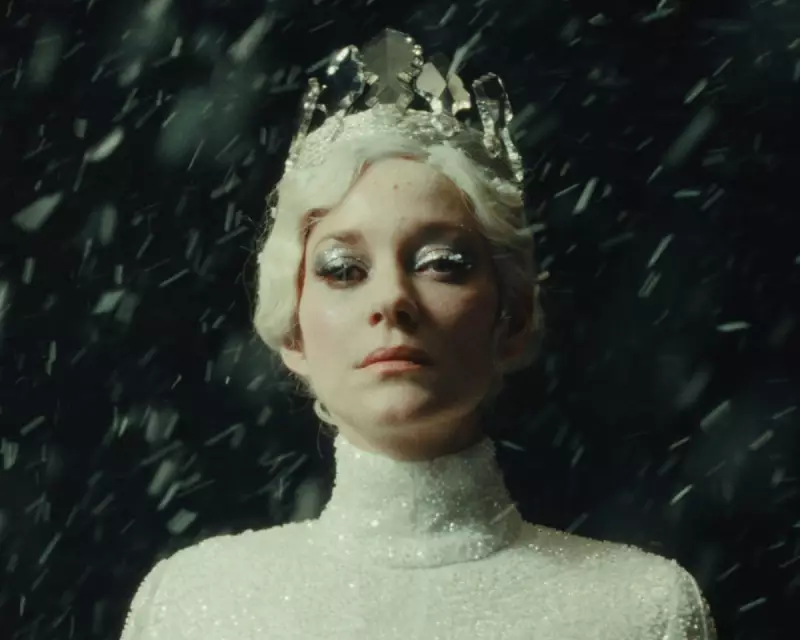
Lucile Hadžihalilović's mesmerising new feature, 'The Ice Tower', has been ranked as the fourth best film of 2025 for UK audiences. This kaleidoscopic fable, headlined by an imperious performance from Oscar-winner Marion Cotillard, serves as a potent and haunting cautionary tale about the seductive dangers of fantasy and unchecked idolisation.
A Hermetic World of Film and Fairy Tale
Directed by the consistently brilliant yet underrated Lucile Hadžihalilović, the film represents a subtle shift for the auteur. Known for creating exquisitely controlled, hermetic worlds—from the eerie boarding school in 2004's Innocence to the strange medical facility in 2015's Evolution—Hadžihalilović here turns her unique lens onto the act of filmmaking itself. The story is loosely anchored in the world of Hans Christian Andersen's 'The Snow Queen', with Cotillard's character, the haughty diva Cristina van der Berg, narrating its opening lines.
The narrative follows Jeanne, a teenage orphan played by Clara Pacini, who escapes her foster home and stows away on a film set adapting the classic fairy tale. Through Jeanne's awestruck eyes, the backstage world of costumes, set dressings, and directorial instruction becomes another of Hadžihalilović's ritualistic microcosms, heavy with latent meaning and unspoken rules.

The Perilous Allure of a Frosty Idol
Jeanne's fascination quickly crystallises into obsession. After posing as an extra named "Bianca," she is adopted as a protege by the aloof Cristina. Hadžihalilović masterfully blurs the lines between the film-within-a-film, Jeanne's vivid daydreams, and a troubling reality, keeping the audience in a perpetual, crepuscular haze. The central question becomes painfully clear: is Jeanne seeking a mother substitute or is this a dangerous infatuation?
This is the core of the film's warning. Cotillard, wielding a damaged hauteur to chilling effect, embodies the cost of living inside a fantasy. Her character understands the splendid isolation of the Snow Queen all too well, hinting at a shared, forlorn past with the enamoured girl. The film's analogue 1970s setting acts as a stark parable for a modern digital age drowned in imagery, where anyone can become dazzled and lost in their own personal snow globe.
Monsters in the Fairy Tale
With an unsettling score featuring the warble of the ondes Martenot, the film invites us to look for the monster. Is it the director, played by Hadžihalilović's real-life partner Gaspar Noé? Or is the monster the captivating yet claustrophobic presence of Cotillard's diva herself? 'The Ice Tower' can be read as a distinctly French take on #MeToo themes, exploring the dynamics of power and desire in the artistic realm.
Ultimately, Hadžihalilović suggests the monster might be the very act of creating art and beauty itself—a process of crystallisation that can freeze human warmth and desire. By hoarding and perfecting form, the film implies, we risk reaching an emotional absolute zero. This potent, visually stunning work cements Hadžihalilović's status as a unique visionary and secures 'The Ice Tower' a top spot among the year's most significant cinematic achievements.